What Is Cryptocurrency? A Beginner's Guide to Digital Assets
A comprehensive beginner's guide explaining cryptocurrency from first principles, covering digital assets, blockchain networks, private keys, market volatility, and risk factors.
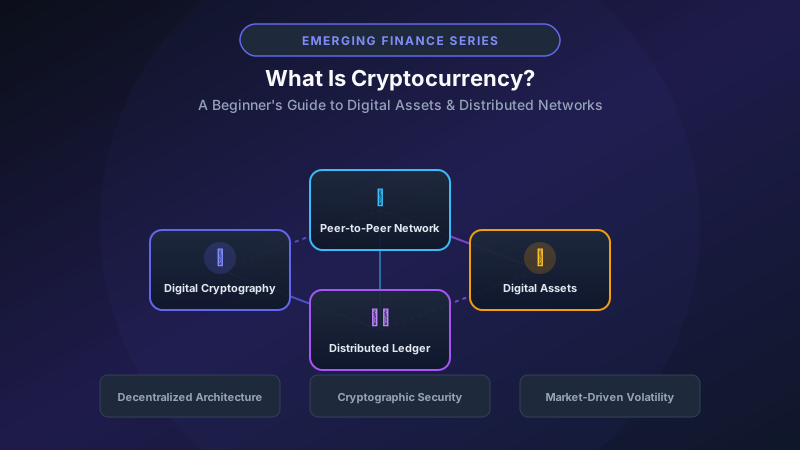
What Is Cryptocurrency? A Beginner's Guide to Digital Assets
Cryptocurrency is a form of digital or virtual currency designed to operate as a medium of exchange, unit of account, or store of value across decentralized computer networks. Unlike sovereign fiat currencies—such as the U.S. Dollar, Euro, or Japanese Yen—cryptocurrencies are generally not issued or backed by central banks or government authorities.
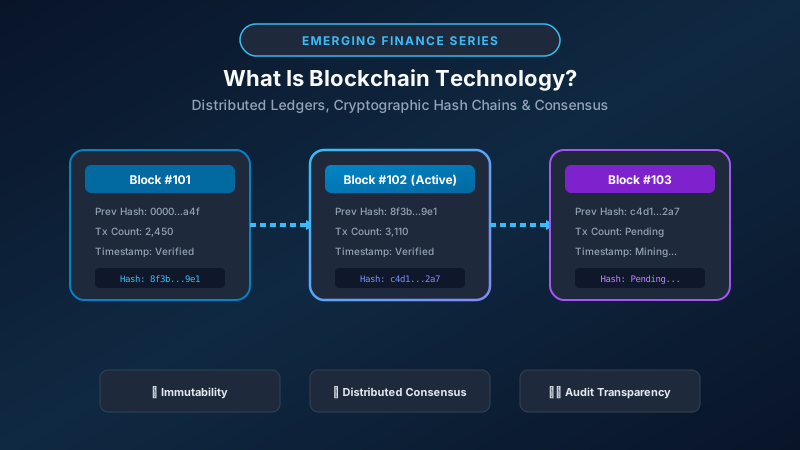
Instead, cryptocurrencies rely on public key cryptography, peer-to-peer network consensus, and distributed ledger technology known as what is blockchain to record transfers and prevent double-spending without requiring a centralized intermediary like a commercial bank.
1. How Cryptocurrency Differs from Ordinary Bank Money
To understand cryptocurrency, it helps to contrast how money moves in conventional banking systems with how digital assets transfer across public networks.
Conventional Bank Money:
User ──► Commercial Bank A ──► Central Bank Clearing Rail ──► Commercial Bank B ──► Recipient
(Regulated Intermediary Verification & Deposit Insurance Coverage)
Decentralized Cryptocurrency:
User ──► Cryptographic Signature ──► Public Peer-to-Peer Nodes ──► Distributed Ledger ──► Recipient
(Algorithmic Consensus Verification & Irreversible Ledger Settlement)
| Dimension | Traditional Bank Money | Cryptocurrency |
|---|---|---|
| Issuing Authority | Sovereign Central Banks | Protocol Algorithms / Code Base |
| Ledger Custody | Commercial Banks & Central Registries | Distributed Public Blockchain Nodes |
| Deposit Protection | Government Insurance (e.g., FDIC, FSCS) | No Sovereign Insurance or Loss Guarantees |
| Transaction Recourse | Bank Chargebacks & Legal Dispute Resolution | Permanent & Irreversible Ledger Settlement |
| Transfer Access | Banking Hours & Account Approval | 24/7 Peer-to-Peer Network Access |
2. Core Technical Components of a Cryptocurrency Network
Cryptocurrency networks function through the interaction of four foundational components:
Public Key Cryptography
Every cryptocurrency address consists of a mathematically linked pair of cryptographic keys:
- Public Key (Address): Analogous to an IBAN or bank account number, shared publicly to receive assets.
- Private Key: A secret cryptographic code that grants exclusive authorization to sign and transfer assets from that address.
The Distributed Ledger (Blockchain)
Rather than storing account balances on a single server, a cryptocurrency network distributes a full copy of the transaction ledger to thousands of independent computers (nodes) worldwide. Learn more about how blocks are chained together in our detailed guide on what is blockchain.
Consensus Mechanisms
Consensus algorithms determine how nodes agree on the validity of new transactions without a central coordinator:
- Proof-of-Work (PoW): Nodes (miners) expend computational energy to solve mathematical puzzles and produce valid blocks, as detailed in our guide on bitcoin-explained.
- Proof-of-Stake (PoS): Participants lock up network tokens (staking) to acquire the right to validate transactions and propose new blocks.
Wallets and Exchanges
Users interact with cryptocurrency networks using software or hardware tools:
- Crypto Wallets: Devices or applications that manage cryptographic keys. For a complete breakdown of custody choices, review crypto-wallets-explained.
- Digital Asset Exchanges: Centralized or decentralized platforms that facilitate trading between fiat money and digital tokens.
3. Categories of Digital Assets
Not all cryptocurrencies serve the same purpose. Financial regulators and market analysts generally categorize digital assets into distinct classes:
                          ┌── Native Payment Tokens (e.g., Bitcoin)
                          │
Digital Asset Taxonomy ───┼── Smart Contract Platforms (e.g., Ethereum)
                          │
                          ├── Stablecoins (Fiat-Pegged Tokens)
                          │
                          └── Real-World Asset (RWA) Tokens
- Native Cryptocurrencies: Assets designed as peer-to-peer medium-of-exchange or store-of-value units within their native protocol layer.
- Smart Contract Tokens: Cryptocurrencies that power decentralized computing platforms capable of executing automated conditional software scripts.
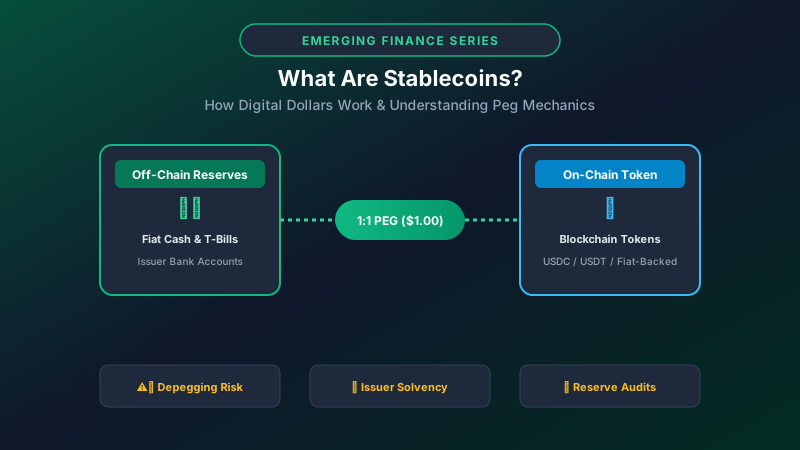
- Stablecoins: Digital tokens pegged to the value of an external asset, such as the U.S. Dollar. Explore their mechanics in what-are-stablecoins.
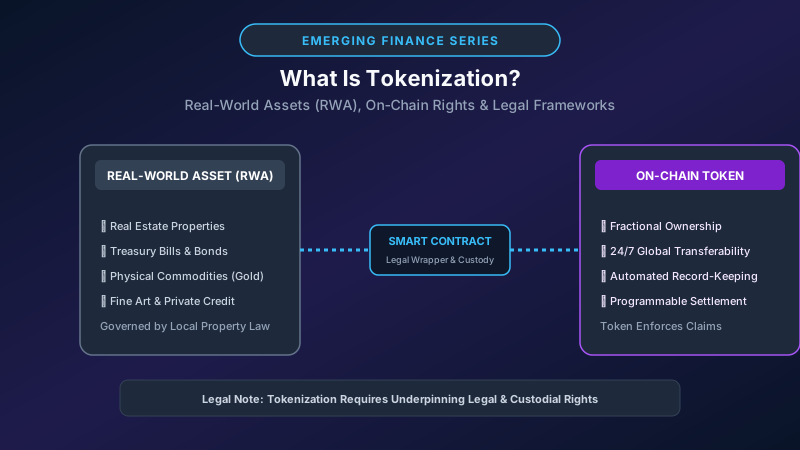
- Tokenized Real-World Assets: Digital representations of physical or financial assets, such as government debt or real estate. See what-is-tokenization.
4. Key Risks and Limitations
Cryptocurrencies represent an emerging technology class accompanied by significant risk factors that consumers must evaluate carefully:
- Price Volatility: Digital asset market valuations fluctuate dramatically based on shifting market sentiment, regulatory announcements, and liquidity conditions.
- Irreversibility of Transactions: If a transaction is sent to an incorrect address or executed under fraudulent conditions, no bank customer support exists to reverse the transfer. Discover step-by-step transaction mechanics in how-cryptocurrency-transactions-work.
- Security & Custody Risks: Self-custody requires rigorous personal security. Loss of private keys or seed phrases results in permanent loss of funds.
- Scams and Fraud: The pseudo-anonymous nature of digital asset transactions attracts widespread fraudulent schemes. Review protection strategies in common-cryptocurrency-scams.
- Regulatory Uncertainty: Global legal and tax treatments vary widely by jurisdiction and continue to evolve. Read our global overview in crypto-taxes-explained.
5. Key Takeaways
- Cryptocurrency relies on decentralized peer-to-peer networks and cryptography rather than central bank issuance.
- Private keys grant total access to funds; losing a private key means losing access to assets permanently.
- Transactions are irreversible once recorded on a public blockchain ledger.
- Digital assets carry no government deposit insurance and exhibit substantial market price volatility.
6. Frequently Asked Questions
What gives cryptocurrency its value?
Cryptocurrency value is determined entirely by open market supply and demand. Unlike government currencies backed by legal tender laws or corporate stocks backed by revenue, unbacked cryptocurrencies hold value only as long as market participants are willing to exchange goods, services, or fiat currency for them.
Is cryptocurrency legal around the world?
Legal status varies by jurisdiction. Some nations embrace digital asset innovation with clear regulatory frameworks, others impose strict oversight or tax reporting requirements, and a few have restricted or banned digital asset trading. Consumers should consult their local regulatory authority.
Where can I learn more about comparing crypto to traditional assets?
For a neutral breakdown comparing digital assets with stocks, bonds, and cash, read our guide on cryptocurrency-vs-traditional-investments.
Educational Disclaimer
This article is provided for general educational and informational purposes only and does not constitute financial, investment, legal, or tax advice. MoneyTalkin' does not recommend buying, selling, holding, or trading any cryptocurrency or digital asset. Digital assets carry high risk and extreme price volatility. Always perform independent research and consult a licensed financial advisor before making financial decisions.
MoneyTalkin' provides financial education, educational concepts, and general informational guides. Articles do not constitute personalized financial, investment, legal, or tax advice. Financial products, rates, terms, and regulatory rules change frequently; consult a qualified financial professional regarding your specific situation. Read our full Disclaimer Policy.
Written by MoneyTalkin'
MoneyTalkin' researches and publishes objective financial education content, money management fundamentals, and practical financial guides.
Related Technical Articles
Explore related topics in this cluster to deepen your understanding.