Bitcoin Explained: How Bitcoin Works and Why It Has Value
Understand Bitcoin's core mechanics, including its 21 million supply cap, Proof-of-Work consensus, block rewards, transactions, and market-determined value.
Bitcoin Explained: How Bitcoin Works and Why It Has Value
Bitcoin (BTC) was introduced in 2008 by an anonymous person or group known as Satoshi Nakamoto through a whitepaper titled "Bitcoin: A Peer-to-Peer Electronic Cash System." Launched in January 2009, Bitcoin became the world's first operational, decentralized cryptocurrency, solving the long-standing computer science challenge of double-spending without relying on a trusted central authority.
Understanding Bitcoin requires examining its technical architecture, programmed monetary policy, network consensus, and the economic factors that influence how market participants assign value to digital scarcity.
1. The Core Architecture of Bitcoin
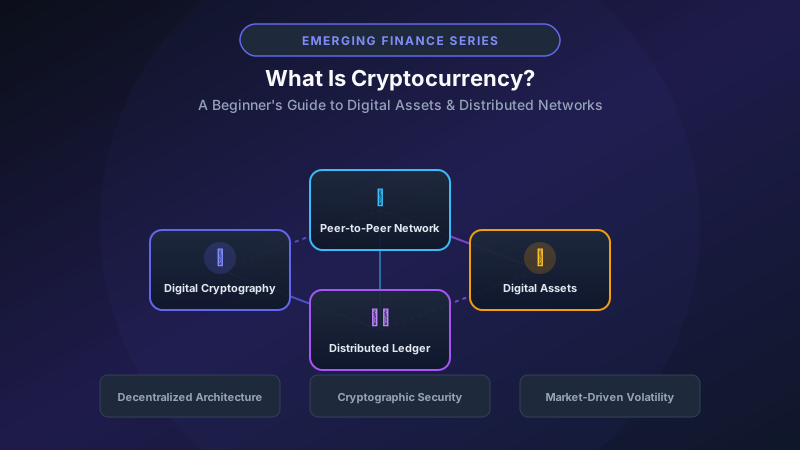
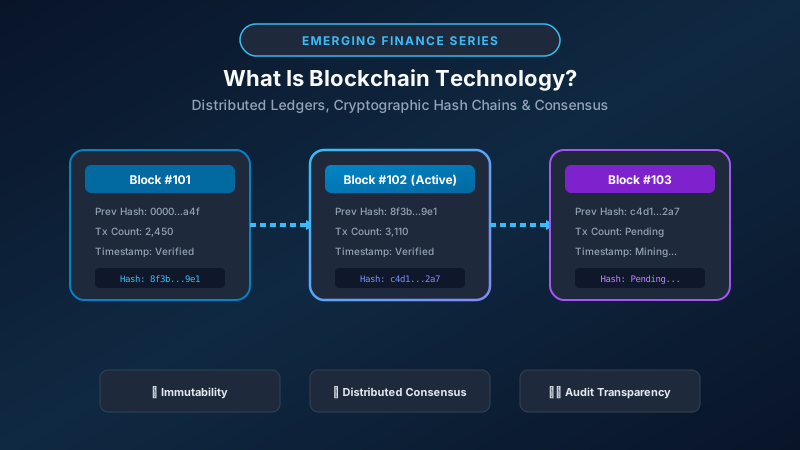
Bitcoin operates as a distributed public network composed of thousands of independent computers (nodes) that collectively maintain a shared transaction ledger called a what is blockchain.
Network Nodes ──► Verify Transaction Signatures ──► Proof-of-Work Mining ──► Block Immutable Entry
- The Ledger: A chronological sequence of transaction blocks linked cryptographically.
- Nodes: Computers running Bitcoin software that validate transactions against protocol rules.
- Miners: Specialized computing hardware that expend electrical power to bundle transactions into blocks and append them to the blockchain.
- UTXO Model: Bitcoin uses an Unspent Transaction Output (UTXO) accounting framework, where transactions consume previous outputs and generate new outputs assigned to public cryptographic addresses.
2. Programmed Supply & The Halving Mechanism
Unlike sovereign fiat currencies whose money supply is adjusted by central banks, Bitcoin operates under a strictly deterministic, code-enforced monetary policy:
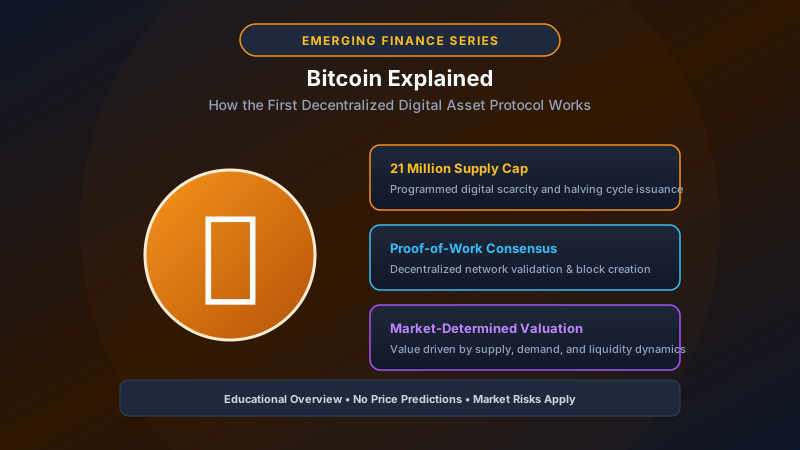
Total Capped Supply: 21,000,000 BTC
Target Block Time: ~10 Minutes
Halving Interval: Every 210,000 Blocks (~4 Years)
| Era / Halving | Year Range | Block Reward | Total Supply Minted |
|---|---|---|---|
| Genesis Era | 2009–2012 | 50.0 BTC per block | 10.50 Million BTC (50%) |
| 1st Halving | 2012–2016 | 25.0 BTC per block | 15.75 Million BTC (75%) |
| 2nd Halving | 2016–2020 | 12.5 BTC per block | 18.37 Million BTC (87.5%) |
| 3rd Halving | 2020–2024 | 6.25 BTC per block | 19.68 Million BTC (93.75%) |
| 4th Halving | 2024–2028 | 3.125 BTC per block | ~19.70 Million BTC (~94%) |
Because block rewards decrease by 50% every four years, the rate of new Bitcoin creation slows over time until approximately the year 2140, when the final satoshi (the smallest unit of Bitcoin, equal to 0.00000001 BTC) will be mined. Explore how monetary liquidity cycles interact with Bitcoin's supply design in bitcoin-interest-rates-explained.
3. How Proof-of-Work Consensus Secures the Network
Bitcoin achieves consensus and immutability through a competitive mechanism called Proof-of-Work (PoW):
- Transaction Pooling: When users broadcast transactions, they enter a global memory pool (mempool).
- Block Candidates: Miners gather valid transactions into a candidate block.
- Cryptographic Puzzle: Miners repeatedly hash the block header alongside a variable nonce to find a hash output that meets the network's current difficulty target.
- Validation & Propagation: Once a valid block is discovered, it is broadcast to the network. Other nodes independently verify all transactions and update their local ledger copies.
This process ensures that altering a past transaction would require re-doing the Proof-of-Work for that block and every subsequent block—an operation requiring immense computational energy that grows exponentially harder with block depth.
4. Why Does Bitcoin Have Value?
Bitcoin possesses no physical form and generates no corporate cash flows or dividend yields. Its economic value stems from a combination of protocol properties and market belief:
               ┌── Programmed Scarcity (21M Cap)
               │
Value Drivers ──┼── Decentralized & Censorship-Resistant Network
               │
               ├── Cryptographic Portability & Verifiability
               │
               └── Global Market Supply & Demand Liquidity
- Scarcity & Predictability: Market participants value a monetary unit whose total supply cap cannot be expanded by political decree.
- Censorship Resistance: Anyone with an internet connection can hold private keys and initiate transactions without needing permission from a centralized administrator. Review custody mechanics in crypto-wallets-explained.
- Network Effects: As the first cryptocurrency, Bitcoin possesses the largest hash rate security, highest market liquidity, and widest recognition among digital assets.
- Uncertain Valuation: Because value depends entirely on market consensus, Bitcoin prices undergo extreme upward and downward cycles based on macroeconomic liquidity, interest rate shifts, and speculative trading sentiment.
5. Key Risks and Considerations
Before interacting with Bitcoin, consumers should understand its structural risks:
- Extreme Volatility: Bitcoin has experienced historical market drawdowns exceeding 50% to 80% during bear market cycles.
- No Sovereign Insurance: Unlike bank deposits, Bitcoin holdings carry no government protection against loss, theft, or exchange insolvency. Compare legal protections in stablecoins-vs-bank-deposits.
- Self-Custody Responsibility: If you manage your own private keys and lose your seed phrase, your funds are permanently inaccessible.
- Environmental & Operational Scrutiny: Proof-of-Work mining consumes substantial electrical energy, leading to ongoing regulatory and environmental debates globally.
6. Key Takeaways
- Bitcoin is a decentralized digital asset governed by open-source code rather than central bank authorities.
- Its supply cap is strictly fixed at 21 million tokens, with block issuance halving every four years.
- Network security is maintained by Proof-of-Work mining and distributed consensus nodes.
- Bitcoin carries no sovereign guarantees and exhibits high market price uncertainty.
7. Frequently Asked Questions
Can Bitcoin be copied or duplicated?
While anyone can copy Bitcoin's open-source code to launch a new blockchain network (a hard fork), they cannot copy the underlying Bitcoin network's security, miners, node infrastructure, or global liquidity.
How does Bitcoin compare to traditional financial assets?
To read an in-depth, neutral comparison of digital assets versus stocks, bonds, and cash across 10 financial dimensions, consult cryptocurrency-vs-traditional-investments.
Educational Disclaimer
This article is strictly educational and does not constitute financial, investment, or trading advice. MoneyTalkin' does not make price predictions or recommend buying or selling Bitcoin. Digital assets carry high risk and extreme price volatility. Always consult a qualified professional before making financial decisions.
MoneyTalkin' provides financial education, educational concepts, and general informational guides. Articles do not constitute personalized financial, investment, legal, or tax advice. Financial products, rates, terms, and regulatory rules change frequently; consult a qualified financial professional regarding your specific situation. Read our full Disclaimer Policy.
Written by MoneyTalkin'
MoneyTalkin' researches and publishes objective financial education content, money management fundamentals, and practical financial guides.
Related Technical Articles
Explore related topics in this cluster to deepen your understanding.