What Is Tokenization? How Real-World Assets Can Become Digital
A plain-language guide explaining asset tokenization, covering real-world assets (RWA), fractional ownership, smart contracts, legal wrappers, and limitations.
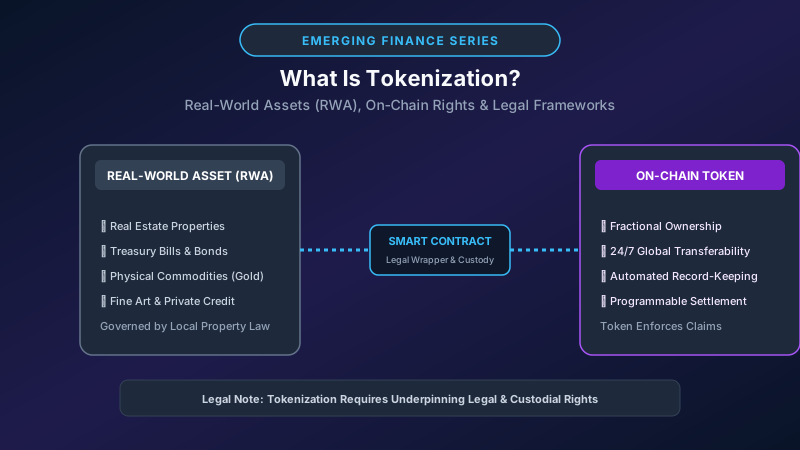
What Is Tokenization? How Real-World Assets Can Become Digital
In modern finance, tokenization refers to the process of representing rights to a physical or financial asset as a digital token on a distributed ledger or what-is-blockchain. These tokens—often termed Real-World Assets (RWAs) or Security Tokens—act as programmable digital representations of underlying economic value.
By integrating traditional financial instruments with blockchain rails, market participants aim to improve settlement speed, automate corporate actions, and enable fractional ownership. However, tokenization introduces distinct legal and technical nuances that investors should understand.
1. How Asset Tokenization Works: The RWA Lifecycle
[ Physical / Financial Asset ] ──► [ Legal Wrapper & Custody ] ──► [ Smart Contract Minting ] ──► [ On-Chain Trading & Settlement ]
 (e.g., Treasury Bill / Gold)      (Special Purpose Vehicle)       (Programmable Token Logic)     (24/7 Peer-to-Peer Transfer)
1. Asset Identification & Legal Structuring
A real-world asset—such as a portfolio of short-term U.S. Treasury bills or a commercial property—is identified. A legal structure, often a Special Purpose Vehicle (SPV), trust, or bankruptcy-remote entity, is established to hold legal title to the physical asset on behalf of token holders.
2. Digital Custody & Audit Verification
Independent custodians or regulated bank partners verify that the underlying assets exist and are securely held. Third-party audit or oracle feeds transmit real-time reserve proofs to the blockchain.
3. Smart Contract Minting
A smart contract mints a fixed supply of digital tokens corresponding to the value or fractional shares of the underlying asset. The smart contract code incorporates regulatory rules—such as restricting transfers to verified KYC (Know Your Customer) account holders.
4. Secondary Transfer & Automated Servicing
Investors buy, hold, or transfer tokens on public or permissioned ledgers. When the underlying asset generates cash flows (such as bond coupon payments or rental income), smart contracts automatically distribute payouts to token holders wallet addresses.
2. Key Use Cases Across Financial Markets
                          ┌── 1. Sovereign Debt & Bonds (Tokenized T-Bills)
                          │
RWA Tokenization Sectors ─┼── 2. Fractionalized Real Estate & Private Credit
                          │
                          └── 3. Physical Commodities (Gold & Agriculture)
| Asset Category | Traditional Processing | Tokenized RWA Advantage |
|---|---|---|
| Government T-Bills | T+1 or T+2 settlement via traditional clearinghouses. | Instant 24/7 atomic settlement; use as collateral in digital pools. |
| Commercial Real Estate | High minimum investments; illiquid paper transfers. | Fractional ownership units; broader investor participation. |
| Private Credit & Loans | Manual loan servicing and paper documentation. | Automated interest distribution via programmable smart contracts. |
| Physical Gold | Physical storage vaulting and shipping logistics. | Digital tokenized ownership representing vaulted gold bars. |
To see how tokenized securities compare with native digital currencies, review cbdcs-vs-stablecoins-vs-cryptocurrency.
3. Legal Realities & Technical Limitations
While tokenization offers technical efficiency, investors must recognize key limitations:
- Token Rights Depend on Legal Frameworks: A digital token cannot override local property or corporate law. If the underlying legal entity holding the physical asset is flawed or unregistered, the token may hold zero legal value.
- Oracles & Counterparty Risk: Token holders rely on the integrity of the off-chain custodian holding the physical asset. If the custodian mismanages the underlying property, the token's value is compromised.
- Regulatory Compliance: Most tokenized real-world assets are classified as financial securities, making them subject to strict securities laws, investor accreditation rules, and trading restrictions.
4. Key Takeaways
- Tokenization creates digital ledger representations of real-world physical or financial assets.
- Legal wrappers and regulated custodians are necessary to connect on-chain tokens with off-chain legal rights.
- Key potential benefits include 24/7 atomic settlement, fractional ownership, and automated smart contract servicing.
- A token is only as valid as the underlying legal framework and custodial integrity backing it.
5. Frequently Asked Questions
How does tokenization apply to institutional banking payments?
Major financial institutions explore tokenization to streamline interbank settlement and securities clearing. Read our complete analysis in blockchain-payments-financial-services.
Are tokenized assets safer than cryptocurrencies?
Tokenized real-world assets represent claims on underlying income-generating or physical assets (like bonds or gold), whereas unbacked native cryptocurrencies rely purely on speculative market demand. However, tokenized assets introduce legal and custodian counterparty risks.
Educational Disclaimer
This article is provided for educational purposes only. MoneyTalkin' does not offer security token issuance, investment, or legal services. Tokenized real-world assets carry legal, operational, and market risks. Always consult a qualified financial and legal professional before investing.
MoneyTalkin' provides financial education, educational concepts, and general informational guides. Articles do not constitute personalized financial, investment, legal, or tax advice. Financial products, rates, terms, and regulatory rules change frequently; consult a qualified financial professional regarding your specific situation. Read our full Disclaimer Policy.
Written by MoneyTalkin'
MoneyTalkin' researches and publishes objective financial education content, money management fundamentals, and practical financial guides.
Related Technical Articles
Explore related topics in this cluster to deepen your understanding.