What Is Blockchain Technology? A Simple Guide for Beginners
A plain-language guide explaining blockchain technology, covering blocks, cryptographic hashes, peer-to-peer nodes, consensus rules, immutability, and real-world uses.
What Is Blockchain Technology? A Simple Guide for Beginners
At its core, a blockchain is a decentralized, digital ledger that securely records transactions across a distributed network of computers. Rather than storing information in a single database controlled by a central authority—such as a bank or government agency—a blockchain replicates identical copies of the transaction record across thousands of independent nodes worldwide.
This architecture enables participants who do not necessarily trust one another to agree on a single, tamper-resistant record of truth without relying on a centralized intermediary.
1. How a Blockchain Works: Blocks, Hashes, and Chains
A blockchain gets its name from how data is organized and connected:
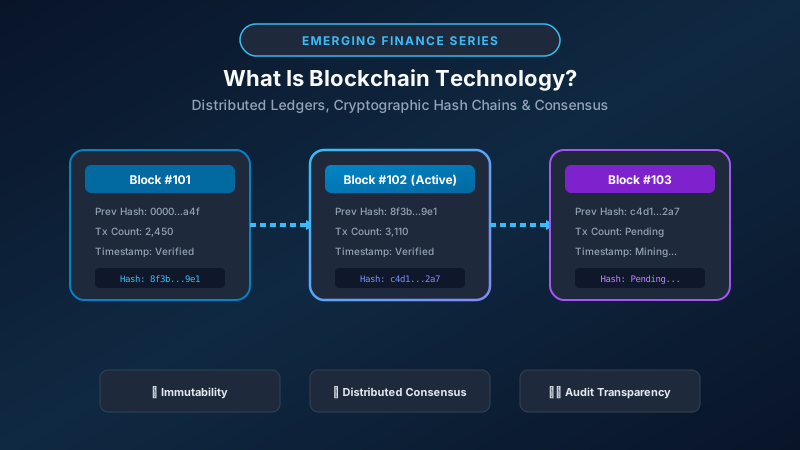
[ Block 101: Tx Data + Hash A ] ──Cryptographic Link──► [ Block 102: Prev Hash A + Tx Data + Hash B ]
1. Transactions & Data Storage
Transactions—such as sending digital tokens or executing smart contracts—are broadcast to the network. Independent nodes gather these pending transfers into a candidate data container called a block.
2. Cryptographic Hashes
Every block contains a unique digital fingerprint called a cryptographic hash (generated using mathematical functions such as SHA-256). The block header includes:
- The current block's transaction data summary.
- A timestamp.
- The exact cryptographic hash of the previous block.
3. The Immutable Chain
Because Block 102 includes the hash of Block 101, any attempt to tamper with data inside Block 101 would immediately change its hash. This breaks the cryptographic link to Block 102 and every block following it, alerting all network nodes to the invalid modification.
2. Public vs. Private Blockchains
Not all blockchain networks operate under the same access rules. Financial institutions and software developers deploy two primary structures:
                          ┌── Public / Permissionless (e.g., Bitcoin, Ethereum)
                          │   • Open read/write access
                          │   • Decentralized global validator nodes
Blockchain Architectures ─┤
                          └── Private / Permissioned (e.g., Enterprise Ledgers)
                              • Restricted membership & access
                              • Pre-approved institutional validators
| Feature | Public Blockchain | Private / Permissioned Blockchain |
|---|---|---|
| Access | Open to anyone globally | Restricted to invited participants |
| Validators | Decentralized competitive nodes | Designated institutions or companies |
| Transparency | Fully readable on public block explorers | Confidential to authorized network members |
| Transaction Speed | Slower (requires broad consensus) | Faster (smaller validator set) |
| Primary Use Cases | Cryptocurrencies, DeFi, Public Tokens | Interbank settlement, Supply chain tracking |
To see how financial institutions apply permissioned and public blockchain rails, explore our guide on blockchain-payments-financial-services.
3. Practical Applications Beyond Cryptocurrency
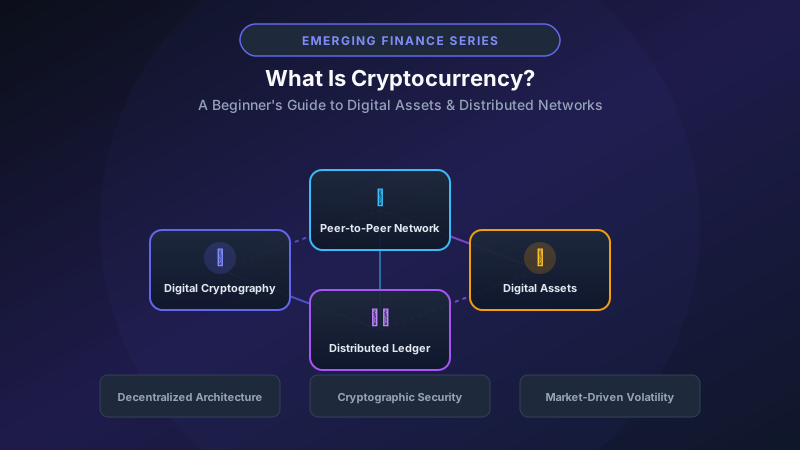
While blockchain technology gained prominence through digital assets like what-is-cryptocurrency and bitcoin-explained, its core capabilities—transparency, immutability, and distributed verification—are utilized across various financial services:
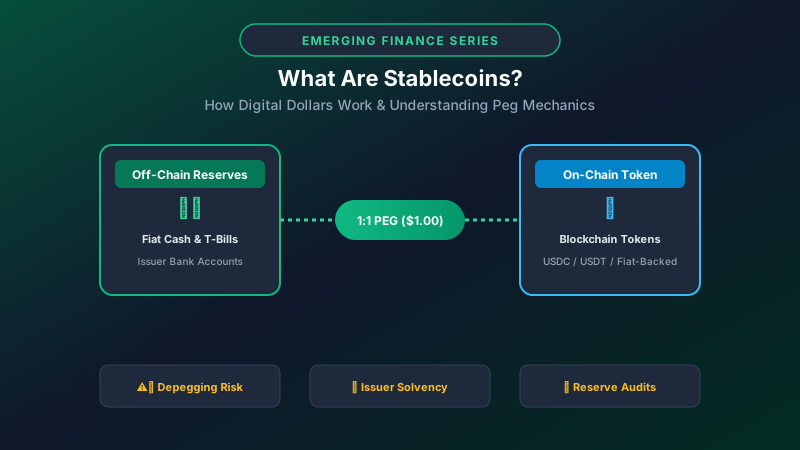
- Cross-Border Payments: Transferring value across international borders without relying on legacy correspondent banking chains. See stablecoins-cross-border-payments.
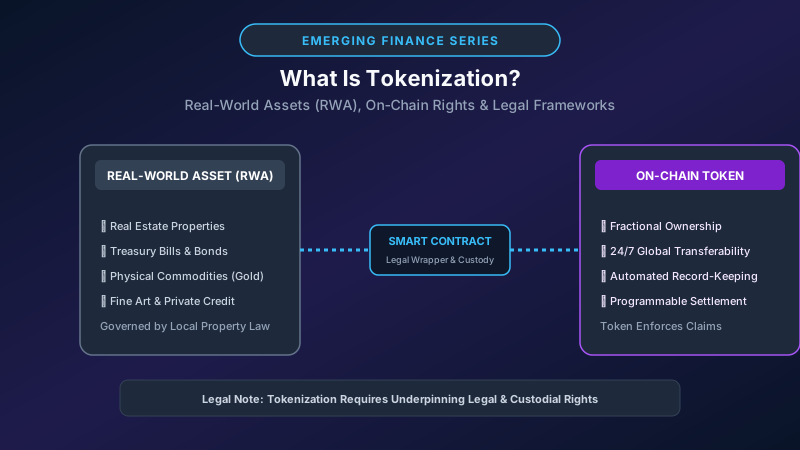
- Asset Tokenization: Representing physical properties, bonds, or equity as digital tokens on a shared ledger. Learn more in what-is-tokenization.
- Smart Contracts: Self-executing code scripts that automatically enforce contractual agreements when predefined conditions are met.
- Digital Identity & Compliance: Securely sharing verified credentials between financial institutions to streamline KYC (Know Your Customer) compliance.
4. Limitations and Misconceptions About Blockchain
While blockchain offers powerful security properties, it is not a universal solution for every data challenge:
- Immutability Is Not Infallibility: Blockchain guarantees that entered data cannot be easily altered; it does not guarantee that the original data entered was accurate or truthful ("garbage in, garbage out").
- Scalability Bottlenecks: Public blockchains often process fewer transactions per second than centralized payment processors like Visa or Mastercard due to the time required for global node consensus.
- Storage Efficiency: Storing full copies of a growing ledger across thousands of computers is resource-intensive compared to traditional cloud databases.
5. Key Takeaways
- A blockchain is a distributed, tamper-resistant digital ledger shared among network computers.
- Blocks are linked using cryptographic hashes; altering historical data breaks the chain and is rejected by nodes.
- Public blockchains are permissionless and open; private blockchains restrict validation to pre-approved entities.
- Blockchain technology powers cryptocurrencies, smart contracts, tokenized assets, and cross-border settlement systems.
6. Frequently Asked Questions
Can a blockchain be hacked?
Hacking a major public blockchain's core ledger would require controlling a majority of the network's total computing power or staked assets (a 51% attack). While smaller, less secure networks have suffered such attacks, mature networks like Bitcoin and Ethereum possess vast decentralized resources that make core ledger tampering computationally and economically unfeasible.
How does blockchain relate to digital wallets and transactions?
To understand how user transactions are signed with private keys and processed across blockchain nodes, read our detailed guide on how-cryptocurrency-transactions-work.
Educational Disclaimer
This article is provided for educational and informational purposes only. MoneyTalkin' does not provide investment, legal, or technology consulting advice. Distributed ledger technology and digital asset systems carry operational and market risks.
MoneyTalkin' provides financial education, educational concepts, and general informational guides. Articles do not constitute personalized financial, investment, legal, or tax advice. Financial products, rates, terms, and regulatory rules change frequently; consult a qualified financial professional regarding your specific situation. Read our full Disclaimer Policy.
Written by MoneyTalkin'
MoneyTalkin' researches and publishes objective financial education content, money management fundamentals, and practical financial guides.
Related Technical Articles
Explore related topics in this cluster to deepen your understanding.