How Cryptocurrency Transactions Work: Addresses, Networks, and Fees
A step-by-step guide explaining the cryptocurrency transaction lifecycle, covering public addresses, private key signatures, network fees, mempools, and confirmations.
How Cryptocurrency Transactions Work: Addresses, Networks, and Fees
Transferring funds in traditional banking involves sending instructions to a centralized institution, which verifies account balances, adjusts private internal ledgers, and routes settlement through central bank clearing rails.
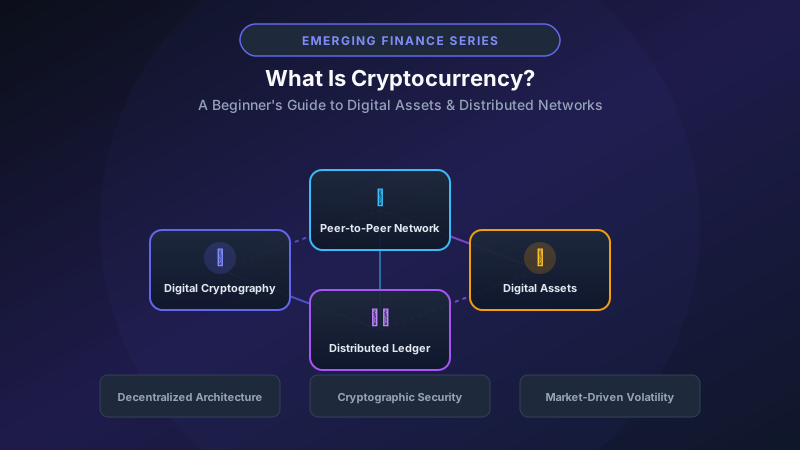
In contrast, a transaction on a what-is-cryptocurrency network is a cryptographically signed instruction broadcast to a peer-to-peer network of independent nodes. This guide outlines the step-by-step lifecycle of a digital asset transaction from wallet signing to final block confirmation.
1. The Step-by-Step Transaction Lifecycle
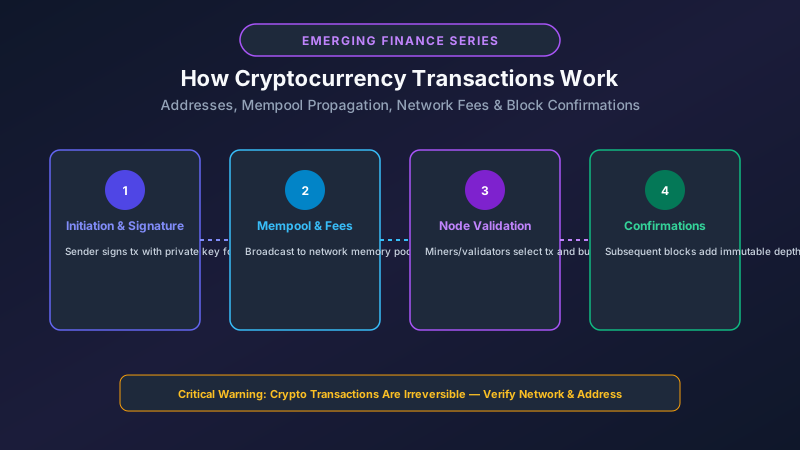
[ Step 1: Wallet Signing ] ──► [ Step 2: Mempool Broadcast ] ──► [ Step 3: Block Inclusion ] ──► [ Step 4: Block Confirmations ]
 (Private Key Signature)        (Network Memory Pool Queue)      (Miners/Validators Propose)     (Immutable Ledger Finality)
Step 1: Transaction Initiation & Digital Signature
To initiate a transaction, the sender inputs the recipient's public address, the transaction amount, and specifies a network fee. The sender's crypto-wallets-explained uses their secret private key to generate an elliptic curve digital signature. This signature proves to the network that the owner of the private key authorized the transfer without ever revealing the key itself.
Step 2: Broadcast to the Mempool (Memory Pool)
Once signed, the transaction is broadcast to peer-to-peer nodes worldwide. Receiving nodes verify that the signature is mathematically valid and that the sender's address possesses unspent inputs (or sufficient balance). Valid pending transactions enter a temporary holding area called the mempool (memory pool).
Step 3: Block Selection & Validation
Miners (in Proof-of-Work systems like bitcoin-explained) or validators (in Proof-of-Stake systems) select pending transactions from the mempool to assemble into a candidate block:
- Fee Prioritization: Miners generally prioritize transactions offering higher network fees per unit of block data space.
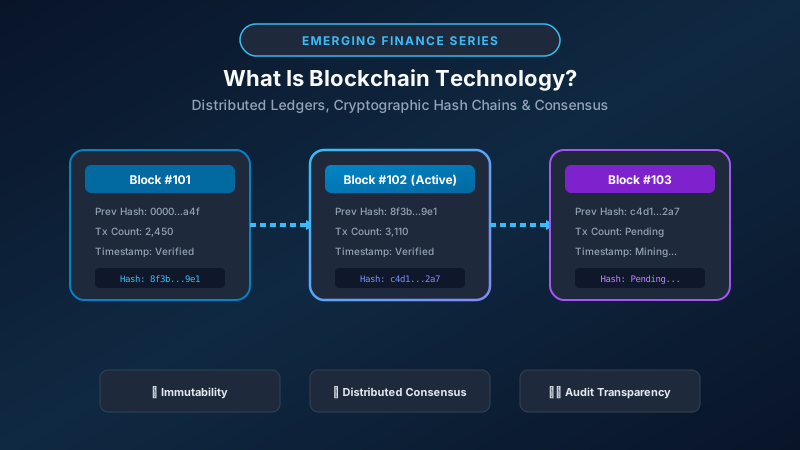
- Consensus Execution: The block is cryptographically solved or staked, validated by network nodes, and appended to the public what-is-blockchain ledger.
Step 4: Confirmations & Finality
When your transaction is included in a newly validated block, it receives its first confirmation. As subsequent blocks are added to the chain on top of that block, the number of confirmations increases. Each additional block adds depth, making it exponentially harder to alter or reverse the ledger entry.
2. Understanding Public Addresses and Network Selection
                  ┌── 1. Correct Public Address Format (Matches Recipient Coin Type)
                  │
Critical Transfer ┼── 2. Matching Blockchain Network (e.g., Ethereum vs BNB Chain vs Solana)
Checklist         │
                  └── 3. Destination Tag / Memo (Required by certain exchange deposit addresses)
- Address Formats: Public addresses are alphanumeric strings generated via cryptographic hashing. Different blockchains use distinct address formats (e.g., Bitcoin addresses start with
1,3, orbc1, whereas Ethereum-compatible addresses start with0x). - Network Compatibility: Sending tokens across incompatible networks (for example, attempting to transfer native Bitcoin to an Ethereum
0xaddress) causes transactions to fail or become permanently unrecoverable. - Memo / Destination Tags: When sending funds to centralized exchange deposit accounts, users must often include a mandatory Memo or Destination Tag alongside the public address so the exchange can credit the specific user account internally.
3. Network Fees (Gas Fees) & Network Congestion
Unlike fixed bank wire fees, cryptocurrency transaction costs fluctuate dynamically based on network demand for limited block capacity:
| Factor | Low Network Congestion | High Network Congestion |
|---|---|---|
| Pending Mempool Transactions | Small queue of pending transfers. | Large backlog of unconfirmed transactions. |
| Fee Competition | Standard base fees achieve fast block inclusion. | Senders outbid others with higher fees for priority. |
| Transaction Processing Time | Quick inclusion in the next block round. | Lower-fee transactions remain delayed in mempool. |
| Cost Mitigation Strategies | Standard transaction processing. | Transact during off-peak hours or use Layer-2 rails. |
4. Key Takeaways
- Crypto transactions are digitally signed using private keys and broadcast to peer-to-peer network nodes.
- Pending transactions queue in the mempool before miners or validators include them in a block.
- Network fees (gas) fluctuate based on real-time demand for block space.
- Blockchain transactions are cryptographically permanent and irreversible once confirmed.
5. Frequently Asked Questions
Can a stuck or pending transaction in the mempool be canceled?
Some wallet applications and network protocols support features like Replace-By-Fee (RBF) or Transaction Speed-Up, allowing senders to resubmit the same transaction with a higher fee to encourage miners to pick it up over the earlier low-fee attempt.
How do stablecoin transaction speeds compare with bank deposits?
To compare how stablecoin token transfers compare with commercial bank wire clearing, explore our comparative guide on stablecoins-vs-bank-deposits.
Educational Disclaimer
This article is provided for educational and informational purposes only. MoneyTalkin' does not provide wallet software or transaction execution services. Transacting in digital assets carries technical and financial risks. Always verify address and network compatibility before executing transfers.
MoneyTalkin' provides financial education, educational concepts, and general informational guides. Articles do not constitute personalized financial, investment, legal, or tax advice. Financial products, rates, terms, and regulatory rules change frequently; consult a qualified financial professional regarding your specific situation. Read our full Disclaimer Policy.
Written by MoneyTalkin'
MoneyTalkin' researches and publishes objective financial education content, money management fundamentals, and practical financial guides.
Related Technical Articles
Explore related topics in this cluster to deepen your understanding.