What Are Stablecoins? How Digital Dollars Work
An educational guide to stablecoins, covering fiat-backed reserves, algorithmic pegs, redemption rights, counterparty risk, and why stable does not mean risk-free.
What Are Stablecoins? How Digital Dollars Work
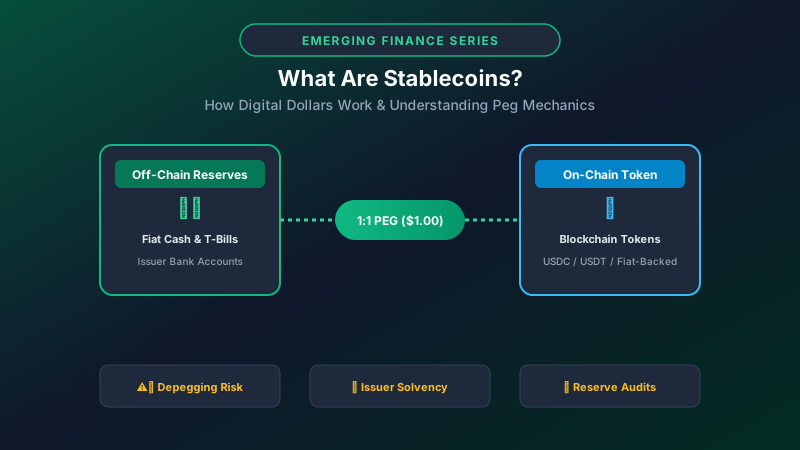
While primary cryptocurrencies like bitcoin-explained experience price volatility based on market sentiment, stablecoins are digital tokens engineered to maintain a stable exchange value relative to a specific reference asset—most commonly national fiat currencies like the U.S. Dollar (USD) or Euro (EUR).
By combining the 24/7 peer-to-peer settlement capability of what is blockchain with the low volatility of fiat currency units, stablecoins have become a foundational payment rail within the digital asset ecosystem. However, the term "stable" describes the design objective rather than a guarantee of safety.
1. How Stablecoins Function: The Three Main Architecture Types
Stablecoin issuers employ different structural mechanisms to maintain their target price peg:
                         ┌── 1. Fiat-Backed (e.g., USDC, USDT)
                         │   • Off-chain cash & short-term Treasury reserves
                         │
Stablecoin Architectures ┼── 2. Crypto-Collateralized (e.g., DAI)
                         │   • On-chain over-collateralized digital assets
                         │
                         └── 3. Algorithmic (Unbacked / Code-Driven)
                             • Supply elasticity & arbitrage incentives (High Risk)
1. Fiat-Collateralized Stablecoins
- Mechanism: The issuing entity collects fiat currency (e.g., USD) from users and holds equivalent cash and short-term debt instruments (such as 90-day Treasury bills) in custodial bank accounts.
- Issuance: For every $1.00 deposited into reserves, the issuer mints 1 digital stablecoin on a public blockchain.
- Redemption: Institutional clients can return stablecoin tokens to the issuer to redeem $1.00 in fiat currency from the reserves.
2. Crypto-Collateralized Stablecoins
- Mechanism: Instead of off-chain bank accounts, these tokens are backed by other cryptocurrencies held inside automated smart contracts on a blockchain.
- Over-Collateralization: Because underlying crypto reserves fluctuate in price, these systems require over-collateralization (e.g., locking $150 worth of Ether to mint $100 worth of stablecoins) to absorb price drops.
3. Algorithmic Stablecoins
- Mechanism: Algorithmic stablecoins attempt to maintain a peg without full reserve backing, relying on code-driven supply contraction and expansion incentives paired with secondary arbitrage tokens.
- Historical Vulnerability: Unbacked algorithmic models have demonstrated severe vulnerability to run dynamics, where sudden loss of market confidence triggers permanent death spirals and total depegging.
2. Primary Use Cases for Stablecoins
Stablecoins serve several core functions across global digital finance:
Trading Liquidity ──► Cross-Border Remittances ──► E-Commerce Payments ──► Inflation Hedging
(Exchange Pairs)      (Lower Fee Transfers)       (24/7 Merchant Payouts)  (Global USD Access)
- Exchange Trading & Settlement: Traders use stablecoins as a neutral pricing unit to quickly exit volatile crypto positions without converting back into traditional fiat bank accounts.
- Cross-Border Remittances: Transferring value across international borders on public blockchain rails. Read our dedicated guide on stablecoins-cross-border-payments.
- Global Dollar Access: In jurisdictions experiencing high local currency inflation or capital controls, stablecoins provide digital access to USD-denominated units of account.
3. Structural Risks: Why "Stable" Does Not Mean Risk-Free
Despite their name, stablecoins carry distinct risk factors that consumers and institutional market participants must evaluate:
| Risk Category | Risk Mechanism | Impact on Holders |
|---|---|---|
| Depegging Risk | Secondary market prices fall below the $1.00 target peg during panic. | Capital loss if sold below peg during market stress. |
| Reserve Quality Risk | Issuer holds illiquid, risky, or unverified reserve assets. | Redemption delays or partial recovery during run events. |
| Counterparty / Custody Risk | Custodial banks or reserve managers suffer insolvency. | Issuer inability to honor 1:1 fiat redemptions. |
| Regulatory Risk | Sudden legal restrictions or licensing requirements imposed on issuers. | Potential freeze of smart contracts or exchange delistings. |
To understand how stablecoin legal structures compare with conventional bank protection, consult our comparative analysis on stablecoins-vs-bank-deposits.
4. Key Takeaways
- Stablecoins are digital tokens designed to track the value of fiat currencies like the U.S. Dollar.
- Fiat-backed stablecoins rely on off-chain bank reserves, whereas algorithmic models rely on software mechanics.
- Stablecoins enable 24/7 global value transfer but carry no direct government deposit insurance.
- Depegging, issuer insolvency, and reserve quality represent real financial risks for stablecoin holders.
5. Frequently Asked Questions
How do stablecoins differ from Central Bank Digital Currencies (CBDCs)?
Stablecoins are issued by private entities on public or private networks. CBDCs are official digital liabilities issued directly by sovereign central banks. For a detailed three-way comparison, read cbdcs-vs-stablecoins-vs-cryptocurrency.
Can stablecoin issuers freeze funds?
Many major fiat-backed stablecoins contain smart contract code enabling the issuer to freeze token addresses in response to law enforcement orders or regulatory compliance mandates.
Educational Disclaimer
This article is provided for educational and informational purposes only. MoneyTalkin' does not endorse or recommend purchasing any stablecoin, digital asset, or cryptocurrency. Stablecoins carry operational, credit, and market risks. Always conduct independent research and consult a licensed financial professional.
MoneyTalkin' provides financial education, educational concepts, and general informational guides. Articles do not constitute personalized financial, investment, legal, or tax advice. Financial products, rates, terms, and regulatory rules change frequently; consult a qualified financial professional regarding your specific situation. Read our full Disclaimer Policy.
Written by MoneyTalkin'
MoneyTalkin' researches and publishes objective financial education content, money management fundamentals, and practical financial guides.
Related Technical Articles
Explore related topics in this cluster to deepen your understanding.