Stablecoins and Cross-Border Payments: What Consumers Should Know
An educational overview examining how stablecoins facilitate cross-border value transfer, analyzing settlement speed, fees, FX conversion, compliance, and consumer risks.
Stablecoins and Cross-Border Payments: What Consumers Should Know
Cross-border payments—including personal remittances, international trade settlements, and freelance payroll transfers—have historically relied on correspondent banking networks (such as the SWIFT messaging framework). While effective, legacy cross-border rails often involve multiple intermediary banks, operating delays, opaque foreign exchange (FX) markups, and high transfer fees.
In response, privately issued what-are-stablecoins have emerged as an alternative vehicle for moving value globally across public what-is-blockchain ledgers. Understanding how stablecoins function in international payments requires examining the complete value chain from local fiat currency on-ramps to final bank off-ramps.
1. The Cross-Border Payment Lifecycle: Legacy Wires vs. Stablecoins
Legacy International Bank Wire (SWIFT Rail):
Sender ──► Local Bank ──► Correspondent Bank A ──► Correspondent Bank B ──► Recipient Bank ──► Recipient
(1 to 5 Business Days • Intermediary Deductions & FX Spreads)
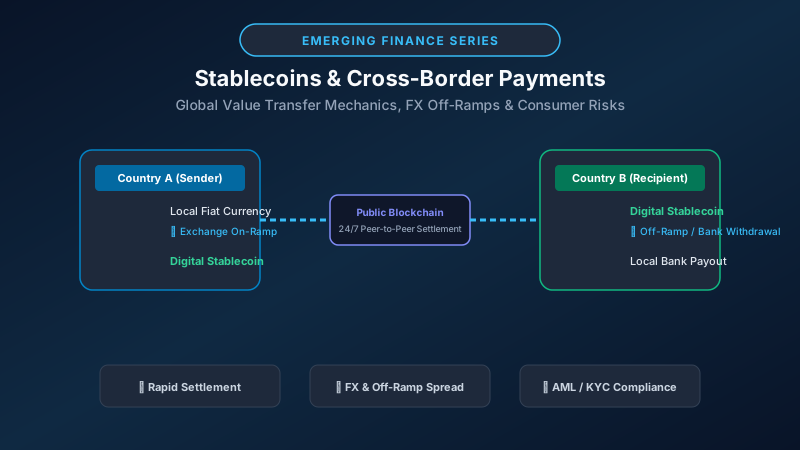
Stablecoin Cross-Border Transfer:
Sender Fiat ──► Local On-Ramp ──► Blockchain Ledger Transfer ──► Recipient Off-Ramp ──► Local Fiat
(Minutes / 24/7 Settlement • Gas Fees & Local On/Off-Ramp Exchange Spreads)
| Lifecycle Stage | Traditional International Wire | Stablecoin Cross-Border Transfer |
|---|---|---|
| 1. Funding / On-Ramp | Commercial bank account deposit. | Local fiat converted to stablecoins via exchange or app. |
| 2. Global Messaging | Interbank SWIFT messaging protocol. | Public blockchain peer-to-peer transaction broadcast. |
| 3. Settlement Time | 1 to 5 business days (subject to time zones). | Seconds to minutes (24/7/365 network operation). |
| 4. Intermediary Chains | Multiple correspondent banks holding Nostro/Vostro accounts. | Direct wallet-to-wallet or exchange-to-exchange transfer. |
| 5. Payout / Off-Ramp | Local bank credit in national currency. | Stablecoin converted back to local currency via local exchange. |
2. Potential Advantages and Trade-Offs for Consumers
                  ┌── Advantages: 24/7 Speed, Transparent On-Chain Transfer, Direct Access
Cross-Border ─────┤
Stablecoin Use    └── Trade-Offs: On/Off-Ramp Fees, FX Spread Costs, Depegging & Legal Risks
Potential Advantages
- Speed & Settlement Finality: Blockchain transfers operate continuously regardless of weekends or banking holidays.
- Transfer Transparency: Transaction IDs allow senders and recipients to trace transfer progress on public block explorers in real time. See how-cryptocurrency-transactions-work.
- Reduced Intermediary Friction: Eliminating multiple correspondent clearing banks can streamline the technical transfer path.
Critical Limitations and Costs
- The "Last Mile" On/Off-Ramp Problem: Stablecoins are digital tokens. Unless the recipient can spend stablecoins directly for goods and services, they must convert them into local cash via a regulated digital exchange or P2P market, incurring service fees and currency exchange spreads.
- Depegging & Issuer Risk: Private stablecoins carry counterparty and reserve risks. Compare protections in stablecoins-vs-bank-deposits.
- Irreversibility: If funds are sent to an incorrect wallet address or incompatible network, no central bank support exists to recover lost assets.
3. Regulatory and Compliance Frameworks
International money transfers are strictly monitored by global financial regulators to prevent money laundering, tax evasion, and illicit financing:
- The FATF Travel Rule: The Financial Action Task Force (FATF) guidelines mandate that virtual asset service providers (VASPs) collect and share identifying information about senders and recipients for transfers exceeding specific statutory thresholds.
- Capital Controls & Foreign Exchange Regulations: Nations with strict capital controls require registered exchanges to report cross-border asset flows and enforce foreign exchange conversion limits.
- Stablecoin Regulatory Legislation: Jurisdictions globally (e.g., MiCA in the EU) are enacting specific legal standards governing stablecoin reserve backing, liquidity requirements, and issuer licensing.
4. Key Takeaways
- Stablecoin cross-border transfers bypass traditional correspondent banking chains to settle in minutes.
- Senders and recipients must evaluate total cost, including exchange on/off-ramp fees and local FX conversion spreads.
- Cross-border token transfers are subject to global AML/KYC laws and regulatory compliance mandates.
- Stablecoins carry issuer, counterparty, and technical risks not present in government-backed bank transfers.
5. Frequently Asked Questions
Are stablecoins better than real-time fiat payment systems?
Sovereign real-time payment systems (like FedNow in the U.S. or Pix in Brazil) offer instant, low-cost domestic transfers with full banking protection. Stablecoins primary niche remains international transfers where domestic real-time rails do not interconnect directly. Learn about domestic real-time rails in fednow-real-time-payments-explained.
Where can I learn more about comparing CBDCs with stablecoins?
To see how sovereign Central Bank Digital Currencies compare with private stablecoins for global payments, consult cbdcs-vs-stablecoins-vs-cryptocurrency.
Educational Disclaimer
This article is for general educational purposes only and does not constitute financial, legal, or tax advice. MoneyTalkin' does not provide money transfer or exchange services. Digital asset transfers carry operational and counterparty risks. Always consult a licensed professional for international financial management.
MoneyTalkin' provides financial education, educational concepts, and general informational guides. Articles do not constitute personalized financial, investment, legal, or tax advice. Financial products, rates, terms, and regulatory rules change frequently; consult a qualified financial professional regarding your specific situation. Read our full Disclaimer Policy.
Written by MoneyTalkin'
MoneyTalkin' researches and publishes objective financial education content, money management fundamentals, and practical financial guides.
Related Technical Articles
Explore related topics in this cluster to deepen your understanding.