FedNow Explained: How U.S. Real-Time Payments Actually Work
An authoritative explanation of the Federal Reserve FedNow Service, detailing how 24/7/365 instant payment settlement operates between participating financial institutions.
FedNow Explained: How U.S. Real-Time Payments Actually Work
In July 2023, the Federal Reserve officially launched the FedNow Service—a new instant payment infrastructure designed to allow financial institutions of all sizes across the United States to provide safe, efficient, real-time payment services.
The launch of FedNow represents the most significant modernization of U.S. payment system infrastructure in decades. Understanding how FedNow functions requires examining its underlying interbank settlement mechanics, comparing it to legacy payment rails like ACH and digital accounts offered by neobanks-vs-traditional-banks, addressing public misconceptions, and analyzing real-world consumer and business applications.
1. What Is FedNow? Core Infrastructure and Settlement Mechanics
At its foundation, the FedNow Service is a payment clearing and settlement utility operated directly by the Federal Reserve Banks. It enables participating depository institutions—banks and credit unions—to transfer funds on behalf of their customers instantaneously.
Key structural features of FedNow include:
-
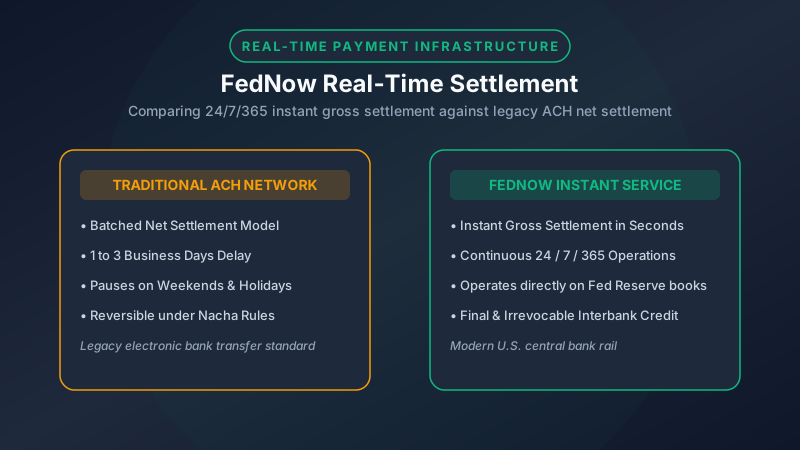
24/7/365 Availability: Unlike legacy banking rails that pause operations on weekends and federal holidays, FedNow operates continuously every day of the year.
-
Instant Gross Settlement: Payments processed through FedNow settle individually in real time directly on the books of the Federal Reserve Banks. When a sender initiates a transaction, funds move from the sending bank's Reserve account to the receiving bank's Reserve account within seconds.
-
Immediate Fund Availability: Receiving financial institutions are required to make credited funds available to the end recipient's bank account almost instantaneously (typically within seconds of transaction authorization).
-
Irrevocable Transactions: Once a FedNow credit transfer is cleared and settled by the Federal Reserve, the transaction is final and irrevocable.
2. FedNow vs. Legacy Payment Rails: ACH, Credit Cards, and RTP
To understand FedNow's impact, consider how it differs from established U.S. payment mechanisms:
Automated Clearing House (ACH)
Traditional ACH payments—governed by Nacha—operate on a batched net settlement model. ACH transactions are bundled into batches and cleared at scheduled intervals during regular banking business hours. Standard ACH debits and credits require 1 to 3 business days to settle fully. While Same Day ACH accelerated settlement windows, transactions remain restricted to business days, leaving weekends unserviced.
Credit Card Networks
When a consumer taps a credit card, transaction authorization occurs in seconds. However, authorization is not settlement. Behind the scenes, actual interbank settlement between the merchant's acquiring bank and the cardholder's issuing bank takes 1 to 3 days. Furthermore, card networks charge merchants interchange fees of 1.5% to 3.5% per transaction.
The Clearing House RTP Network
Prior to FedNow, the private sector operated a real-time payment rail known as the RTP network, launched in 2017 by The Clearing House (a consortium of major commercial megabanks). FedNow functions similarly to RTP but provides a neutral, central-bank-operated utility accessible to thousands of smaller regional banks and community credit unions that did not participate in the private bank consortium.
3. What FedNow Is NOT: Clearing Up Public Misconceptions
Following its launch, public commentary generated widespread confusion regarding FedNow's scope. Clarifying these factual misconceptions is essential:
-
FedNow is NOT a Central Bank Digital Currency (CBDC): FedNow is not a digital currency, cryptocurrency, or programmable token. It processes standard U.S. dollar deposits held at regulated depository institutions.
-
FedNow is NOT a Consumer Mobile App: Consumers cannot download a 'FedNow app' from an app store. FedNow is an invisible underlying interbank rail. Consumers access FedNow features through their existing mobile banking applications provided by participating banks.
-
FedNow is NOT a Replacement for Cash: FedNow provides a digital transfer utility alongside cash, ACH, check clearing, and wire services.
4. Real-World Consumer and Business Use Cases
The transition to instant interbank settlement creates powerful operational efficiencies across multiple sectors:
-
Instant Payroll Disbursement: Businesses can run payroll on demand. Gig-economy workers, hourly employees, or contractors can receive earned wages immediately at the end of a shift, eliminating waiting periods for bi-weekly ACH processing.
-
Instant Insurance Claims: Insurance companies responding to disaster claims can disburse emergency funds directly to a claimant's bank account in seconds during weekend emergencies.
-
Real-Time Bill Payment and Fraud Reduction: Consumers can pay utility bills or mortgage payments on the exact due date—even on a Sunday night—avoiding late fees or checking-account-fees-explained without needing to schedule payments days in advance.
-
Optimized Corporate Liquidity: Businesses can manage working capital precisely, retaining funds in yield-bearing accounts until the exact second a supplier invoice is due.
Architectural Comparison of U.S. Payment Networks
The table below contrasts FedNow with other primary U.S. payment networks:
| Feature / Dimension | FedNow Service | Traditional ACH | Credit Card Networks |
| :--- | :--- | :--- | :--- |
| Operator | Federal Reserve Banks | Nacha / Clearing Houses | Visa, Mastercard, AMEX |
| Settlement Time | Seconds (Real-time) | 1 to 3 business days | 1 to 3 days (Instant auth) |
| Availability | 24 / 7 / 365 | Business days / hours | 24 / 7 / 365 |
| Settlement Type | Real-Time Gross Settlement | Batched Net Settlement | Deferred Net Settlement |
| Irrevocability | Immediate & final | Reversible under Nacha rules| Subject to chargebacks |
| Transaction Fee | Fractions of a cent | Low fixed cents per batch | 1.5% - 3.5% interchange |
Fraud Prevention and Risk Management
Because FedNow transactions are instant and irrevocable, financial institutions must enforce sophisticated real-time fraud monitoring. Unlike credit cards where fraudulent charges can be reversed via chargeback procedures, instant credit transfers cannot be recalled once settled.
Participating banks deploy machine learning algorithms, transaction velocity controls, and rigid authentication standards at the mobile banking interface to intercept unauthorized transfer attempts before initiating FedNow payloads.
As financial institutions nationwide continue connecting to the FedNow network, real-time interbank settlement is rapidly establishing itself as the baseline expectation for modern financial-super-apps-explained in the United States.
6. Global Real-Time Payment Systems Context
The introduction of FedNow brings the United States into alignment with international real-time payment standards established across major global economies.
For example, the United Kingdom launched its Faster Payments System (FPS) in 2008, enabling instant 24/7 interbank transfers across British banks. Similarly, India developed the Unified Payments Interface (UPI) in 2016, processing billions of instant mobile transactions monthly across participating financial institutions. The European Union introduced SEPA Instant Credit Transfer (SCT Inst) to enable real-time Euro transfers across European banks.
By launching FedNow as a standardized central bank utility, the U.S. financial system establishes a modern settlement foundation capable of interfacing with future cross-border real-time payment networks.
7. System Security and Anti-Money Laundering (AML) Compliance
Operating a 24/7/365 real-time gross settlement network requires heightened cybersecurity and anti-money laundering (AML) protocols across all participating depository institutions.
Because FedNow credit transfers settle irrevocably in seconds, participating banks cannot rely on manual post-transaction compliance checks. Instead, bank infrastructure integrates automated, real-time AML screening engines and Office of Foreign Assets Control (OFAC) sanction list verification directly into the payment transaction pipeline, ensuring instant compliance without introducing settlement delays.
8. Summary Checklist: What Businesses and Consumers Should Know
As FedNow adoption expands across commercial banks and credit unions, users should evaluate how real-time interbank settlement affects financial management:
-
Confirm Bank Participation: Check whether your primary bank or credit union supports receiving or sending FedNow instant transfers.
-
Verify Payment Details Before Authorization: Because FedNow credit transfers settle instantly and irrevocably, double-check recipient account numbers and routing codes prior to payment execution.
-
Optimize Cash Management: Businesses can utilize 24/7/365 settlement to streamline payroll, supplier disbursements, and emergency liquidity management without weekend processing delays.
MoneyTalkin' provides financial education, educational concepts, and general informational guides. Articles do not constitute personalized financial, investment, legal, or tax advice. Financial products, rates, terms, and regulatory rules change frequently; consult a qualified financial professional regarding your specific situation. Read our full Disclaimer Policy.
Written by MoneyTalkin'
MoneyTalkin' researches and publishes objective financial education content, money management fundamentals, and practical financial guides.
Related Technical Articles
Explore related topics in this cluster to deepen your understanding.