Financial Super-Apps Explained: Banking, Investing, Budgeting and Payments in One Place
A comprehensive overview of financial super-apps, analyzing how single platforms integrate banking, stock trading, payments, and budgeting, alongside privacy and concentration risks.
Financial Super-Apps Explained: Banking, Investing, Budgeting and Payments in One Place
In the early era of consumer financial technology, the market was characterized by fragmentation. Consumers used one app for checking, a separate app for stock trading, a third app for peer-to-peer (P2P) payments, a fourth app for credit score tracking, and a fifth app for budgeting.
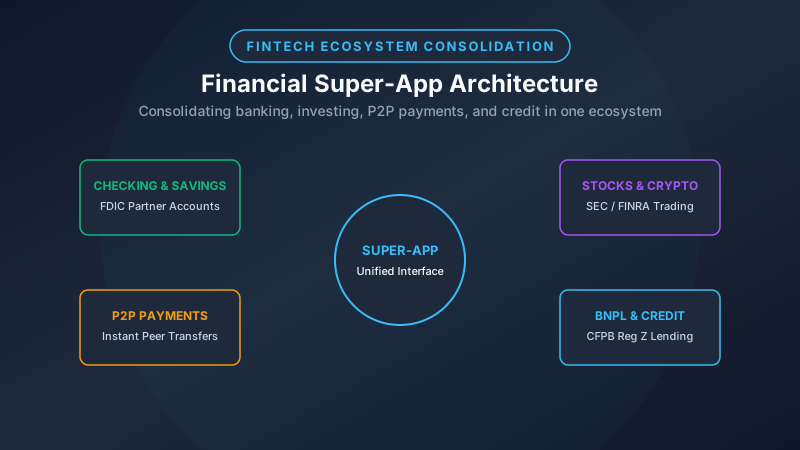
Today, digital platforms are executing aggressive consolidation strategies to construct financial super-apps—all-in-one mobile environments offering deposit accounts, high-yield savings, stock and crypto trading, point-of-sale credit, peer-to-peer payments, and automated budgeting within a single interface. Prominent examples in the U.S. market include PayPal, Block (Cash App), Robinhood, and SoFi.
Evaluating the rise of financial super-apps requires analyzing their structural features, assessing consumer convenience, identifying concentration risks, and understanding complex cross-agency regulatory oversight.
1. What Is a Financial Super-App? Core Product Modules
A financial super-app consolidates multiple previously distinct financial product categories into a unified mobile dashboard:
-
Banking & High-Yield Cash Accounts: Providing FDIC-insured checking and savings functionality, direct deposit, and debit cards, often utilizing partner-bank infrastructure explored in neobanks-vs-traditional-banks.
-
Investment & Wealth Management: Enabling zero-commission stock, ETF, and cryptocurrency trading, automated portfolio rebalancing, and fractional share purchasing.
-
Peer-to-Peer (P2P) Payments: Allowing instant money transfers between users connected over social graphs or phone contact networks.
-
Credit & Point-of-Sale Lending: Integrating built-in buy-now-pay-later-everyday-purchases features, personal loans, or cash advances based on internal cash flow data.
-
Financial Tracking & Budgeting: Aggregating credit score monitoring, net worth tracking, and automated cash flow categorization.
2. Consumer Benefits: Frictionless Money Management
The rapid consumer adoption of super-apps is driven by major operational conveniences:
-
Instant Internal Fund Transfers: Moving money between a checking account, a stock trading portfolio, and a P2P payment balance occurs instantly within a single application framework, bypassing 1-to-3-day ACH transfer windows.
-
Unified Balance Sheet Visibility: Users gain a holistic view of liquid cash, investment performance, revolving credit liabilities, and net worth on a single screen without logging into multiple banking portals.
-
Cross-Product Rewards and Incentives: Super-apps leverage multi-product bundling—offering higher savings yields or debit card cash-back rewards to users who set up direct deposit or maintain active investment subscriptions.
3. Concentration Risks: Single-Point-of-Failure Hazards
While super-app consolidation offers high convenience, bundling an entire financial life into a single technology platform introduces structural risks:
Single-Point-of-Failure Account Lockouts
If an automated fraud detection algorithm unexpectedly flags suspicious activity on a super-app account—or if a user falls victim to account takeover fraud—the user is instantly locked out of all financial capabilities simultaneously. Checking accounts, investment portfolios, payment tools, and bill pay mechanisms become inaccessible concurrently, creating severe personal liquidity crises.
Data Privacy and Behavioral Bundling
Super-apps collect comprehensive behavioral data across spending, investing, borrowing, and peer connections. Aggregating this multi-dimensional dataset enables platforms to serve targeted financial advertising, cross-sell high-margin credit products, or dynamic pricing models that consumers may find intrusive.
Platform Lock-In and Friction
As consumers store cash, investments, credit lines, and historical records inside a single super-app ecosystem, switching to competing financial providers becomes increasingly difficult, reducing long-term market fee competition.
4. Complex Cross-Agency Regulatory Oversight
From a regulatory perspective, financial super-apps operate across multiple overlapping federal jurisdictions:
-
Securities and Exchange Commission (SEC) & FINRA: Regulate stock trading, brokerage operations, customer protection rules (SEC Rule 15c3-3), and investment advice.
-
Consumer Financial Protection Bureau (CFPB): Enforces consumer protection laws across credit lending, P2P payment error resolution (Regulation E), and open banking data rights under Section 1033.
-
Federal Reserve, FDIC, and OCC: Oversee banking activities, capital requirements, and partner-bank relationships.
-
State Money Transmitter Regulators: License and audit P2P payment transfer infrastructure across individual states.
Because super-apps combine banking, brokerage, and payment rails under one roof, regulatory compliance requires maintaining rigorous ledger separation between FDIC-insured bank deposits and SEC-regulated brokerage securities.
Architectural Ecosystem Overview
The table below synthesizes the trade-offs of financial super-app consolidation:
| Operational Dimension | Consolidated Super-App | Multi-Provider App Setup |
| :--- | :--- | :--- |
| User Convenience | High (Single login, instant internal moves)| Low (Multiple app logins & ACH transfers) |
| Account Freeze Risk| High (Single lockout freezes all money)| Low (Isolated account redundancies) |
| Data Aggregation | High (Single entity holds all transaction data)| Distributed across separate providers |
| Yield & Fee Selection| Locked into platform native offerings| Ability to cherry-pick best market APYs |
| Regulatory Framework| Overlapping SEC, FINRA, CFPB, FDIC rules| Clear single-entity regulatory scopes |
Strategic Guidance for Consumers
To capture the convenience of financial super-apps while mitigating single-point-of-failure risks, consumers should follow the rule of financial redundancy:
-
Never store 100% of liquid emergency reserves inside a single super-app ecosystem.
-
Maintain an independent secondary checking account at a separate, traditional FDIC-insured bank.
-
Keep emergency physical credit cards issued by an independent financial institution to ensure access to credit if a primary super-app encounters technical downtime.
By maintaining deliberate account redundancies, consumers can enjoy the streamlined user experience of financial super-apps without compromising long-term financial security.
5. Cross-Selling Dynamics and Behavioral Nudging
The commercial strategy behind financial super-apps relies heavily on cross-selling high-margin financial products within a single user interface.
Because a super-app maintains full visibility over a user's liquid cash balances, spending patterns, and credit score metrics, the platform's algorithms can deploy targeted behavioral nudges. For example, if a user holds excess cash in a zero-interest checking balance, the app pushes notifications inviting the user to open a margin trading account, apply for point-of-sale credit, or purchase cryptocurrency.
Consumers utilizing super-apps should remain mindful of these behavioral prompts, ensuring that financial decisions are driven by personal financial goals rather than algorithmic app notifications.
6. Institutional Security and Cyber Resilience in Consolidated Ecosystems
Because financial super-apps consolidate multiple financial domains into a single mobile environment, maintaining state-of-the-art cybersecurity and infrastructure resilience is essential.
Super-app platforms deploy multi-factor authentication (MFA), biometric passkeys, device fingerprinting, and real-time fraud detection engines to protect user accounts from unauthorized access. Furthermore, platforms separate banking balances from brokerage securities, ensuring that deposits receive FDIC pass-through protection up to $250,000 while investment holdings are covered by the Securities Investor Protection Corporation (SIPC) up to $500,000.
Understanding these institutional security boundaries empowers consumers to leverage the immense convenience of financial super-apps while maintaining prudent account redundancies.
7. Summary Checklist for Super-App Users
To take full advantage of financial super-app convenience while protecting against concentration risks, implement these risk-management rules:
-
Maintain Account Redundancies: Keep an independent checking account and emergency liquid buffer at a separate, traditional FDIC-insured bank.
-
Enable Strong Authentication Controls: Use multi-factor authentication, biometric passkeys, and real-time transaction push notifications on all super-app accounts.
-
Audit Active Subscriptions: Periodically review connected products, recurring payments, and active credit lines within the super-app dashboard.
Explore underlying payment rails in our guide on FedNow Real-Time Payments.
MoneyTalkin' provides financial education, educational concepts, and general informational guides. Articles do not constitute personalized financial, investment, legal, or tax advice. Financial products, rates, terms, and regulatory rules change frequently; consult a qualified financial professional regarding your specific situation. Read our full Disclaimer Policy.
Written by MoneyTalkin'
MoneyTalkin' researches and publishes objective financial education content, money management fundamentals, and practical financial guides.
Related Technical Articles
Explore related topics in this cluster to deepen your understanding.