Neobanks vs. Traditional Banks: What Actually Changes for Customers?
A comprehensive structural breakdown comparing digital neobanks to traditional chartered banks, detailing partner-bank arrangements, pass-through FDIC insurance, fee models, and cash deposit access.
Neobanks vs. Traditional Banks: What Actually Changes for Customers?
The rapid growth of financial technology over the past decade introduced tens of millions of consumers to neobanks—mobile-first digital platforms offering fee-free checking, early paycheck access, high-yield savings features, and streamlined mobile applications. Prominent examples in the U.S. market include platforms such as Chime, Current, Varo, and Revolut.
However, marketing terminology often obscures fundamental structural differences between neobanks and traditional commercial banks (such as JPMorgan Chase, Bank of America, or regional community banks). Understanding these distinctions is crucial for consumers assessing deposit safety, regulatory protections, operational limits, and account access.
1. The Legal Charter Distinction: Tech Company vs. Bank
The most critical fact consumers must understand is that most neobanks are not banks. They are technology companies that design user interfaces, mobile software, and customer acquisition channels.
To offer banking services legally, a financial institution must possess a federal or state bank charter issued by regulatory authorities such as the Office of the Comptroller of the Currency (OCC) or state banking commissions. Obtaining a national bank charter requires stringent capital reserves, rigorous regulatory compliance audits, and ongoing supervision.
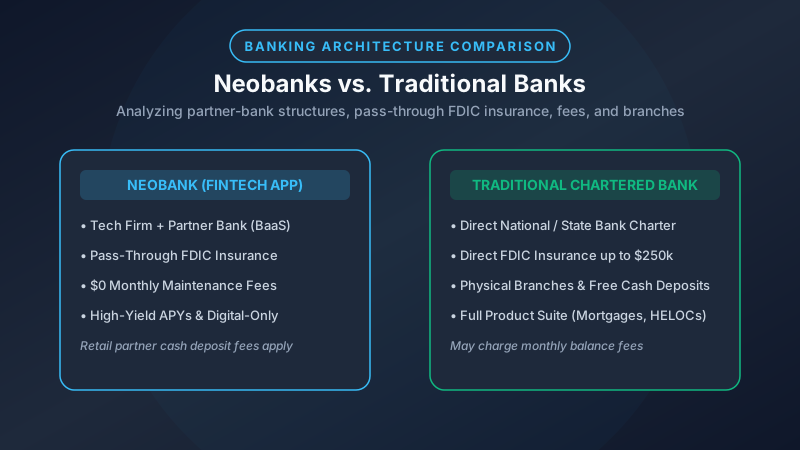
Instead of acquiring their own bank charters (a costly multi-year process), most neobanks operate under a partner-bank model using Banking-as-a-Service (BaaS) infrastructure. In this arrangement, the neobank partners with an established, chartered financial institution—such as The Bancorp Bank, Stride Bank, or Evolve Bank & Trust. The partner bank holds consumer funds, issues debit cards via Visa or Mastercard networks, and maintains regulatory compliance behind the scenes.
2. FDIC Deposit Insurance: Direct vs. Pass-Through Coverage
Deposit safety is a central concern for consumers storing liquid savings. In the United States, deposit accounts at chartered banks are insured up to $250,000 per depositor, per ownership category, by the Federal Deposit Insurance Corporation (FDIC).
-
Traditional Chartered Banks: Deposits held at a chartered bank receive direct FDIC insurance. If the bank fails, the FDIC steps in directly to reimburse insured depositors up to the statutory $250,000 limit.
-
Neobanks (Partner-Bank Model): Consumer deposits at neobanks are held in omnibus or individual accounts at the partner bank, qualifying for pass-through FDIC insurance. If the underlying partner bank fails, pass-through coverage protects consumer funds up to $250,000.
Important Caveat: Middleware Bankruptcy Risks
While pass-through FDIC insurance protects against the failure of the partner bank, it does not automatically cover operational disruptions or insolvency of intermediate middleware technology providers (BaaS platforms).
For example, the bankruptcy of financial technology middleware provider Synapse in 2024 led to frozen accounts for tens of thousands of end-users across multiple neobanks. Because the partner banks and the middleware provider held conflicting ledger records, customer funds were locked for months while reconciliation audits took place—demonstrating that pass-through insurance does not prevent temporary access freezes if ledger systems fail.
3. Physical Branch Access and Cash Deposit Logistics
Another major functional difference lies in physical infrastructure and cash handling:
-
Traditional Banks: Maintain extensive physical branch networks and proprietary ATMs. Customers can visit a branch in person to speak with tellers, deposit physical currency fee-free, obtain notarized documents, purchase cashier's checks, or access safety deposit boxes.
-
Neobanks: Operate entirely without physical branches. While neobanks provide fee-free access to large third-party ATM networks (such as Allpoint or Moneypass for cash withdrawals), depositing physical cash often requires visiting participating retail partner locations (such as Walgreens, CVS, or Walmart) using Green Dot or reLoad networks, which frequently incur third-party deposit fees of $3.95 to $5.95 per deposit.
4. Fee Structures, Yields, and Product Breadth
Neobanks gained massive market share primarily by eliminating traditional banking fees. Because neobanks operate without expensive physical branch real estate, their lower overhead enables distinct pricing advantages:
-
No Monthly Maintenance Fees: Most neobanks offer free checking without requiring minimum daily balances or monthly direct deposits.
-
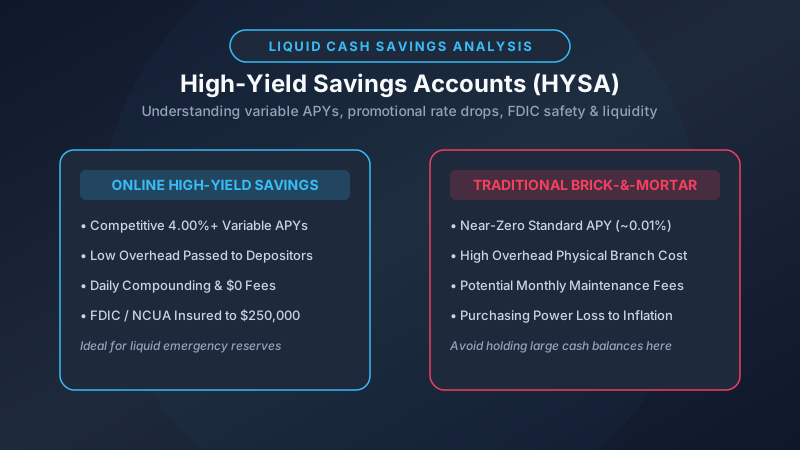
Competitive Interest Rates: Neobanks frequently offer high-yield savings features—building on models explored in high-yield-savings-account-explained—that significantly outpace the near-zero rates of traditional brick-and-mortar megabanks.
-
Fee-Free Overdraft Features: Many neobanks provide spot overdraft cushions (e.g., $20 to $200) without charging traditional $35 fees, contrasting sharply with standard checking-account-fees-explained.
However, traditional banks retain advantages in product breadth. A full-service traditional bank provides a unified ecosystem containing mortgages, home equity lines of credit (HELOCs), auto loans, wealth management, commercial business checking, and international wire transfers—products that stripped-down neobanks rarely support.
5. Security Protocols and Customer Support Responsiveness
Account security and customer support mechanisms differ substantially between these institutional models.
Traditional banks provide multi-channel support, including branch managers, telephone call centers, and secure online messaging. If a traditional bank account is frozen due to fraud detection, a customer can visit a local branch with physical identification to resolve the block immediately.
Neobanks rely primarily on automated in-app chat systems or digital ticketing systems. When automated fraud algorithms freeze a neobank account unexpectedly, resolving the issue digitally without a physical branch to visit can lead to multi-day communication delays.
Comparative Architectural Summary
The table below synthesizes the core differences between neobanks and traditional banks:
| Feature / Dimension | Neobanks (Fintech Apps) | Traditional Commercial Banks |
| :--- | :--- | :--- |
| Legal Charter | Tech company (Partner-bank model) | Holds direct federal/state bank charter |
| FDIC Insurance | Pass-through via partner bank | Direct FDIC coverage up to $250,000 |
| Branch Access | Digital only (No physical branches) | Physical branch networks & in-person tellers |
| Cash Deposits | Retail partners (often $3.95-$5.95 fee)| Fee-free at branch tellers & bank ATMs |
| Monthly Account Fees| Typically $0 without minimums | Often $10-$15 unless waived by deposit |
| Loan Products | Limited (Basic credit building / BNPL)| Full suite (Mortgages, HELOCs, Auto) |
| Support Channels | In-app chat, email, automated phone | In-person, dedicated phone line, chat |
How to Choose the Right Banking Structure
Consumers evaluating where to deposit their money do not have to choose exclusively between the two models. A practical strategy utilized by many household financial planners involves a dual-institution setup:
-
Maintain a secondary checking or high-yield savings account at a reputable digital neobank to enjoy high interest yields, early direct deposit, and zero monthly maintenance fees.
-
Retain a primary account at a local or national traditional bank to preserve access to physical cash deposits, in-person teller support, and complex lending products.
By understanding the partner-bank architecture and pass-through insurance mechanisms behind neobanks, consumers can make informed decisions that optimize financial convenience while safeguarding their liquid assets.
6. Community Reinvestment Act (CRA) and Regional Banking Impact
A key structural difference between traditional chartered banks and digital neobanks involves community lending obligations under federal law.
Traditional chartered banks are bound by the Community Reinvestment Act (CRA) of 1977. The CRA mandates that commercial banks reinvest deposits into local communities where they operate branches, providing small business loans, affordable housing mortgages, and community development financing in low- and moderate-income neighborhoods.
Because digital neobanks operate without physical branch footprints, their partner-bank structures do not bear local CRA obligations in the same direct manner. Consumers who prioritize local economic development often prefer traditional community banks or credit unions, ensuring that local bank deposits directly support regional small business lending and local housing growth.
MoneyTalkin' provides financial education, educational concepts, and general informational guides. Articles do not constitute personalized financial, investment, legal, or tax advice. Financial products, rates, terms, and regulatory rules change frequently; consult a qualified financial professional regarding your specific situation. Read our full Disclaimer Policy.
Written by MoneyTalkin'
MoneyTalkin' researches and publishes objective financial education content, money management fundamentals, and practical financial guides.
Related Technical Articles
Explore related topics in this cluster to deepen your understanding.