Checking Account Fees Explained: Common Charges and How to Avoid Them
A comprehensive guide detailing common checking account fees, fee schedule disclosures, direct deposit waivers, minimum balances, and zero-fee banking choices.
Checking Account Fees Explained: Common Charges and How to Avoid Them
A checking account is the primary transactional hub for personal finances, receiving paychecks via direct deposit and facilitating daily expenses, bill payments, and debit card transactions. However, ancillary banking charges can quietly drain money from your account if you do not understand your bank's fee schedule.
While many institutions advertise "free checking," account agreements often contain conditional fee waivers, minimum balance thresholds, and service charges for specific banking activities.
Understanding how checking account fees operate—including monthly maintenance charges, overdraft fees, ATM surcharges, wire transfer fees, and fee waiver mechanics—helps consumers audit their banking expenses alongside guides on evaluating high-yield savings accounts, exploring money market accounts, and executing a full monthly expense audit.
1. Do All Banks Charge Checking Account Fees?
A common misconception is that all banks charge monthly service fees for maintaining a checking account.
- Institution-Specific Rules: Fee schedules vary significantly across financial institutions.
- Online Banks & Credit Unions: Many online-only banks and community credit unions offer genuinely free checking accounts with zero monthly maintenance fees and no minimum balance requirements.
- Traditional Banks: Large commercial banks frequently assess monthly maintenance fees on basic accounts but provide explicit waiver conditions (such as recurring direct deposits or minimum balance thresholds).
2. Primary Types of Checking Account Fees
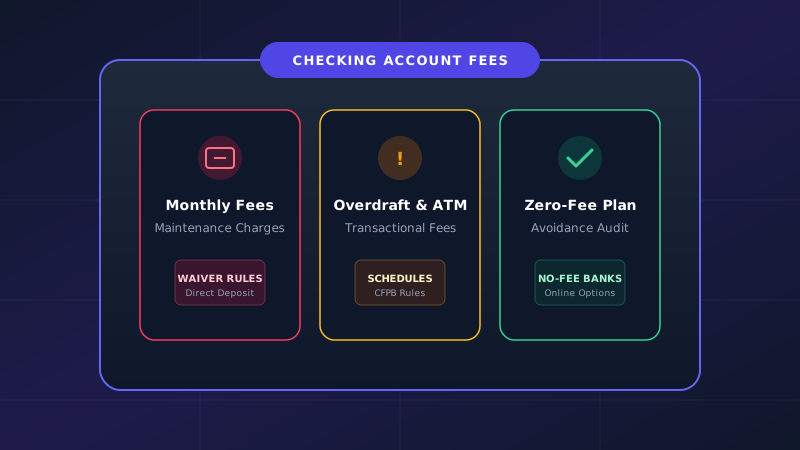
Checking account fees generally fall into three categories: account maintenance fees, transactional fees, and administrative service fees.
A. Monthly Maintenance Fees
A monthly maintenance fee (or service charge) is a recurring fee assessed by a bank for maintaining your checking account.
- Purpose: Banks charge this fee to cover operational costs, customer service, and branch infrastructure.
- Conditional Waivers: Most banks waive the monthly maintenance fee if you meet specific qualifying conditions during each monthly statement cycle (such as maintaining a minimum daily balance or receiving qualifying direct deposits).
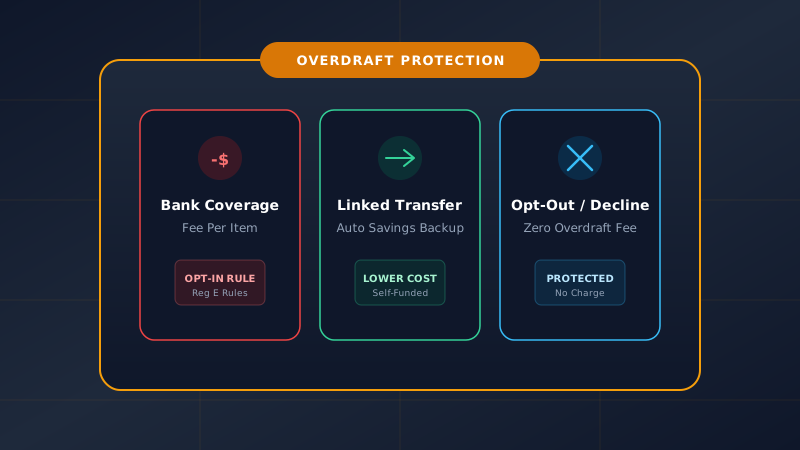
B. Overdraft and Nonsufficient Funds (NSF) Fees
When an account balance lacks sufficient funds to cover a check, recurring payment, or debit transaction:
- Overdraft Fee: Assessed if the bank pays the transaction on your behalf, bringing your account balance negative.
- Nonsufficient Funds (NSF) Fee: Historically assessed if the bank declines the item unpaid. Under Consumer Financial Protection Bureau (CFPB) regulatory guidance, many major U.S. banks have eliminated NSF fees entirely.
Note: Overdraft fees and opt-in rules are governed by federal regulations, and fee amounts vary by institution.
C. ATM Fees (In-Network vs. Out-of-Network)
Using an automated teller machine (ATM) can incur two distinct charges:
- Out-of-Network Bank Fee: Charged by your own bank for using an ATM outside its proprietary network.
- ATM Operator Surcharge: Charged directly by the owner of the third-party ATM.
Fee Reimbursements: Certain online banks and premium checking accounts reimburse out-of-network ATM operator fees up to a monthly dollar cap.
3. Secondary and Administrative Banking Fees
Beyond monthly maintenance and ATM fees, banks assess administrative fees for specialized services:
| Fee Category | Description | How It Is Triggered |
|---|---|---|
| Wire Transfer Fees | Charges for executing electronic funds transfers | Sending or receiving domestic or international wire transfers |
| Cashier's Check / Money Order | Official bank-certified payment documents | Requesting a cashier's check or official money order at a branch |
| Paper Statement Fees | Monthly fee for receiving printed paper mail statements | Opting out of electronic paperless statements |
| Foreign Transaction Fees | Surcharge on international purchases (typically 1% to 3%) | Using a debit card for foreign purchases or overseas online merchants |
| Card Replacement Fees | Fee for replacing lost or stolen debit cards | Requesting expedited replacement debit card delivery |
4. Minimum Balance Requirements Explained
Many traditional checking accounts link fee waivers to account balance minimums. Banks utilize two distinct methods for calculating minimum balances:
A. Minimum Daily Balance
The bank requires your account balance to remain at or above a specified dollar threshold every single day of the statement cycle. If your balance dips below the threshold for even one day, the full monthly maintenance fee is charged.
B. Average Daily Balance
The bank calculates the sum of your end-of-day balances divided by the number of days in the statement cycle. As long as your average balance meets the required threshold, the monthly fee is waived, even if the balance fell below the threshold on individual days.
5. Direct Deposit Fee Waiver Mechanics
For many working adults, establishing a qualifying direct deposit is the easiest way to waive monthly checking account maintenance fees.
What Qualifies as a Direct Deposit?
Under most bank agreements, a qualifying direct deposit includes:
- Automated Clearing House (ACH) salary, wage, or stipend payments from an employer.
- Government benefit payments (such as Social Security, military pension, or tax refunds).
What Does NOT Qualify?
Person-to-person (P2P) transfers, mobile check deposits, cash deposits, or standard ACH transfers initiated from a personal external bank account generally do not qualify as direct deposits for fee-waiver purposes.
6. How to Read a Bank Fee Schedule
Federal regulations, including the Truth in Savings Act (Regulation DD), require banks to provide clear, written fee disclosures when an account is opened.
Key elements of a bank Fee Schedule (Fee Disclosure Document) include:
- Fee Amounts: Explicit listing of every potential account charge.
- Waiver Criteria: Precise quantitative rules required to waive monthly service fees.
- Posting Order Disclosures: Explanation of how the bank processes deposits and debits each business day.
Always review the official Fee Schedule on the bank's website or request a copy at a local branch before opening an account.
7. Practical Checklist to Eliminate Checking Account Fees
To eliminate checking account fees from your monthly budget, follow this practical checklist:
- Review Your Monthly Statements: Inspect your past 3 to 6 bank statements to identify any recurring service charges, ATM fees, or paper statement fees.
- Opt into Paperless Statements: Switch to electronic e-statements to avoid $2 to $5 monthly paper statement fees.
- Verify Direct Deposit Thresholds: Confirm that your direct deposit amount meets your bank's minimum monthly requirement.
- Use In-Network ATMs Only: Use your bank's mobile app to locate free in-network ATMs or select a bank that offers ATM fee reimbursements.
- Decline Unnecessary Add-On Services: Avoid paying for wire transfers or cashier's checks when standard ACH or online bill pay is sufficient.
- Consider Switching to a No-Fee Institution: If your bank refuses to waive monthly fees, switch your primary checking to a reputable online bank or credit union that offers $0 monthly maintenance accounts.
Sources
- Consumer Financial Protection Bureau (CFPB): Checking Accounts & Guide to Bank Fees https://www.consumerfinance.gov/consumer-tools/bank-accounts/
- Federal Deposit Insurance Corporation (FDIC): Truth in Savings Act (Regulation DD) Guidelines https://www.fdic.gov/resources/supervision-and-examinations/consumer-compliance-examination-manual/
- Federal Reserve Board: Consumer Information on Bank Fees & Accounts https://www.federalreserve.gov/
Educational Disclaimer
This guide is for educational purposes only and does not constitute formal financial, legal, or banking advice. Fee schedules, waiver requirements, and account features vary significantly by financial institution and are subject to change. Always review your specific bank's official fee disclosures.
MoneyTalkin' provides financial education, educational concepts, and general informational guides. Articles do not constitute personalized financial, investment, legal, or tax advice. Financial products, rates, terms, and regulatory rules change frequently; consult a qualified financial professional regarding your specific situation. Read our full Disclaimer Policy.
Written by MoneyTalkin'
MoneyTalkin' researches and publishes objective financial education content, money management fundamentals, and practical financial guides.
Related Technical Articles
Explore related topics in this cluster to deepen your understanding.