Money Market Accounts Explained: How They Work, Rates, and Features
A comprehensive guide to Money Market Accounts (MMAs), including interest calculations, debit and check features, minimum balances, and deposit insurance rules.
Money Market Accounts Explained: How They Work, Rates, and Features
A money market account (MMA) is a type of interest-bearing deposit account offered by banks and credit unions. Combining key elements of both traditional savings accounts and checking accounts, money market accounts typically offer competitive interest rates along with limited check-writing privileges and debit card access.
Understanding how a money market account functions—along with its insurance protections, fee structures, and minimum balance requirements—can help account holders determine whether an MMA fits their cash-management strategy alongside options like a high-yield savings account vs. fixed deposit or a dedicated emergency fund.
1. What Is a Money Market Account?
A money market account is an insured bank deposit product designed for holding liquid cash while earning variable interest. Unlike standard checking accounts that primarily facilitate daily transactional spending, money market accounts encourage cash retention by paying interest based on an Annual Percentage Yield (APY).
Money market accounts are offered by chartered commercial banks, online banks, and credit unions. At credit unions, these accounts are often called money market share accounts. Both bank MMAs and credit union money market share accounts function similarly for consumers, providing interest earnings backed by federal deposit insurance.
2. Money Market Account vs. Standard Savings Account
While money market accounts and standard savings accounts share many similarities, they differ in several key features:
- Transactional Access: Standard savings accounts rarely include check-writing capabilities or debit cards. Money market accounts frequently provide checkbooks and debit cards for direct spending or payments.
- Minimum Balance Requirements: Traditional savings accounts often feature low or zero minimum balance thresholds. Money market accounts frequently require higher opening deposits or higher daily balances to earn the top interest rate tier or avoid monthly maintenance fees.
- Tiered Rate Structures: Money market accounts frequently utilize tiered interest structures, where higher account balances earn higher APY rates.
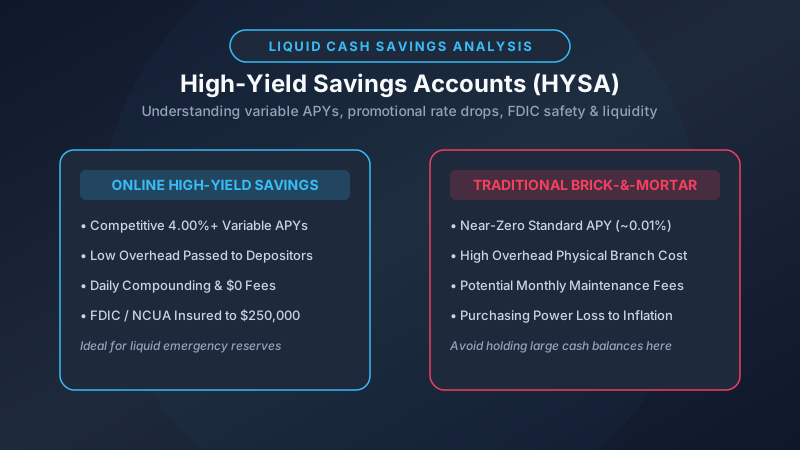
- Interest Rates: Money market accounts do not universally pay higher rates than traditional or high-yield savings accounts. Depending on the financial institution and prevailing market conditions, high-yield savings accounts (HYSAs) may offer comparable or higher APYs than MMAs.
3. Money Market Account vs. Money Market Mutual Fund
A common point of confusion is the distinction between a money market account and a money market mutual fund. Despite their similar names, these are fundamentally different financial products:
| Feature | Money Market Account (MMA) | Money Market Mutual Fund |
|---|---|---|
| Product Type | Bank deposit account | Mutual fund investment security |
| Issuer | Bank or credit union | Brokerage or mutual fund company |
| Insurance Protection | FDIC or NCUA insured | Not FDIC or NCUA insured |
| Principal Risk | Guaranteed principal up to federal limits | Low risk, but principal value can theoretically fluctuate |
| Returns | Declared APY (variable interest rate) | Investment dividend yield based on short-term debt holdings |
| Access | Checks, debit card, online transfer | Brokerage settlement, electronic transfer |
A money market account is a bank deposit insured by the federal government. A money market mutual fund is an investment security holding short-term debt instruments (such as U.S. Treasury bills and commercial paper). While money market mutual funds strive to maintain a stable $1.00 net asset value (NAV), they are not government-insured bank deposits.
4. How Interest and APY Work on Money Market Accounts
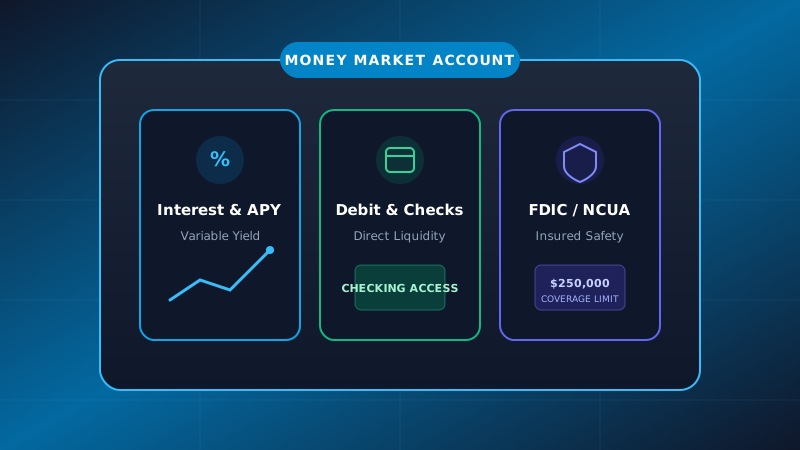
Interest on a money market account is calculated as a variable rate that moves in response to federal benchmark rates, broader economic conditions, and individual bank pricing strategies.
Banks calculate interest daily based on the principal balance and compound it monthly or daily. The Annual Percentage Yield (APY) reflects the total amount of interest earned over a full year, taking into account the compounding frequency.
Tiered APY Structures
Many financial institutions structure money market account rates into tiers. For example:
- Balances under $5,000 may earn a baseline APY.
- Balances between $5,000 and $25,000 may earn an elevated APY tier.
- Balances above $25,000 may qualify for the institution's top rate tier.
Account holders should verify whether an institution requires a specific minimum balance to unlock premium rates or if a flat APY applies across all balance levels.
5. Federal Deposit Insurance Coverage (FDIC & NCUA)
Deposit safety is a primary feature of money market accounts opened at federally insured institutions:
- FDIC Insurance: Deposits at FDIC-insured banks are protected by the Federal Deposit Insurance Corporation (FDIC) up to $250,000 per depositor, per insured bank, for each ownership category.
- NCUA Insurance: Deposits at federally insured credit unions are protected by the National Credit Union Administration (NCUA) through the National Credit Union Share Insurance Fund (NCUSIF) up to $250,000 per member, per credit union, for each ownership category.
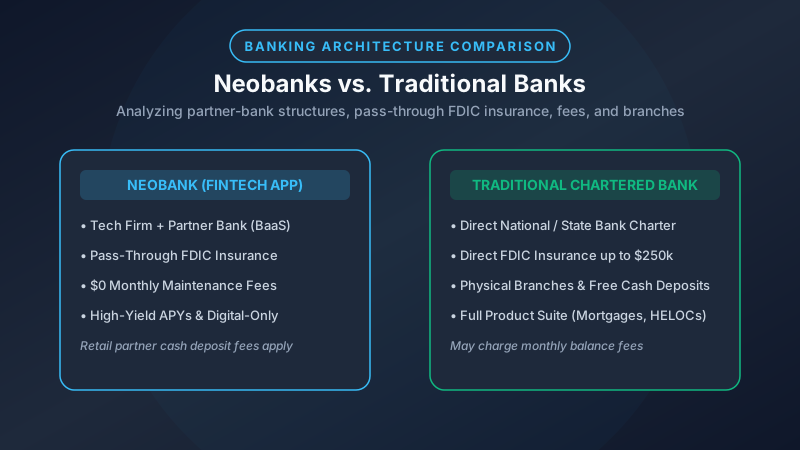
Federal deposit insurance covers principal and accrued interest up to the statutory limit in the event of a bank failure. Readers evaluating digital banks should confirm whether the institution holds a direct bank charter or uses pass-through insurance partners, as detailed in our guide on whether digital neobanks are safe.
6. Withdrawal Limitations and Transaction Features
Historically, federal regulations (specifically Federal Reserve Regulation D) limited convenient withdrawals from savings and money market accounts to six per monthly statement cycle.
In April 2020, the Federal Reserve revised Regulation D to remove the mandatory six-transaction limit, giving financial institutions flexibility in managing account activity. However, banks and credit unions retain the authority to enforce their own monthly transaction limits, charge excess withdrawal fees, or convert accounts that exceed transaction limits into checking accounts.
Common payment and access methods for money market accounts include:
- Debit Card Purchases: Point-of-sale transactions or ATM cash withdrawals.
- Check Writing: Writing physical checks directly against the account balance.
- Electronic Bank Transfers: ACH transfers and online bill payment features.
7. Potential Fees and Minimum Balance Conditions
While money market accounts provide flexibility, account holders should evaluate potential costs:
- Monthly Maintenance Fees: Waived if a minimum daily balance or qualifying direct deposit threshold is maintained.
- Excess Withdrawal Fees: Charged if an account exceeds the institution's monthly transaction limit.
- Paper Statement Fees: Charged if the account holder opts out of paperless electronic statements.
- Below-Minimum Interest Penalties: Dropping below a specified balance threshold may reduce the APY to a nominal rate.
8. Who Should Consider a Money Market Account?
A money market account may be suitable for individuals who:
- Want to earn competitive yield while preserving direct check-writing or debit access.
- Are building or holding a major cash reserve, such as a home down payment or tax allocation.
- Maintain higher cash balances that satisfy minimum balance requirements without triggering maintenance fees.
- Seek government-backed deposit protection backed by the FDIC or NCUA.
Conversely, individuals who require unlimited daily debit transactions may prefer a checking account, while those seeking fixed long-term yields without spending access might evaluate certificates of deposit (CDs).
Sources
- Federal Deposit Insurance Corporation (FDIC): Deposit Insurance Coverage Rules https://www.fdic.gov/resources/deposit-insurance/
- National Credit Union Administration (NCUA): Share Insurance Coverage Overview https://ncua.gov/consumers/share-insurance-coverage
- Board of Governors of the Federal Reserve System: Savings Deposits and Regulation D Amendments https://www.federalreserve.gov/
Educational Disclaimer
This article is for educational and informational purposes only and does not constitute personalized financial, legal, or investment advice. Deposit insurance limits, interest rates, account features, and bank policies vary by institution and are subject to change. Verify terms directly with your financial institution and consult a qualified advisor regarding individual cash management decisions.
MoneyTalkin' provides financial education, educational concepts, and general informational guides. Articles do not constitute personalized financial, investment, legal, or tax advice. Financial products, rates, terms, and regulatory rules change frequently; consult a qualified financial professional regarding your specific situation. Read our full Disclaimer Policy.
Written by MoneyTalkin'
MoneyTalkin' researches and publishes objective financial education content, money management fundamentals, and practical financial guides.
Related Technical Articles
Explore related topics in this cluster to deepen your understanding.