How to Build an Emergency Fund: 3 to 6 Month Savings Blueprint
Learn why an emergency fund is essential, how much to save, where to store your emergency cash, and step-by-step strategies to build it.
How to Build an Emergency Fund: The Definitive 10-to-15 Minute Financial Safety Blueprint
An emergency fund is a dedicated, highly liquid cash reserve maintained specifically to absorb unexpected, urgent financial shocks. Whether confronting sudden job loss, major medical expenses, emergency car repairs, or critical home maintenance, having cash readily accessible prevents individuals from relying on high-interest credit cards, personal loans, or premature retirement account liquidations.
Building a robust emergency fund is universally recognized by financial planners as the fundamental first step in personal finance. Without an emergency cash reserve, even a brief interruption in earned income can cascade into revolving debt, damaged credit scores, and severe long-term financial distress.
Executive Summary: Key Emergency Fund Parameters
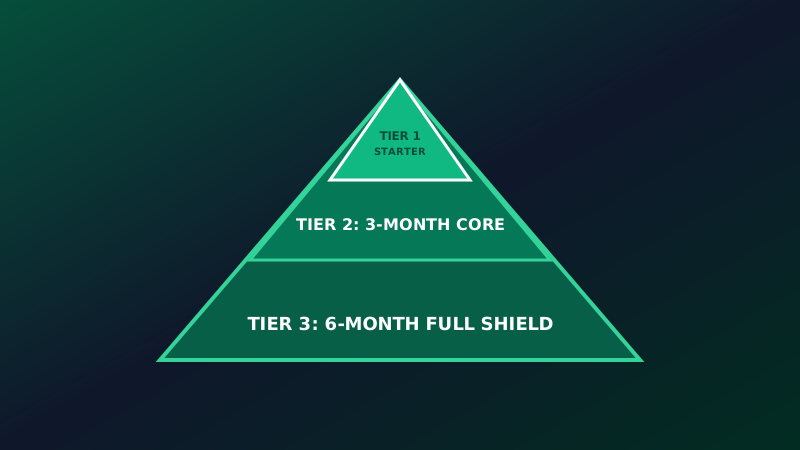
- Target Fund Size: 3 to 6 months of essential living expenses for stable dual-income households; 6 to 12 months for single earners, freelancers, commission-based workers, or those in volatile economic sectors.
- Storage Account Type: High-Yield Savings Accounts (HYSA) or Money Market Accounts (MMA) offering principal stability, FDIC or NCUA insurance, and penalty-free 24-to-48-hour access.
- Strict Usage Criteria: Reserved exclusively for unbudgeted, necessary, and time-sensitive financial emergencies.
- Primary Objective: Capital preservation and immediate liquidity, not wealth accumulation or speculative growth.
Why an Emergency Fund Is Essential for Financial Stability
Without a dedicated liquid cash buffer, unexpected life events force households into reactive decision-making. The primary financial risks of operating without an emergency fund include:
1. High-Interest Debt Accumulation
When unexpected bills arise, individuals without cash reserves frequently charge expenses to credit cards with annual percentage rates (APRs) ranging from 20% to 30%. Paying only minimum balances on these debts compounds interest costs, creating a persistent cycle of monthly debt service that consumes disposable income.
2. Forced Asset Liquidation in Down Markets
Selling investments—such as stocks, mutual funds, or exchange-traded funds (ETFs)—to cover immediate cash needs introduces timing risk. If an emergency occurs during a broader stock market correction, an investor is forced to sell equities at depressed valuations, locking in capital losses and relinquishing future recovery gains.
3. Early Retirement Account Withdrawal Penalties
Withdrawing funds from tax-advantaged accounts like a 401(k) or Traditional IRA prior to age 59½ incurs severe friction. In addition to ordinary income tax liability on the distribution, the IRS imposes a 10% early withdrawal penalty, drastically reducing the net cash received and undermining long-term compounding.
4. Psychological Stress and Decision Fatigue
Financial vulnerability generates chronic stress that negatively impacts personal health, workplace focus, and relationship stability. Maintaining a multi-month cash buffer creates a psychological barrier between daily life and unexpected economic shocks.
Comprehensive Deep-Dive: Calculating Your Target Fund Size
Determining the precise dollar amount required for an emergency fund involves auditing essential household expenses rather than total gross salary.
Step 1: Differentiate Essential vs. Discretionary Expenses
An emergency fund covers baseline survival obligations required to keep your household operational during a crisis:
| Category | Essential Expenses (Include in Target) | Discretionary Expenses (Exclude from Target) |
|---|---|---|
| Housing | Rent or mortgage principal/interest, property tax | Home renovations, high-end decor upgrades |
| Utilities | Electricity, heating fuel, water, basic internet | Premium streaming packages, gaming subscriptions |
| Food & Staples | Basic groceries and essential hygiene items | Restaurant dining, food delivery services |
| Healthcare | Health insurance premiums, vital medications | Elective cosmetic procedures, luxury wellness |
| Transportation | Car payments, minimum fuel, basic auto insurance | Ride-share rides for entertainment |
| Debt Service | Minimum required monthly debt payments | Accelerated principal payoff amounts |
Step 2: Detailed Household Monthly Baseline Scenarios
To demonstrate how baseline requirements vary across real-world situations, consider three distinct household profiles:
Profile A: Single Young Professional in a Medium-Cost City
- Rent & Basic Utilities: $1,400
- Groceries & Essentials: $400
- Transportation (Public Transit & Auto Insurance): $200
- Health Insurance Copays & Prescriptions: $150
- Student Loan Minimum Payment: $150
- Monthly Baseline Essential Expenses: $2,300
- 3-Month Target (Stable Corporate Role): $$2,300 \times 3 = \mathbf{$6,900}$
- 6-Month Target (Single Earner Safety Net): $$2,300 \times 6 = \mathbf{$13,800}$
Profile B: Dual-Income Family with Two Children
- Mortgage (PITI) & Utilities: $2,800
- Groceries, Household Goods & Diapers: $950
- Health Insurance Premiums & Out-of-Pocket Family Fund: $650
- Auto Loans (2 Vehicles), Fuel & Insurance: $850
- Required Minimum Credit Card Payments: $250
- Monthly Baseline Essential Expenses: $5,500
- 3-Month Target (Dual-Income Cushion): $$5,500 \times 3 = \mathbf{$16,500}$
- 6-Month Target (Full Family Protection): $$5,500 \times 6 = \mathbf{$33,000}$
Profile C: Self-Employed Freelancer / Contractor
- Housing & Home Office Utilities Allocation: $1,900
- Groceries & Baseline Supplies: $500
- Private Health Insurance & HSA Funding: $450
- Auto Maintenance & Fuel: $350
- Minimum Debt Obligations: $200
- Monthly Baseline Essential Expenses: $3,400
- 9-Month Target (Variable Income Safety Buffer): $$3,400 \times 9 = \mathbf{$30,600}$
- 12-Month Target (Volatile Economic Sector Protection): $$3,400 \times 12 = \mathbf{$40,800}$
Advanced Analysis: Where to Store Your Emergency Cash
The ideal storage location balances three fundamental attributes: capital preservation (safety), immediate access (liquidity), and yield (interest rate).
                      EMERGENCY CASH STORAGE SPECTRUM
   Low Yield / High Access                      Moderate Yield / High Access
┌─────────────────────────────┐              ┌─────────────────────────────┐
│   Traditional Checking      │              │ High-Yield Savings (HYSA)   │
│ • Instant access            │   ────────►  │ • 4.0% - 5.0% APY           │
│ • Near-zero interest        │              │ • FDIC / NCUA Insured       │
└─────────────────────────────┘              └─────────────────────────────┘
1. High-Yield Savings Accounts (HYSA)
Offered primarily by online FDIC-insured banking institutions, HYSAs pay annual percentage yields (APYs) significantly higher than traditional brick-and-mortar savings accounts. Funds remain fully liquid and protected up to $250,000 per depositor, per insured bank in the United States, or £120,000 per eligible person per firm in the UK under the Financial Services Compensation Scheme (FSCS, effective December 1, 2025).
2. Money Market Accounts (MMA)
Offered by banks and credit unions, MMAs combine interest rates comparable to HYSAs with convenient access features like debit cards or check-writing privileges for immediate crisis payments.
3. Short-Term U.S. Treasury Bills (T-Bills) Ladder
For larger emergency reserves (e.g., $30,000+), laddering 4-week or 8-week U.S. Treasury bills backed by the federal government offers high safety and state/local tax exemption on interest earnings, while maintaining rolling monthly liquidity.
Vehicles to Avoid for Emergency Cash
- Equities & Stock Funds: Market volatility risks 20% to 40% capital drops right when recessions occur.
- Long-Term CDs: Early redemption penalties forfeit interest when funds are needed urgently.
- Cryptocurrency or Illiquid Real Estate: High price volatility and conversion delays violate core safety rules.
Step-by-Step Blueprint to Build Your Reserve
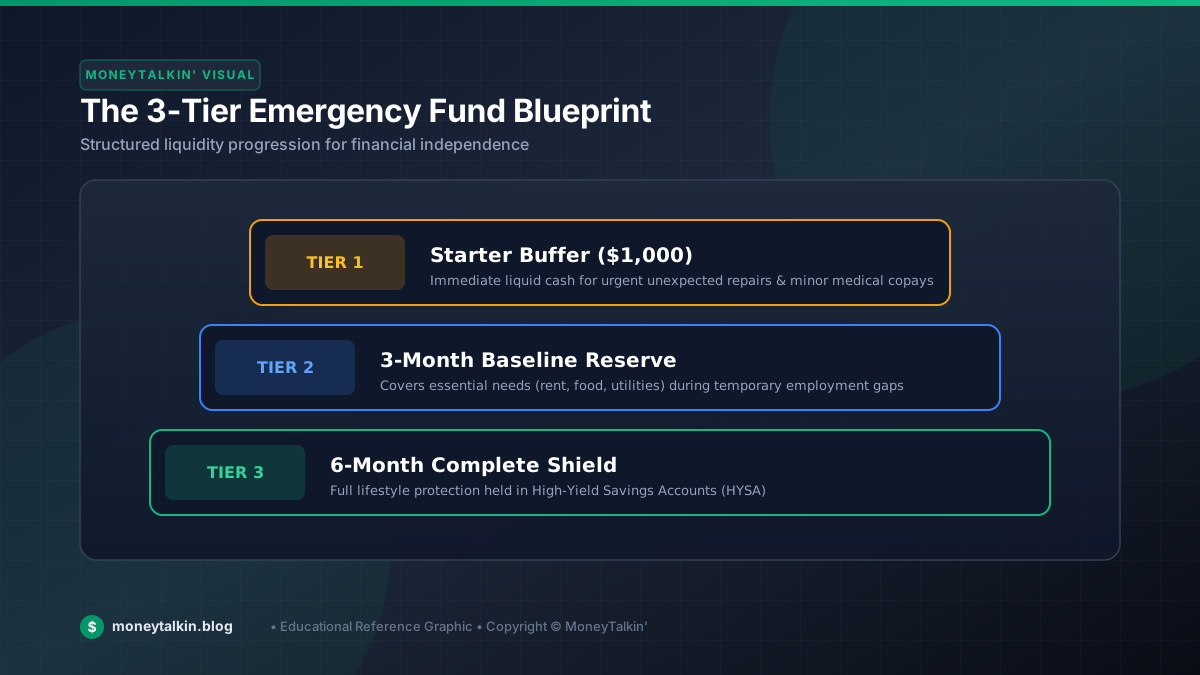
Building a multi-thousand-dollar fund requires a structured, multi-phase execution plan:
- Phase 1: Build a $1,000 Starter Buffer (30–60 Days):
Focus aggressively on accumulating an initial $1,000 reserve to absorb minor unexpected expenses like flat tires or small medical copays. - Phase 2: Audit Expenses & Eliminate Leakage:
Review 90 days of transaction statements. Cancel unused subscriptions and redirect discretionary spending directly into your emergency fund. - Phase 3: Automate Recurring Payday Direct Transfers:
Set up an automatic direct deposit or bank transfer on payday so a set portion of earnings goes straight to your HYSA before reaching your spending account. - Phase 4: Channel Lump-Sum Windfalls:
Direct annual work bonuses, tax refunds, or cash gifts directly into your emergency fund to accelerate progress. - Phase 5: Re-evaluate Annually:
Recalculate your emergency fund target whenever major life changes occur (e.g., mortgage adjustment, marriage, birth of a child, or career change).
Psychological Strategies & Behavioral Guardrails
Establishing an emergency fund is as much a behavioral challenge as a financial calculation. To maintain momentum and avoid tapping the fund inappropriately, implement these strategies:
- Separate Account Friction: Keep your emergency cash at a separate bank from your primary checking account. Adding a 24-hour transfer delay reduces impulse spending.
- Define a "True Emergency": Establish written rules. A true emergency is unplanned, necessary, and urgent. Planned annual expenses (such as car insurance or holiday travel) belong in sinking funds, not emergency accounts.
- Replenishment Discipline: If you must use a portion of your emergency fund, pause extra retirement or debt principal payments until the core cash reserve is restored to its full benchmark.
Common Emergency Fund Pitfalls
- Confusing Expected Costs with Emergencies: Annual vehicle registration or holiday gifts are predictable expenses that belong in sinking funds, not emergency accounts.
- Chasing Returns over Liquidity: Moving emergency cash into volatile assets to earn higher returns undermines the core purpose of financial protection.
- Over-funding Beyond Reasonable Needs: Keeping more than 12 months of expenses in cash creates purchasing power loss to inflation. Excess capital beyond emergency thresholds should be invested in growth assets.
Practical Takeaway Checklist
- Audit bank statements to isolate monthly essential baseline costs.
- Determine your target months (3, 6, or 12) based on your income vulnerability.
- Open an FDIC- or NCUA-insured High-Yield Savings Account.
- Establish automated recurring transfers on every payday.
- Establish strict rules with family members on what qualifies as a genuine emergency.
Sources
- Federal Deposit Insurance Corporation (FDIC): Deposit Insurance Coverage Rules
https://www.fdic.gov/resources/deposit-insurance/ - Consumer Financial Protection Bureau (CFPB): Building an Emergency Reserve Guide
https://www.consumerfinance.gov/consumer-tools/save/ - Federal Reserve Board: Report on the Economic Well-Being of U.S. Households
https://www.federalreserve.gov/publications/household-well-being.htm
Disclaimer
This guide is provided for educational purposes only and does not constitute individual financial, investment, or legal advice. Consult a certified financial planner (CFP) or tax professional to evaluate your personal situation.
If preparing for career disruption, see our Financial Survival Guide After a Layoff.
MoneyTalkin' provides financial education, educational concepts, and general informational guides. Articles do not constitute personalized financial, investment, legal, or tax advice. Financial products, rates, terms, and regulatory rules change frequently; consult a qualified financial professional regarding your specific situation. Read our full Disclaimer Policy.
Written by MoneyTalkin'
MoneyTalkin' researches and publishes objective financial education content, money management fundamentals, and practical financial guides.
Related Technical Articles
Explore related topics in this cluster to deepen your understanding.