High-Yield Savings Accounts vs. Fixed Deposits: Where to Hold Cash
Compare high-yield savings accounts and fixed deposits (CDs) on liquidity, interest rates, inflation risks, and capital preservation.
High-Yield Savings Accounts vs. Fixed Deposits: Where to Hold Cash
Choosing the right storage vehicle for cash reserves is a critical financial decision. Investors and savers seeking capital preservation face a common dilemma: should cash be placed in a High-Yield Savings Account (HYSA) or locked into a Fixed Deposit (FD) / Certificate of Deposit (CD)?
Both instruments offer exceptional safety, backed by government deposit insurance in major financial jurisdictions (such as FDIC insurance in the United States or FSCS protection in the United Kingdom). However, they differ fundamentally in liquidity, interest rate stability, and withdrawal flexibility.
Executive Summary: Comparative Matrix
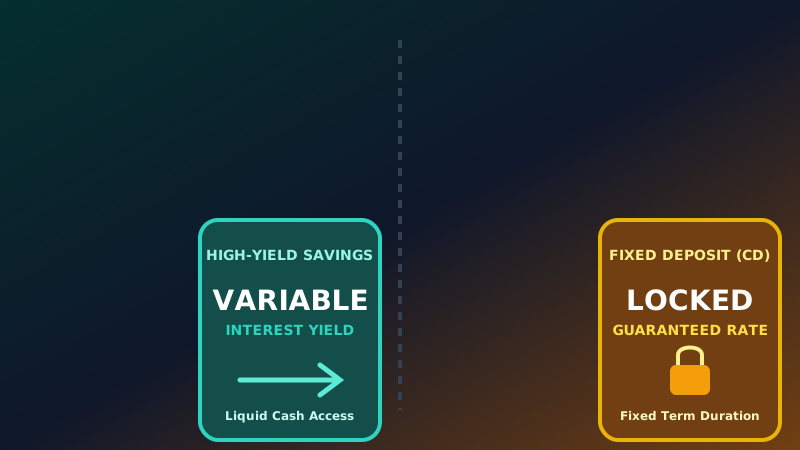
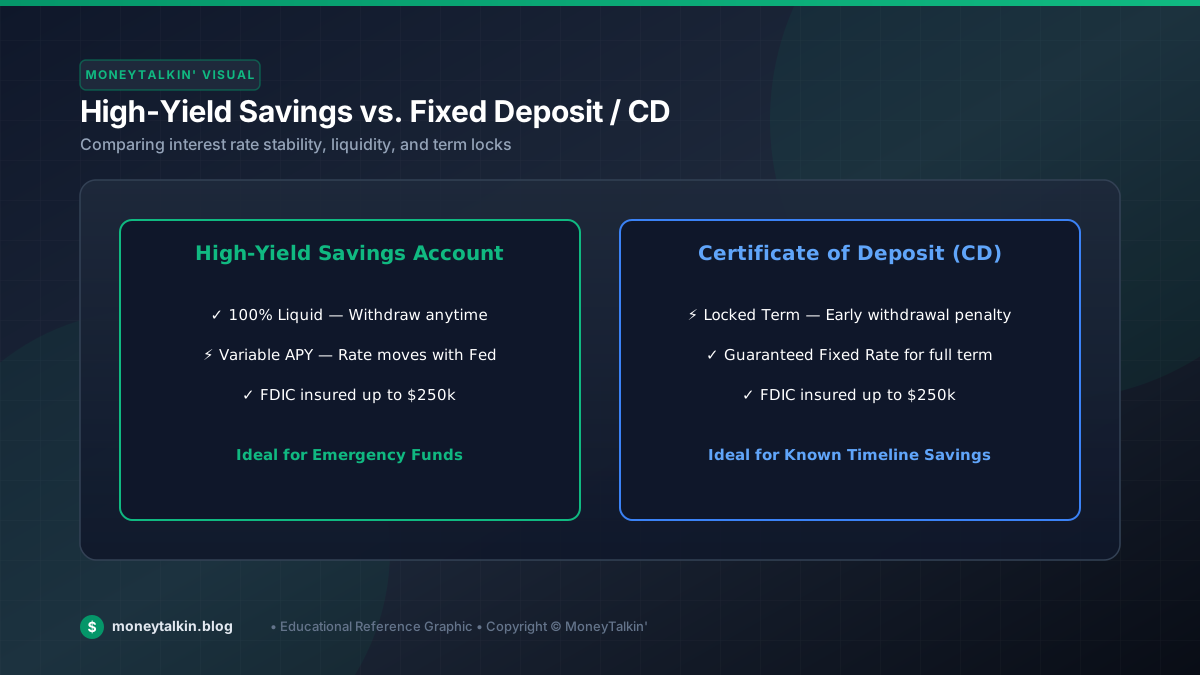
- High-Yield Savings Account (HYSA): Variable interest rate, 100% liquid, penalty-free access, ideal for emergency funds and short-term goals.
- Fixed Deposit (FD) / Certificate of Deposit (CD): Fixed guaranteed interest rate, locked time horizon (e.g., 6 to 60 months), early withdrawal penalty, ideal for known future purchases.
- Deposit Insurance: Both offer federal insurance up to $250,000 per depositor per bank in the US (FDIC) and £120,000 in the UK (FSCS, effective Dec 1, 2025).
Detailed Comparison of Features
| Feature | High-Yield Savings Account (HYSA) | Fixed Deposit / Certificate of Deposit (CD) |
|---|---|---|
| Interest Rate Structure | Variable (shifts with central bank benchmark rates) | Fixed (guaranteed rate locked for full term) |
| Liquidity & Access | Full 24-to-48-hour access, penalty-free withdrawals | Locked capital; early withdrawal incurs penalty |
| Term Length | Indefinite / No lock-in period | Fixed terms (3, 6, 12, 24, 36, or 60 months) |
| Rate Risk | Exposure to falling interest rates | Protected against falling interest rates |
| Opportunity Risk | Can benefit if central banks raise rates | Cannot capture higher rates if market yields rise |
| Best Use Case | Emergency funds, short-term savings (<1 year) | Planned purchases with fixed dates (1–5 years) |
How High-Yield Savings Accounts Work
A High-Yield Savings Account is a savings product offered primarily by online banks and credit unions that pay interest significantly higher than traditional brick-and-mortar financial institutions.
Advantages of HYSAs
- Uncompromised Liquidity: You can deposit or withdraw cash at any time without paying early termination fees.
- Rate Upside Potential: When central banks increase interest rates to combat inflation, HYSA yields rise automatically.
- Compound Interest Accrual: Interest typically compounds daily and credits monthly, compounding yield over time.
Disadvantages of HYSAs
- Variable Rate Volatility: If central banks cut benchmark interest rates, your HYSA interest yield will decrease automatically without advance warning.
How Fixed Deposits / Certificates of Deposit Work
A Fixed Deposit (commonly referred to as a Certificate of Deposit or CD in the US) is a financial contract in which a saver agrees to leave a specified sum of money on deposit with a bank for a fixed duration in exchange for a guaranteed interest rate.
                 FIXED DEPOSIT (CD) LADDERING STRATEGY
┌────────────────┐     ┌────────────────┐     ┌────────────────┐     ┌────────────────┐
│  1-Year CD     │     │  2-Year CD     │     │  3-Year CD     │     │  4-Year CD     │
│  Matures Yr 1  │     │  Matures Yr 2  │     │  Matures Yr 3  │     │  Matures Yr 4  │
└────────────────┘     └────────────────┘     └────────────────┘     └────────────────┘
Advantages of Fixed Deposits
- Guaranteed Rate Lock: Your interest rate cannot decrease during the agreed term, regardless of broader economic downturns or central bank rate cuts.
- Discipline Enforcement: The early withdrawal penalty deters impulsive spending of long-term savings.
Disadvantages of Fixed Deposits
- Illiquidity Penalty: Withdrawing cash before the maturity date incurs a penalty, often forfeiting 3 to 6 months of earned interest.
- Reinvestment Risk: When the CD matures, prevailing market interest rates may be lower than your original locked rate.
Practical Mathematical Example
Suppose an investor has $20,000 in cash earmarked for a home down payment needed in exactly 2 years. They evaluate two options:
- Option A (HYSA): Initial rate of 4.50% APY. However, central banks cut rates by 1.00% in Year 2, resulting in an average 2-year yield of 4.00%.
- Option B (2-Year CD): Guaranteed rate of 4.65% APY locked for the entire 24-month term.
Mathematical Comparison
$$\text{Option A (HYSA Yield): } $20,000 \times (1 + 0.04)^2 = $21,632$$ $$\text{Option B (2-Year CD Yield): } $20,000 \times (1 + 0.0465)^2 = $21,903.62$$
Outcome: By locking in the guaranteed CD rate, the investor earns an additional $271.62 in risk-free interest while guaranteeing exact timing for their home purchase.
The CD Laddering Framework for Blended Liquidity
To combine the high interest lock of CDs with regular cash liquidity, investors implement a CD Ladder:
- Divide $10,000 into four equal portions of $2,500.
- Open four CDs with staggered maturities: 3 months, 6 months, 9 months, and 12 months.
- As each CD matures every 3 months, reinvest the capital into a new 12-month CD at prevailing interest rates.
- Result: You achieve the higher yield of a 12-month CD while maintaining penalty-free access to 25% of your capital every 90 days.
Strategic Verdict: How to Allocate Between Both
- Keep in HYSA: Emergency funds (3–6 months of expenses), upcoming taxes, vehicle maintenance reserves, and general short-term cash needs.
- Keep in Fixed Deposits / CDs: Savings for planned, non-negotiable expenses with fixed future dates 1 to 5 years away (e.g., wedding expenses, home down payment, major anniversary trip).
Sources
- Federal Deposit Insurance Corporation (FDIC): Deposit Insurance & Bank Rates
https://www.fdic.gov/resources/deposit-insurance/ - Bank of England / FSCS: UK Deposit Protection Information
https://www.fscs.org.uk/
Disclaimer
This material is provided for educational purposes only and does not constitute formal financial advice. Consult a qualified professional before making financial decisions.
Tax Considerations & Rate Adjustment Triggers
When choosing between High-Yield Savings Accounts and fixed Certificates of Deposit, savers must factor in tax policy and market interest rate dynamics:
- Taxation of Interest Income: Interest earned from both HYSAs and CDs is taxed by the IRS as ordinary income in the year it is earned, reported on Form 1099-INT. High-yielding cash holdings should be evaluated on an after-tax basis.
- Federal Reserve Trigger Mechanism: High-yield savings APYs adjust dynamically when the Federal Reserve modifies its target federal funds rate range. When central bank rate cuts occur, HYSA yields drop quickly, whereas active CD rates remain locked until maturity.
Review detailed deposit rate dynamics in high yield savings rising rate environment.
Educational Summary & Key Definitions
Understanding financial fundamentals requires mastering core vocabulary and operational definitions:
- Principal: The original amount of money deposited or borrowed, excluding interest earnings or finance charges.
- Annual Percentage Yield (APY): The real rate of return earned on a deposit account, taking into account the effect of compounding interest over a 12-month period.
- Liquidity: The ease and speed with which an asset can be converted into liquid cash without incurring significant capital loss.
- Diversification: An investment risk management strategy that mixes a wide variety of investments within a portfolio to limit exposure to any single asset class.
Consulting official regulatory guidelines—such as disclosures from the CFPB, FDIC, NCUA, and Federal Reserve—ensures you make informed financial decisions backed by verified consumer protections.
MoneyTalkin' provides financial education, educational concepts, and general informational guides. Articles do not constitute personalized financial, investment, legal, or tax advice. Financial products, rates, terms, and regulatory rules change frequently; consult a qualified financial professional regarding your specific situation. Read our full Disclaimer Policy.
Written by MoneyTalkin'
MoneyTalkin' researches and publishes objective financial education content, money management fundamentals, and practical financial guides.
Related Technical Articles
Explore related topics in this cluster to deepen your understanding.