Stablecoins vs. Bank Deposits: What's the Difference?
A plain-language comparison of private stablecoins versus insured bank deposits, evaluating deposit insurance, legal protections, custody, and risks.
Stablecoins vs. Bank Deposits: What's the Difference?
As digital currencies become more prominent, consumers frequently encounter digital dollar tokens known as what-are-stablecoins alongside traditional bank checking and savings accounts. While both instruments display dollar balances and facilitate transactions, their legal foundations, financial protections, underlying rails, and risk profiles differ fundamentally.
Describing stablecoins as "digital dollars" can create misleading assumptions regarding safety. This article compares stablecoins and commercial bank deposits across key financial and regulatory dimensions.
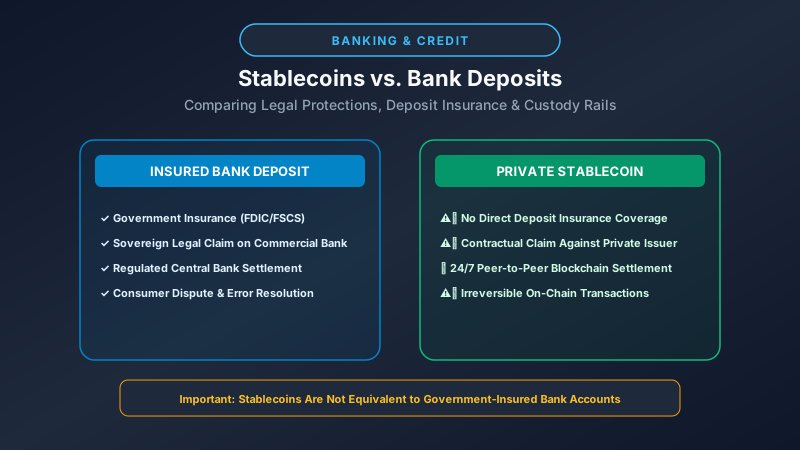
1. Structural Comparison: Bank Deposits vs. Private Stablecoins
Insured Bank Deposit:
Depositor ──► Commercial Bank ──► Sovereign Legal Claim ──► Government Insurance Shield (FDIC/FSCS)
Private Stablecoin:
Token Holder ──► Issuer Reserves ──► Private Contractual Claim ──► Public Blockchain Settlement
(No Direct Sovereign Insurance Shield)
| Comparative Feature | Commercial Bank Deposit | Private Stablecoin Token |
|---|---|---|
| Legal Status | Direct liability of a licensed commercial bank; legal tender money unit. | Private contractual claim against a non-bank token issuer. |
| Deposit Insurance | Statutory government coverage (e.g., $250,000 FDIC / £85,000 FSCS). | No sovereign deposit insurance protection for token holders. |
| Issuer Oversight | Comprehensive prudential regulation and central bank reserve access. | Varies by jurisdiction; evolving stablecoin licensing frameworks. |
| Settlement Rails | Central bank clearinghouses (Fedwire, ACH, SEPA, Faster Payments). | Public or private blockchain networks (24/7 peer-to-peer). |
| Transaction Recourse | Consumer dispute protections, error resolution, and fraud chargebacks. | Irreversible on-chain transactions; no centralized chargeback mechanism. |
| Interest / Yield | Banks may pay interest (e.g., High-Yield Savings Accounts). | Fiat-backed stablecoin issuers generally do not pay interest directly to holders. |
2. Deposit Insurance and Legal Claims
The most critical distinction between bank deposits and stablecoins lies in sovereign protection and bankruptcy priority:
Insured Commercial Bank Deposits
When you deposit cash into a regulated commercial bank account, your deposit represents a direct claim on that institution. If the bank becomes insolvent, sovereign deposit insurance programs guarantee your principal up to statutory limits regardless of the bank's asset liquidation timeline. Learn more about bank safety frameworks in are-digital-neobanks-safe.
Stablecoin Redemption Claims
Holding a stablecoin token gives you a digital token whose issuer promises 1:1 redemption for fiat currency under its terms of service. However:
- No Direct Government Protection: If the issuer, its reserve custodian, or its reserve bank fails, government deposit schemes do not cover stablecoin holders directly.
- Bankruptcy Priority Uncertainty: In a corporate insolvency event, token holders may be classified as unsecured creditors, subjecting recovery to protracted legal proceedings.
3. Settlement Rails and Accessibility
While bank accounts excel in legal safety, stablecoin rails offer distinct technological features:
                  ┌── Bank Deposits: High Legal Protection / Regional Operating Hours
Payment Tradeoff ─┤
                  └── Stablecoins: Global 24/7 Settlement / Higher Counterparty Risk
- Operating Hours: Traditional interbank wire clearing systems operate primarily during business hours on weekdays. Stablecoin networks operate continuously 365 days a year.
- Cross-Border Transfer: Moving money internationally through traditional bank correspondent networks can take days and incur intermediary fees. Stablecoins settle across borders in minutes on public blockchain ledgers. See stablecoins-cross-border-payments.
- Programmability: Stablecoins can interact directly with automated smart contracts and decentralized protocols without requiring manual bank authorization.
4. Key Takeaways
- Stablecoins and bank deposits serve different functions with completely different legal risk profiles.
- Bank deposits feature government deposit insurance and consumer error resolution rights.
- Stablecoins are private digital tokens that carry no direct sovereign deposit guarantees.
- Stablecoins offer 24/7 global settlement advantages but introduce issuer credit, custody, and depegging risks.
5. Frequently Asked Questions
Are stablecoins safe for holding long-term emergency savings?
Financial planners generally recommend keeping emergency reserves in FDIC-insured (or local equivalent) bank accounts or Treasury instruments. Stablecoins carry issuer, depegging, and custody risks that make them unsuitable as substitutes for insured emergency cash reserves.
How do Central Bank Digital Currencies (CBDCs) fit into this picture?
CBDCs represent official digital money issued directly by a central bank, combining digital rails with direct sovereign backing. Compare all three money types in cbdcs-vs-stablecoins-vs-cryptocurrency.
Educational Disclaimer
This article is provided strictly for educational purposes. MoneyTalkin' does not offer banking, investment, or legal services. Stablecoins are not insured bank deposits and carry risk of loss. Always consult a qualified professional before making banking or capital allocation decisions.
MoneyTalkin' provides financial education, educational concepts, and general informational guides. Articles do not constitute personalized financial, investment, legal, or tax advice. Financial products, rates, terms, and regulatory rules change frequently; consult a qualified financial professional regarding your specific situation. Read our full Disclaimer Policy.
Written by MoneyTalkin'
MoneyTalkin' researches and publishes objective financial education content, money management fundamentals, and practical financial guides.
Related Technical Articles
Explore related topics in this cluster to deepen your understanding.