High-Yield Savings Accounts in a Changing Rate Environment: What to Watch
High-Yield Savings Accounts offer variable APYs that respond to central bank policy. Discover how to evaluate yield changes, fine print, and safety.
High-Yield Savings Accounts in a Changing Rate Environment: What to Watch
High-Yield Savings Accounts (HYSAs) have become a cornerstone of modern cash management, emergency reserve planning, and short-term capital storage for millions of American households. Offered primarily by federally insured online banking institutions, these accounts yield significantly higher Annual Percentage Yields (APYs) than traditional brick-and-mortar deposit accounts.
However, as macroeconomic conditions and Federal Reserve policy benchmarks evolve—as evidenced by national banking industry data collected as of September 2026—savers must understand that HYSA yields are inherently variable. Advertised rates can change rapidly, and headline APYs are only one factor to evaluate when selecting a deposit institution.
1. What Is a High-Yield Savings Account?
A High-Yield Savings Account functions conceptually like a standard savings account: it keeps your cash fully liquid, permits regular deposits and withdrawals, and protects account principal up to statutory federal limits.
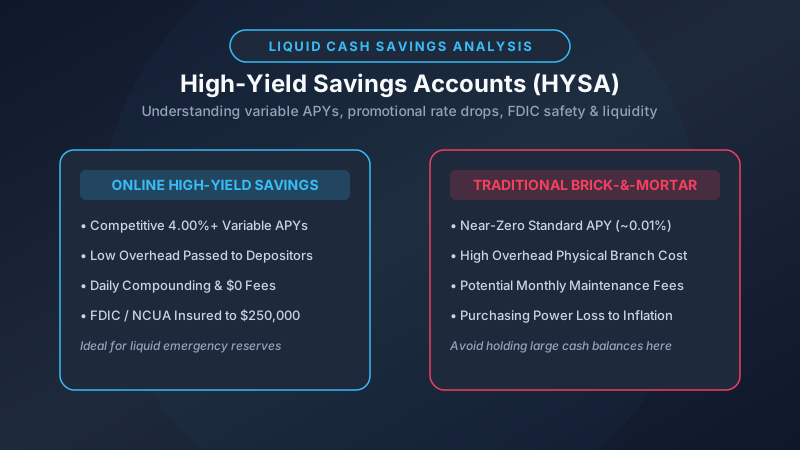
The primary distinction lies in the interest rate paid. While traditional branch-based mega-banks frequently pay nominal interest rates close to 0.01% APY, online financial institutions pass along higher yields due to lower operational overhead (e.g., no physical branch network leases or branch staffing costs).
The Core Characteristic: Variable APY
Unlike fixed-rate deposit products like Certificates of Deposit, a High-Yield Savings Account features a variable rate.
- The financial institution retains full contractual discretion to raise or lower the account's APY at any time without advance notice.
- If benchmark interest rates rise, online banks often increase HYSA APYs to attract core deposit growth.
- If central bank rates decline, online banks typically cut advertised savings APYs to preserve net interest margins.
Understanding how yield compounding functions—as outlined in our guide to APY vs. interest rate explained—helps depositors evaluate real annual earnings accurately.
2. How Central Bank Rates Drive HYSA APYs
Online savings APYs move in general alignment with the Federal Funds Rate—the benchmark interest rate commercial banks charge each other for overnight loans.
Federal Reserve FOMC Policy Decision
                 │
                 ▼
Federal Funds Target Rate Range Adjustments
                 │
                 ▼
Interbank Lending Rates & Treasury Yield Shifts
                 │
                 ▼
Online Banks Adjust Variable HYSA APYs (Up or Down)
When the Federal Reserve adjusts its monetary target range:
- Upward Rate Adjustments: Competition among online institutions drives HYSA APYs upward as banks seek core deposit capital.
- Downward Rate Adjustments: Online banks quickly reduce savings yields to manage interest expense.
Because APYs are not locked, an account advertising a top-tier 4.50% or 5.00% APY today may adjust downward to 3.50% or lower if central bank benchmark rates decline over subsequent months.
3. Fine Print to Evaluate Beyond Headline APY
While comparing advertised APYs is a natural starting point, savers should scrutinize account terms to avoid hidden fees or restrictive yield conditions.
| Account Feature | What to Look For | Potential Risk |
|---|---|---|
| Promotional Rate Tiering | High APY valid for limited time (e.g., 3 months) | Rate drops significantly after promo period ends |
| Balance Cap Limitations | High APY paid only on balances up to $5,000 | Balances above threshold earn baseline low rate |
| Minimum Balance Requirements | Account fee charged if balance falls below threshold | Fees can offset monthly interest earnings |
| Maintenance Fees | Monthly service charges | Reduces net return on cash holdings |
| Transfer Limits & Delays | External ACH transfer processing times (1-3 days) | Slower access to emergency funds |
Teaser & Promotional Rates
Some institutions advertise high headline APYs that incorporate temporary promotional bonuses or require complex referral activity. Once the promotional window closes, the account defaults to a standard variable rate that may be lower than competing online banks.
Tiered APYs
Other accounts pay top-tier rates only on specified balance tiers (for example, 5.00% on the first $10,000, and 0.50% on all funds exceeding $10,000). Always check how your specific account balance will be credited.
4. Operational & Liquidity Rules: What Depositors Should Know
To manage cash effectively in a high-yield account, depositors must understand operational access mechanisms.
Federal Reserve Regulation D and Transfer Limits
Historically, Federal Reserve Regulation D limited monthly convenience withdrawals from savings accounts to a maximum of six per monthly statement cycle. While the central bank suspended enforcement of the strict six-withdrawal limit, individual financial institutions maintain the contractual right to enforce withdrawal limits, assess excess transaction fees, or convert over-drawn savings accounts into checking accounts.
Checking Account Integration & ACH Speeds
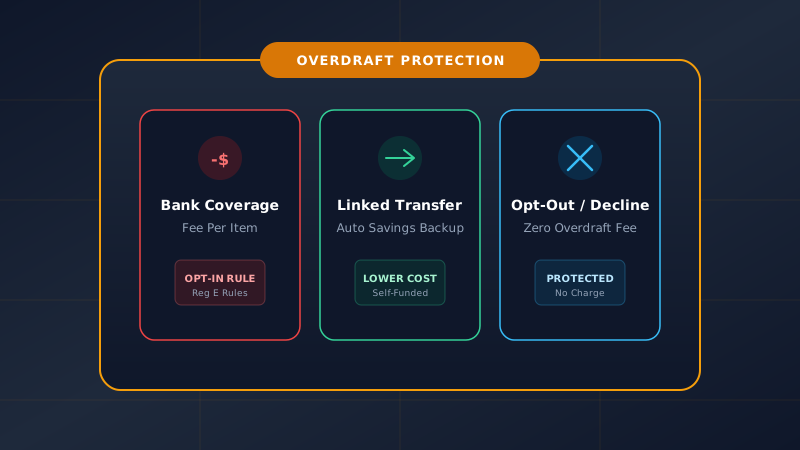
Unlike standard checking accounts, HYSAs rarely provide physical checkbooks or paper debit cards. Transferring funds between an online HYSA and a traditional primary checking account relies on Automated Clearing House (ACH) transfers, which typically take 1 to 3 business days to clear unless real-time payment processing is supported. Reviewing our guide on checking account fees explained helps ensure smooth integration between savings and transactional accounts.
5. Tax Treatment of Savings Interest Income
A frequently overlooked aspect of high-yield savings accounts is the tax treatment of interest earnings:
- Ordinary Income Tax: Interest earned from bank savings accounts is treated as ordinary income by the IRS and state tax authorities, not as lower-taxed capital gains.
- Form 1099-INT: Financial institutions issue a Form 1099-INT to account holders who earn $10 or more in interest during the calendar year.
- Impact of High Yields: When savings yields hover near 4% to 5%, an account holder maintaining $50,000 in cash generates $2,000 to $2,500 in annual taxable interest. Depending on your marginal tax bracket (e.g., 22% or 24%), federal and state taxes reduce your net real yield.
Comparing taxable interest against tax-exempt alternatives—such as U.S. Treasury securities—is a vital step for high-income earners.
6. Federal Deposit Protection: FDIC vs. NCUA
Safety of principal is paramount for cash reserves and emergency funds.
- FDIC Insurance: Deposit accounts at insured commercial banks are protected up to $250,000 per depositor, per insured institution, for each ownership category.
- NCUA Insurance: Equivalent high-yield savings accounts at federally insured credit unions (often called Share Savings Accounts) are protected up to $250,000 by the National Credit Union Share Insurance Fund.
Fintech "Partner Bank" Models
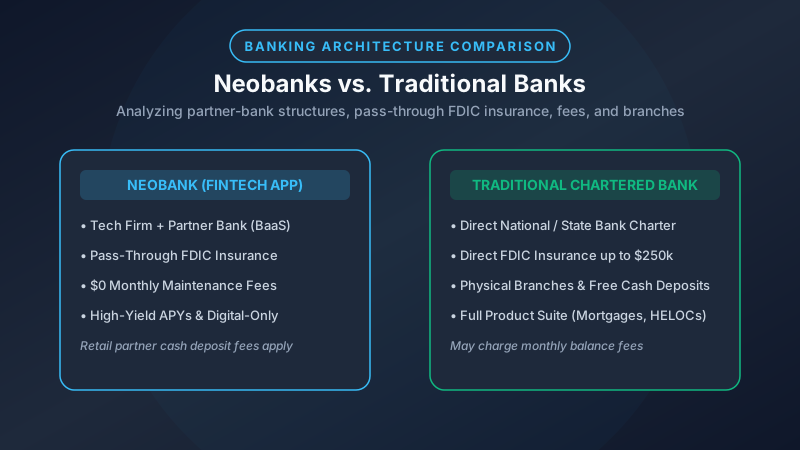
Many modern financial technology companies (fintechs) offer high-yield cash accounts. Fintechs themselves are generally not banks. Instead, they partner with program banks that hold customer deposits.
If using a fintech cash app:
- Verify that your deposits are passed through to an insured partner bank.
- Confirm that FDIC coverage applies on a "pass-through" basis to individual account holders in the event of fintech or bank failure.
7. HYSA vs. Alternative Liquid Vehicles
To build an optimal cash allocation strategy, compare HYSAs against other low-risk liquid options:
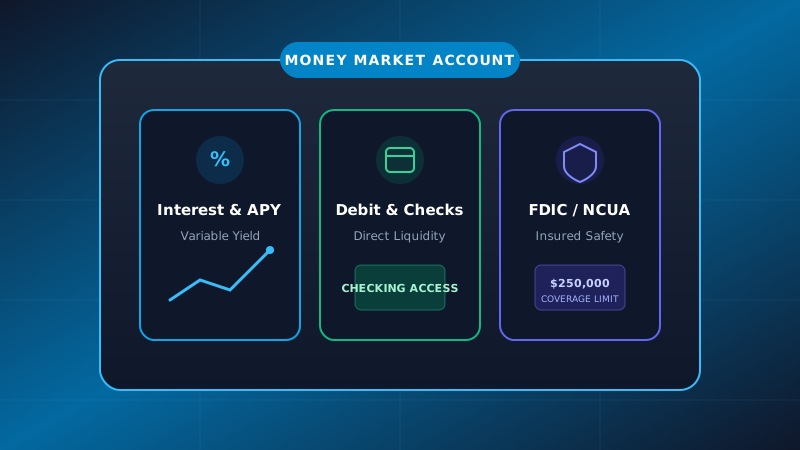
- Money Market Accounts (MMAs): Similar to HYSAs, but often include check-writing privileges or debit card access. See money market accounts explained.
- Emergency Fund Allocation: HYSAs serve as ideal storage vehicles for liquid emergency reserves. Read our guide on emergency fund amount explained to structure your liquidity buffer appropriately.
- Short-Term Treasury Bills: Government-backed securities offering state-tax-exempt yields. Compare options in our detailed guide to bank CD vs Treasury bills.
Practical Checklist for High-Yield Savers
- Verify Federal Insurance: Confirm the bank or credit union is listed in the official FDIC BankFind or NCUA Research directory.
- Audit Fees: Select accounts with zero monthly maintenance fees and no minimum balance penalties.
- Monitor Rate Adjustments: Track APY changes periodically to ensure your institution remains competitive relative to broader market benchmarks.
MoneyTalkin' provides financial education, educational concepts, and general informational guides. Articles do not constitute personalized financial, investment, legal, or tax advice. Financial products, rates, terms, and regulatory rules change frequently; consult a qualified financial professional regarding your specific situation. Read our full Disclaimer Policy.
Written by MoneyTalkin'
MoneyTalkin' researches and publishes objective financial education content, money management fundamentals, and practical financial guides.
Related Technical Articles
Explore related topics in this cluster to deepen your understanding.