APY vs. Interest Rate: What Is the Difference?
An educational guide explaining the difference between simple interest rate and APY, the compounding mechanism, bank fee impacts, and how to evaluate savings products.
APY vs. Interest Rate: What Is the Difference?
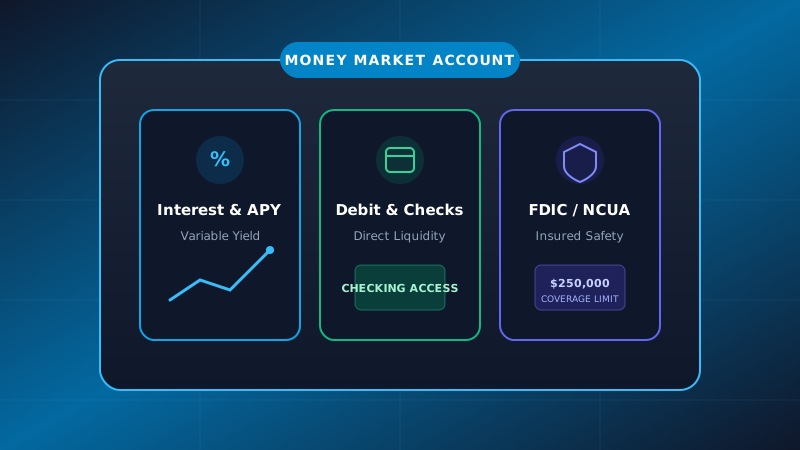
When comparing deposit products such as savings accounts, certificates of deposit (CDs), or money market accounts, consumers frequently encounter two distinct figures: the interest rate (often called the nominal rate) and the Annual Percentage Yield (APY).
While these terms are closely related, they are not identical. Understanding the mathematical and practical differences between interest rate and APY is essential for evaluating true bank returns, comparing yield offers accurately, and avoiding marketing confusion across deposit accounts like money market accounts and CD ladders.
1. What Is the Nominal Interest Rate?
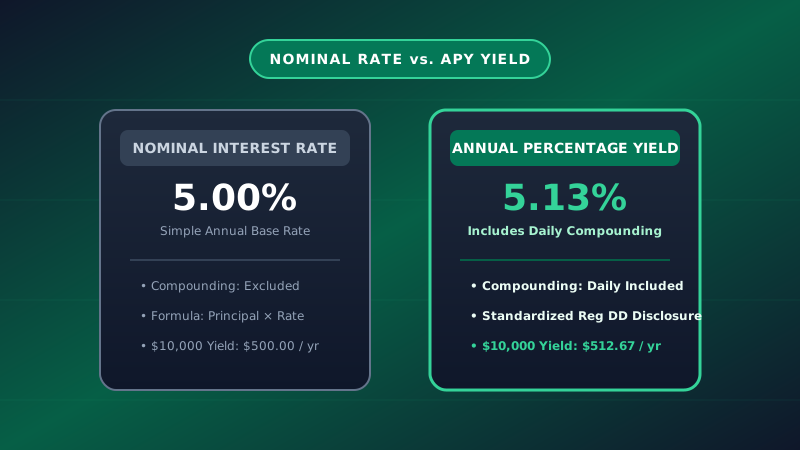
The nominal interest rate (or simple interest rate) is the base percentage rate a financial institution pays on a deposit balance over one year, excluding the effect of interest compounding.
For example, if a bank offers a simple nominal interest rate of 4.00% per year on a $10,000 deposit without compounding, the account would earn exactly $400 in simple interest over 12 months:
$$\text{Simple Interest} = \text{Principal} \times \text{Interest Rate} = $10,000 \times 0.0400 = $400$$
However, modern commercial banks and credit unions rarely pay uncompounded simple interest. Instead, earned interest is periodically added back to the principal balance, generating interest on previous interest—a process known as compound interest.
2. What Is Annual Percentage Yield (APY)?
The Annual Percentage Yield (APY) is the real rate of return earned on a deposit over one full year, taking into account the effect of compounding frequency.
Because compounding adds earned interest back to the account balance, the principal grows incrementally throughout the year. As a result, the total percentage return (the APY) is higher than the stated nominal interest rate whenever compounding occurs more than once per year.
Under U.S. federal banking disclosure regulations (specifically Truth in Savings Act / Regulation DD enforced by the Consumer Financial Protection Bureau), banks are required to state the APY prominently in advertising to allow consumers to compare deposit products on a standardized basis.
3. The Compounding Mechanism Explained
Compounding occurs when earned interest is credited to an account and immediately begins earning its own interest. The mathematical relationship between nominal interest rate ($r$), compounding frequency per year ($n$), and APY is expressed by the standard compounding formula:
$$\text{APY} = \left(1 + \frac{r}{n}\right)^n - 1$$
Where:
- $r$ = nominal annual interest rate (as a decimal)
- $n$ = number of compounding periods per year (e.g., 12 for monthly, 365 for daily)
Effect of Compounding Frequency (Hypothetical Calculation)
To see how compounding frequency impacts total return, consider a hypothetical deposit of $10,000 at a fixed nominal interest rate of 5.00% per year:
| Compounding Frequency | Compounding Periods ($n$) | Nominal Rate ($r$) | Effective APY | Total Interest Earned (Year 1) |
|---|---|---|---|---|
| Annual | 1 time / year | 5.00% | 5.000% | $500.00 |
| Quarterly | 4 times / year | 5.00% | 5.095% | $509.45 |
| Monthly | 12 times / year | 5.00% | 5.116% | $511.62 |
| Daily | 365 times / year | 5.00% | 5.127% | $512.67 |
As shown in the table, daily compounding generates slightly higher effective yield ($512.67) than annual compounding ($500.00) on the exact same 5.00% nominal rate.
4. Why APY Provides a Standardized Comparison
Because different banks use different compounding schedules—some compounding daily, others monthly or quarterly—comparing stated nominal interest rates alone can be misleading.
APY standardizes all deposit offers into an annual percentage figure reflecting 365 days of compounding. This allows consumers to compare two competing accounts directly:
- Bank A: Offers 4.95% nominal rate with daily compounding $\rightarrow$ 5.07% APY
- Bank B: Offers 5.00% nominal rate with annual compounding $\rightarrow$ 5.00% APY
In this comparison, Bank A delivers a higher actual annual dollar yield than Bank B, despite Bank B advertising a higher initial nominal interest rate. Looking at APY eliminates mathematical ambiguity.
5. Why APY Alone Does Not Tell the Full Story
While APY is a standardized metric, relying solely on advertised APY figures without reviewing account terms can lead to unexpected costs or lower net earnings.
Factors That Affect Net Yield beyond APY
- Monthly Maintenance Fees: A high advertised APY of 5.00% on a $2,000 balance earns $100 per year. However, if the bank charges a $10 monthly maintenance fee ($120 annually), the account incurs a net negative return.
- Minimum Balance Restrictions: Some high-yield accounts require a substantial minimum daily balance (e.g., $10,000) to earn the advertised APY. Falling below the threshold may trigger maintenance fees or drop the interest rate to a nominal 0.01%.
- Tiered APY Caps: Financial institutions may offer a premium APY only on balances up to a specified maximum (e.g., 6.00% APY on the first $1,000, and 0.25% APY on all remaining funds).
- Introductory or Promotional Rates: Teaser rates may expire after 3 or 6 months, after which the account reverts to a lower standard APY.
- Variable vs. Fixed Rates: Savings and money market account APYs are variable and subject to change at any time based on market conditions, unlike fixed-rate certificates of deposit.
6. APY vs. APR: A Crucial Distinction
Consumers frequently confuse APY (Annual Percentage Yield) with APR (Annual Percentage Rate):
- APY (Yield): Applies to deposit accounts where you earn money. It includes compounding to reflect total earned income.
- APR (Rate): Applies to loans and credit cards where you owe money. Under U.S. Truth in Lending regulations, APR reflects simple annual interest plus certain mandatory upfront finance fees, but does not compound daily interest in the stated APR figure.
When saving money, a higher APY is favorable. When borrowing money via loans or credit cards, a lower APR is favorable.
7. Practical Checklist for Evaluating Bank Yield Offers
Before opening an interest-bearing deposit account based on an advertised APY, review this evaluation checklist:
- Confirm Stated APY vs. Nominal Rate: Verify the official APY disclosed in Truth in Savings documentation.
- Check Minimum Opening and Maintenance Balances: Ensure your average balance satisfies requirements without incurring fees.
- Review Monthly Fee Schedules: Confirm fee waiver requirements (e.g., direct deposit thresholds).
- Verify Compounding and Crediting Frequency: Confirm whether interest compounds daily and credits monthly.
- Confirm Federal Deposit Insurance: Ensure the financial institution is directly insured by the FDIC or NCUA up to $250,000.
Sources
- Consumer Financial Protection Bureau (CFPB): Truth in Savings Act (Regulation DD) Guidelines https://www.consumerfinance.gov/
- Federal Deposit Insurance Corporation (FDIC): Understanding Deposit Interest and Rates https://www.fdic.gov/
- Federal Reserve Board: Regulation DD Disclosures and APY Calculations https://www.federalreserve.gov/
Educational Disclaimer
This article is for educational and informational purposes only and does not constitute personalized financial, tax, or investment advice. Interest rates, APY disclosures, fee structures, and account conditions vary by institution and change over time based on market conditions. Verify official disclosures directly with your financial institution.
MoneyTalkin' provides financial education, educational concepts, and general informational guides. Articles do not constitute personalized financial, investment, legal, or tax advice. Financial products, rates, terms, and regulatory rules change frequently; consult a qualified financial professional regarding your specific situation. Read our full Disclaimer Policy.
Written by MoneyTalkin'
MoneyTalkin' researches and publishes objective financial education content, money management fundamentals, and practical financial guides.
Related Technical Articles
Explore related topics in this cluster to deepen your understanding.