CD Laddering Explained: How to Build a Certificate of Deposit Ladder
A step-by-step guide to certificate of deposit (CD) laddering, explaining staggered maturity dates, interest rate management, early withdrawal penalties, and liquidity.
CD Laddering Explained: How to Build a Certificate of Deposit Ladder
A certificate of deposit (CD) ladder is a strategic cash-management framework designed to balance competitive interest yields with regular liquidity access. By splitting a cash allocation across multiple CDs with staggered maturity dates, savers can lock in predictable interest rates while maintaining access to maturing funds on a recurring schedule.
Understanding how to construct a CD ladder—along with the trade-offs regarding early-withdrawal penalties, reinvestment strategies, and federal deposit insurance—can help individuals decide whether CD laddering fits their financial plan alongside a high-yield savings account vs. fixed deposit or dedicated savings mechanisms like a sinking fund.
1. What Is a Certificate of Deposit (CD)?
A Certificate of Deposit (CD) is a time deposit product offered by banks and credit unions. When an investor opens a CD, they deposit a fixed sum of money for a specified period (the term), ranging from 3 months to 5 years or longer. In exchange, the financial institution guarantees a fixed Annual Percentage Yield (APY) for the duration of the term.
Key characteristics of a standard CD include:
- Guaranteed Fixed APY: The interest rate remains constant throughout the term, protecting account holders against declining market rates.
- Fixed Maturity Date: Principal funds are locked until the agreed-upon term expires.
- Early-Withdrawal Penalties: Withdrawing funds prior to maturity typically incurs a fee, often calculated as a specified number of days or months of simple interest.
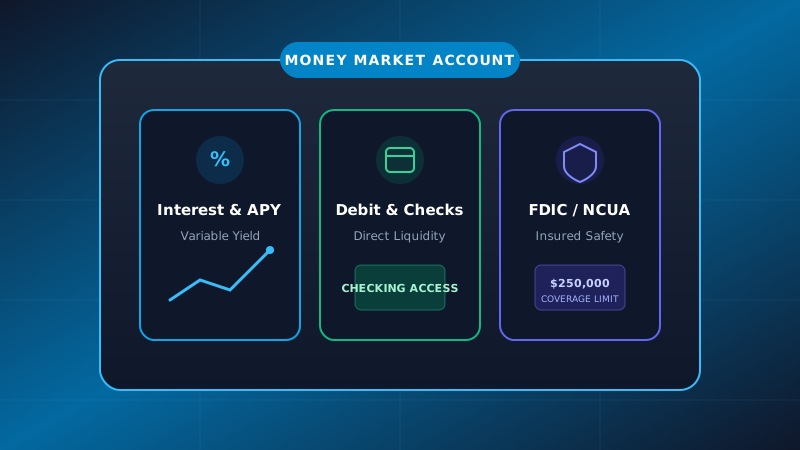
- Federal Deposit Insurance Protection: CDs issued by federally insured banks are covered by the FDIC, and credit union CDs (share certificates) are insured by the NCUA up to $250,000 per depositor per institution.
2. What Is a CD Ladder?
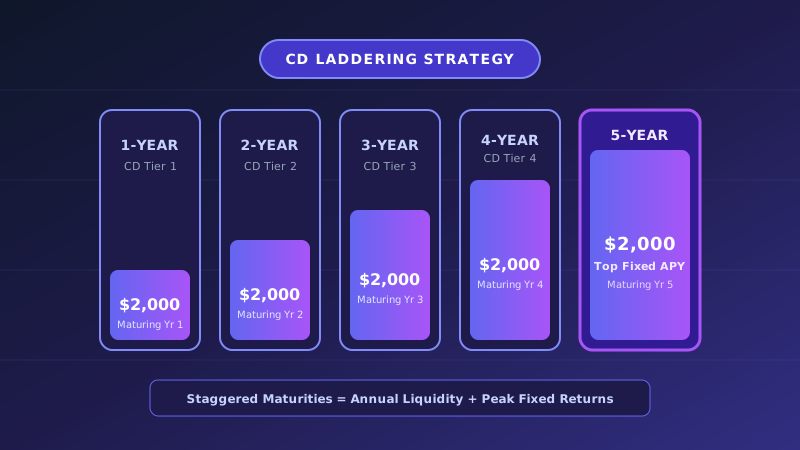
A CD ladder is a portfolio strategy where an investor divides a capital pool into equal portions and purchases multiple CDs with different, staggered maturity dates (such as 1-year, 2-year, 3-year, 4-year, and 5-year terms).
Instead of locking 100% of available cash into a single long-term CD (which restricts liquidity) or placing all cash into short-term deposits (which may pay lower yields), a CD ladder provides:
- Regular Cash Availability: A portion of the total principal matures at predictable intervals (e.g., every year or every 6 months).
- Yield Optimization: In standard yield curve environments, longer-term CDs often offer higher APYs than short-term liquid accounts, allowing a portion of the ladder to earn higher fixed rates.
- Interest Rate Risk Mitigation: As each CD matures, the funds can be reinvested into a new long-term CD at current market rates, averaging out rate fluctuations over time.
3. How a Simple 5-Year CD Ladder Works (Hypothetical Example)
To illustrate how a CD ladder operates in practice, consider a hypothetical investor with $10,000 in savings who wants to build a 5-year annual CD ladder.
Step 1: Initial Setup
The investor divides the $10,000 initial capital into five equal allocations of $2,000 each and purchases five separate CDs:
- CD 1: $2,000 in a 1-year CD
- CD 2: $2,000 in a 2-year CD
- CD 3: $2,000 in a 3-year CD
- CD 4: $2,000 in a 4-year CD
- CD 5: $2,000 in a 5-year CD
Step 2: The Annual Reinvestment Cycle
- End of Year 1: The 1-year CD matures ($2,000 plus earned interest). If the cash is not needed for immediate expenses, the investor reinvests the principal and interest into a new 5-year CD.
- End of Year 2: The original 2-year CD matures. The investor reinvests these funds into another new 5-year CD.
- End of Year 3, 4, and 5: As each remaining original CD reaches maturity, the proceeds are rolled into a new 5-year CD.
The Fully Formed Ladder State
After 5 years, the ladder reaches full maturity. At this point, the investor owns five separate 5-year CDs, with one 5-year CD maturing every single year. This achieves the primary goal of the strategy: earning longer-term fixed APYs on the portfolio while accessing 20% of total capital every 12 months without early-withdrawal penalties.
4. Understanding Early-Withdrawal Penalties
A critical consideration in CD laddering is the structure of early-withdrawal penalties. Because banks rely on time deposits for balance sheet planning, pulling principal out of a CD prior to maturity results in a penalty fee.
While penalty structures vary by financial institution and product terms, common penalty formulas include:
- Short-Term CDs (under 12 months): Penalty equal to a specified number of days of interest (e.g., 30 to 90 days).
- Medium-Term CDs (12 to 36 months): Penalty equal to a specified number of days of interest (e.g., 90 to 180 days).
- Long-Term CDs (48 to 60+ months): Penalty equal to a specified number of days or months of interest (e.g., 180 to 365 days).
If a CD is accessed early before generating sufficient accrued interest, the penalty fee may reduce a portion of the original deposited principal. For this reason, core liquid reserves like a primary emergency fund should remain in liquid accounts such as a high-yield savings account or money market account rather than a rigid CD structure.
5. Variations of the CD Ladder Strategy
Investors tailor ladder structures based on their specific liquidity timelines and interest rate expectations:
- Mini / Short-Term Ladder: Utilizes 3-month, 6-month, 9-month, and 12-month CDs. Provides liquidity every quarter, making it useful for near-term spending targets.
- Barbell Strategy: Combines short-term liquid CDs (e.g., 6-month terms) with very long-term CDs (e.g., 5-year terms), skipping intermediate terms to capture short-term flexibility alongside long-term yields.
- Bullet Strategy: Purchases multiple CDs with different start dates that all mature in the same target year (e.g., aiming for a child's college entrance or a planned home purchase).
6. When Is CD Laddering Useful?
A CD ladder can be a practical cash management strategy for individuals who:
- Possess clear, predictable future cash needs spaced over multiple years.
- Desire guaranteed principal protection backed by federal deposit insurance (FDIC/NCUA).
- Seek higher fixed yields than standard liquid accounts while avoiding market volatility associated with stocks or bonds.
- Benefit from behavioral discipline, as locking cash reduces impulse spending temptations.
7. When Might a CD Ladder Not Fit Your Needs?
Conversely, CD laddering may be inappropriate under certain financial circumstances:
- Uncertain Cash Timelines: If unexpected liquidity needs arise, early-withdrawal penalties can erode net returns.
- Rising Interest Rate Environment: In rapidly rising rate environments, locking funds into long-term fixed rates may cause investors to miss out on higher yields available in liquid savings products.
- Simplicity Preference: Managing multiple CD accounts across different maturity dates requires ongoing record-keeping and annual tracking.
8. FDIC and NCUA Deposit Insurance Safety
CD ladders opened at federally insured institutions receive robust deposit protection:
- FDIC Protection: Up to $250,000 per depositor, per insured commercial bank, for each ownership category.
- NCUA Protection: Up to $250,000 per member, per federally insured credit union.
Savers holding total deposits exceeding $250,000 across multiple CDs should spread their ladder accounts across separate insured banking institutions to maintain complete insurance coverage.
Sources
- Federal Deposit Insurance Corporation (FDIC): Deposit Insurance Coverage Guide https://www.fdic.gov/resources/deposit-insurance/
- National Credit Union Administration (NCUA): Share Insurance Coverage Details https://ncua.gov/consumers/share-insurance-coverage
- Consumer Financial Protection Bureau (CFPB): Certificate of Deposit Basics https://www.consumerfinance.gov/
Educational Disclaimer
This guide is for informational purposes only and does not constitute personalized investment, legal, or financial advice. CD terms, penalty structures, and APYs vary by financial institution and change based on market conditions. Verify exact terms directly with your bank or credit union before purchasing deposit products.
MoneyTalkin' provides financial education, educational concepts, and general informational guides. Articles do not constitute personalized financial, investment, legal, or tax advice. Financial products, rates, terms, and regulatory rules change frequently; consult a qualified financial professional regarding your specific situation. Read our full Disclaimer Policy.
Written by MoneyTalkin'
MoneyTalkin' researches and publishes objective financial education content, money management fundamentals, and practical financial guides.
Related Technical Articles
Explore related topics in this cluster to deepen your understanding.