The Power of Compound Interest: Math & Growth Over 30 Years
Detailed financial analysis and educational guide on The Power of Compound Interest: Math & Growth Over 30 Years.
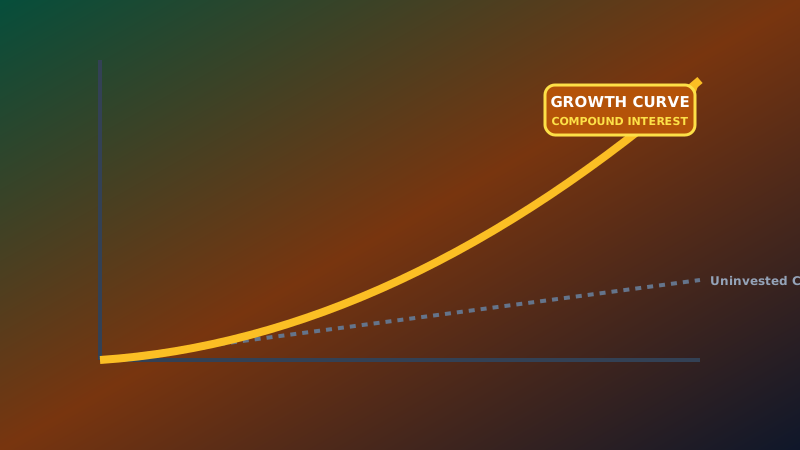
The Power of Compound Interest: Mathematical Growth and Real-World Impact
Compound interest is frequently described as the most powerful force in wealth accumulation. Unlike simple interest—which calculates returns solely on the initial principal—compound interest earns returns on both the original principal and the accumulated interest from prior periods.
This exponential compounding effect transforms modest, regular savings into substantial wealth over extended time horizons. However, compounding works as a double-edged sword: while it accelerates investment growth, it also causes high-interest debt (such as credit card balances) to accumulate exponentially.
Executive Summary: Compounding Fundamentals
- Simple vs. Compound Interest: Simple interest grows linearly; compound interest grows exponentially.
- Core Drivers: Time horizon, interest rate (annual yield), compounding frequency (daily, monthly, annually), and contribution consistency.
- Rule of 72: A quick mathematical shortcut to estimate how many years it takes for an investment to double ($\text{Years to Double} \approx 72 / \text{Interest Rate}$).
- Key Takeaway: Starting to invest 10 years earlier has a far greater impact on total accumulated wealth than doubling your monthly contribution later in life.
The Compound Interest Formula Explained
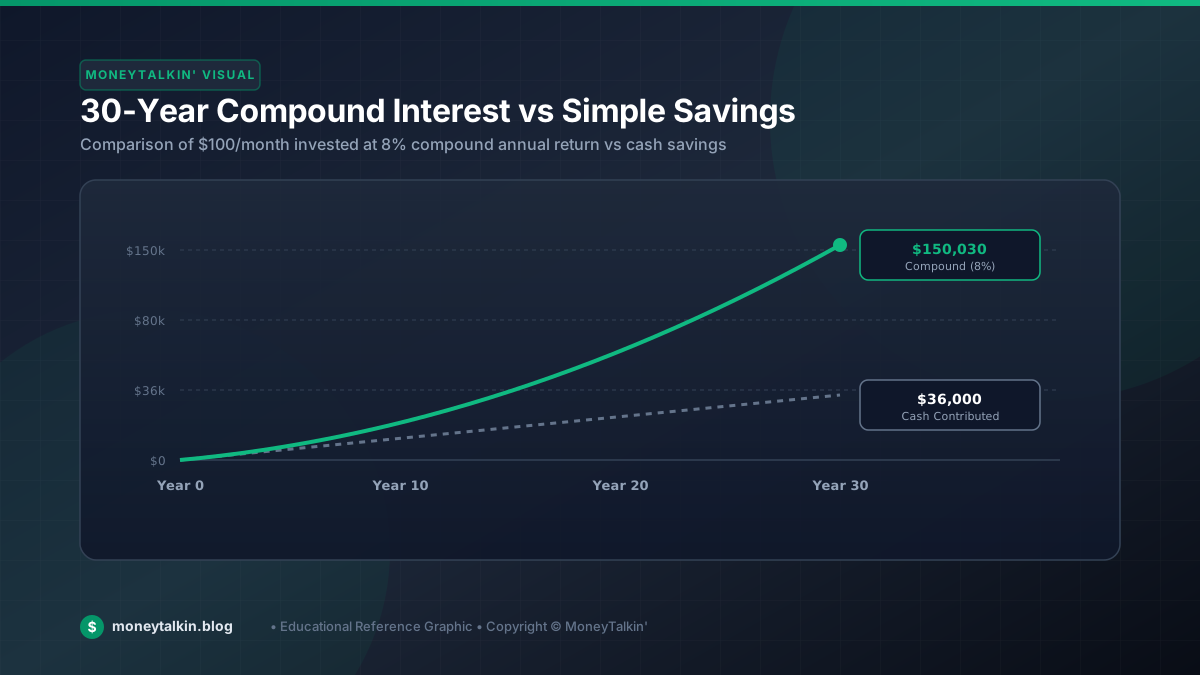
The mathematical equation used to calculate compound interest growth is:
$$A = P \left(1 + \frac{r}{n}\right)^{nt}$$
Where:
- $A$ = Final Accumulated Balance (principal + interest)
- $P$ = Initial Principal Investment
- $r$ = Annual Nominal Interest Rate (decimal format, e.g., 7% = 0.07)
- $n$ = Compounding Frequency per year (daily = 365, monthly = 12, annually = 1)
- $t$ = Time Horizon in years
                     COMPOUND vs. SIMPLE INTEREST GROWTH
    Balance ($)
        │                                         / (Compound: Exponential)
        │                                       /
        │                                    /
        │                              /───
        │                        /────
        │                 /──────  (Simple: Linear)
        │          /───────────────────────────────
        └───────────────────────────────────────────── Time (Years)
Step-by-Step Mathematical Comparison
To demonstrate the exponential impact of compounding, consider two investors, Investor A and Investor B, who both earn a 7% average annual return on their investments.
Investor Profiles
- Investor A (Early Start): Begins investing at Age 25. Contributes $300 per month ($3,600/year) for 10 years, then stops contributing entirely at Age 35. Leaves the accumulated balance to compound untouched until Age 65 (total out-of-pocket contribution: $36,000).
- Investor B (Late Start): Waits until Age 35 to begin investing. Contributes $300 per month ($3,600/year) continuously for 30 years straight until Age 65 (total out-of-pocket contribution: $108,000).
Mathematical Results at Age 65
| Metric | Investor A (Starts Age 25, Stops at 35) | Investor B (Starts Age 35, Continues to 65) |
|---|---|---|
| Total Years Contributing | 10 Years | 30 Years |
| Total Out-of-Pocket Invested | $36,000 | $108,000 |
| Compounding Time Horizon | 40 Years total | 30 Years total |
| Final Portfolio Value at Age 65 | $341,200 | $335,900 |
Crucial Takeaway: Even though Investor A invested $72,000 less cash out-of-pocket than Investor B, Investor A ended up with more wealth at retirement simply because their money had an extra 10 years to compound exponentially.
The Rule of 72: Quick Mental Math
The Rule of 72 is a practical mental calculation used to estimate how long it takes for an investment to double at a given annual rate of return:
$$\text{Years to Double} \approx \frac{72}{\text{Annual Interest Rate}}$$
- At a 4% return (conservative bonds), capital doubles in: $72 / 4 = \mathbf{18 \text{ years}}$.
- At an 8% return (broad stock market historical index average), capital doubles in: $72 / 8 = \mathbf{9 \text{ years}}$.
- At a 12% return, capital doubles in: $72 / 12 = \mathbf{6 \text{ years}}$.
Negative Compounding: The Danger of Credit Card Debt
Compounding works against you when carrying high-interest debt. Credit card issuers compound interest daily on unpaid balances.
Suppose a borrower carries a $5,000 credit card balance at a 22% APR and only pays the minimum monthly requirement ($125).
- Total time required to pay off the balance: Over 11 years.
- Total interest paid to the credit card company: Over $4,600 (nearly doubling the original cost of the purchases).
Practical Strategies to Maximize Compounding
- Start Immediately: Time is the most influential variable in the compound interest formula.
- Reinvest All Dividends: Automatically reinvesting quarterly stock dividends (DRIP) accelerates share accumulation and compounding.
- Minimize Fee Drag: High fund expense ratios (e.g., 1.00% vs. 0.05%) consume a large portion of potential compounding over 30 years.
Sources
- U.S. Securities and Exchange Commission (SEC Investor.gov): Compound Interest Calculator & Fundamentals
https://www.investor.gov/financial-tools-calculators/calculators/compound-interest-calculator - Financial Industry Regulatory Authority (FINRA): The Power of Compounding
https://www.finra.org/investors/investing
Disclaimer
This material is provided for educational purposes only. Past market returns do not guarantee future results. Consult a qualified professional for personal investment planning.
The Rule of 72 & Compounding Frequency Math
To estimate how long it takes for an investment to double at a constant annual return, investors use The Rule of 72:
Years to Double = 72 / Annual Interest Rate
- At a 6% annual return, capital doubles in 12 years (72 / 6).
- At a 9% annual return, capital doubles in 8 years (72 / 9).
Impact of Compounding Frequency
The frequency with which interest is compounded (annually, monthly, or daily) affects overall yield. Daily compounding generates higher effective returns than annual compounding because accrued interest begins earning interest immediately on subsequent days. Review compounding metrics in apy vs interest rate explained.
The Cost of Waiting: Starting Early vs. Late
To see the dramatic impact of starting early, consider two hypothetical investors saving $300/month at a 7% average annual return:
- Investor A (Starts Age 25, Stops Age 35): Invests $36,000 over 10 years, then stops contributing. At age 65, portfolio grows to ~$385,000.
- Investor B (Starts Age 35, Continues to Age 65): Invests $108,000 over 30 years ($300/mo). At age 65, portfolio grows to ~$366,000.
Starting 10 years earlier allows Investor A to build more wealth with one-third of the total out-of-pocket contributions.
Educational Summary & Key Definitions
Understanding financial fundamentals requires mastering core vocabulary and operational definitions:
- Principal: The original amount of money deposited or borrowed, excluding interest earnings or finance charges.
- Annual Percentage Yield (APY): The real rate of return earned on a deposit account, taking into account the effect of compounding interest over a 12-month period.
- Liquidity: The ease and speed with which an asset can be converted into liquid cash without incurring significant capital loss.
- Diversification: An investment risk management strategy that mixes a wide variety of investments within a portfolio to limit exposure to any single asset class.
Consulting official regulatory guidelines—such as disclosures from the CFPB, FDIC, NCUA, and Federal Reserve—ensures you make informed financial decisions backed by verified consumer protections.
MoneyTalkin' provides financial education, educational concepts, and general informational guides. Articles do not constitute personalized financial, investment, legal, or tax advice. Financial products, rates, terms, and regulatory rules change frequently; consult a qualified financial professional regarding your specific situation. Read our full Disclaimer Policy.
Written by MoneyTalkin'
MoneyTalkin' researches and publishes objective financial education content, money management fundamentals, and practical financial guides.
Related Technical Articles
Explore related topics in this cluster to deepen your understanding.