How Much Should You Have in an Emergency Fund?
A practical personal finance guide to determining your emergency fund size, evaluating essential expenses, assessing job volatility, and managing liquid reserves.
How Much Should You Have in an Emergency Fund?
Financial advice often presents a single rule of thumb for emergency savings: "Save three to six months of expenses." While useful, treating it as a universal rule ignores critical differences in income stability, household size, health exposure, and personal risk profiles.
An emergency fund is a dedicated pool of liquid cash set aside to absorb major unbudgeted financial shocks—such as job loss, medical bills, urgent home repairs, or auto breakdowns—without relying on high-interest credit card debt or liquidating retirement investments.
Understanding how to calculate a personalized emergency fund target—by auditing essential expenses, assessing job-loss risk, factoring in insurance deductibles, and selecting liquid storage accounts—helps households establish financial security alongside guides on how to build an emergency fund, distinguishing emergency cash from sinking funds, applying the 50/30/20 budgeting framework, and conducting a monthly expense audit.
1. Essential Expenses vs. Total Spending
A common error when calculating an emergency fund target is multiplying total monthly income or gross living expenses by 3 or 6.
An emergency fund covers essential baseline survival expenses, not discretionary lifestyle spending.
Calculating Baseline Essential Expenses
Essential expenses include mandatory non-negotiable obligations required to maintain basic health, shelter, and employment:
- Housing: Rent or mortgage, property taxes, home insurance, and essential utilities (electricity, water, gas, internet).
- Food & Supplies: Groceries and basic household supplies (excluding dining out and luxury food items).
- Transportation: Auto loans, car insurance, gas, transit passes, and essential vehicle maintenance.
- Healthcare & Debt Minima: Health insurance premiums, prescription medications, and minimum debt payments.
Discretionary expenses—such as restaurant dining, vacation savings, entertainment subscriptions, and luxury shopping—should be paused during a true financial emergency.
2. Key Personal Risk Factors That Determine Fund Size
Rather than adopting a rigid multi-month rule, tailor your emergency savings target to four primary risk factors:
[Income Stability] + [Household Structure] + [Insurance Deductibles] + [Job Mobility] = Personal Target
A. Income Stability (W-2 vs. Variable Income)
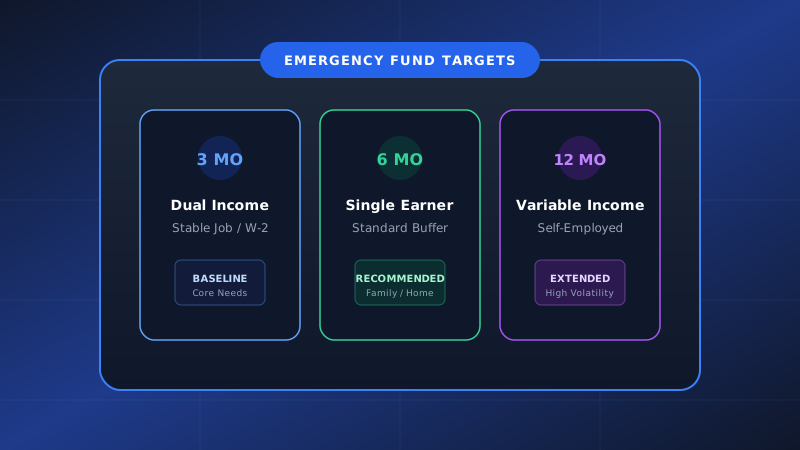
- Stable W-2 Income: Salaried employees in low-volatility industries (such as healthcare or government administration) with dual-income households carry lower income risk and may target 3 to 4 months of essential expenses.
- Variable / 1099 Income: Freelancers, commission-based sales professionals, small business owners, and gig economy workers face revenue volatility and should target 6 to 12 months of essential expenses.
B. Household Structure and Dependents
- Single-Income Households: A household relying on a single breadwinner carries higher income disruption risk than a dual-income household where both adults earn independent wages.
- Dependents: Supporting children, aging parents, or family members with specialized medical needs increases baseline cash requirements.
C. Health and Property Risk Exposure
Review your maximum out-of-pocket insurance deductibles:
- Health Insurance: If your health policy carries a $5,000 individual out-of-pocket maximum, an unexpected medical emergency could require $5,000 in cash immediately.
- Home and Auto Insurance: High homeowner or auto insurance deductibles require matching cash reserves.
D. Industry Volatility and Job Re-employment Timeline
Consider how long it typically takes to secure a comparable new role in your specialized field during an economic downturn. Specialized executives or tech workers may require 6 to 9 months to complete job searches, whereas workers in high-demand trades may secure new employment quickly.
3. Emergency Fund Framework Tiers
Financial planners structure emergency cash targets into progressive tiers:
| Savings Tier | Typical Target Range | Best Suited For | Primary Goal |
|---|---|---|---|
| Starter Buffer | $1,000 to $2,000 | Individuals actively paying off high-interest debt | Prevents minor shocks from adding new debt |
| Baseline Fund | 3 Months of Essential Expenses | Dual-income W-2 households with low debt & stable jobs | Absorbs short-term job transitions or medical events |
| Standard Fund | 6 Months of Essential Expenses | Single-income households, homeowners with children | Standard benchmark for complete financial resilience |
| Extended Fund | 9 to 12 Months of Essential Expenses | Self-employed, freelancers, commission earners, seasonal workers | Protects against prolonged industry slumps |
4. Hypothetical Calculation Example
To see how an emergency fund target is calculated in practice, consider a hypothetical household evaluating their monthly budget:
Step 1: Audit Baseline Essential Expenses
- Rent & Essential Utilities: $1,800 / month
- Baseline Groceries & Supplies: $600 / month
- Transportation (Loan, Insurance, Gas): $500 / month
- Health Insurance & Minimum Debt Payments: $400 / month
- Total Monthly Essential Expenses: $\mathbf{$3,300 \text{ per month}}$
(Note: Total monthly gross spending was $5,500, but $2,200 in non-essential dining, subscriptions, and shopping was excluded).
Step 2: Select the Multiplier Based on Risk Profile
The household relies on a single W-2 income with two young children. Based on their single-earner risk profile, they select a 6-month target multiplier.
Step 3: Calculate the Total Emergency Fund Goal
$$\text{Emergency Fund Target} = $3,300 \times 6 = \mathbf{$19,800}$$
Hypothetical example for illustrative purposes. Personal targets vary based on individual circumstances.
5. Where to Keep Your Emergency Cash
An emergency fund must balance two primary requirements: safety of principal and immediate liquidity.
Recommended Accounts
- High-Yield Savings Accounts (HYSAs): Offer competitive interest yields while maintaining full FDIC/NCUA insurance ($250,000 limit) and 1- to 3-day electronic transfer access.
- Money Market Accounts (MMAs): Provide competitive interest yields with direct debit card or check-writing access for immediate emergency payments.
- Short-Term U.S. Treasury Bills: Suitable for secondary emergency tiers, offering state-tax-exempt yields backed by the U.S. government.
Where NOT to Keep Emergency Cash
- The Stock Market / Equity ETFs: Stock prices fluctuate unpredictably. Liquidating stocks during a market downturn to cover a job loss forces you to lock in capital losses.
- Illiquid Real Estate or CDs: Real estate cannot be converted to cash quickly. Fixed-term CDs charge early withdrawal penalties if cash is needed unexpectedly.
- Physical Cash at Home: Holding tens of thousands in physical cash exposes your savings to theft, fire, and zero interest growth.
6. Replenishment and When NOT to Use the Fund
Establishing a clear definition of an "emergency" prevents fund depletion:
Valid Emergency Uses
- Sudden job loss or involuntary income reduction.
- Unplanned medical or dental emergency procedures.
- Urgent home repairs (such as a broken furnace in winter or roof leak).
- Emergency vehicle repairs required to maintain transportation to work.
Invalid Uses (Use Sinking Funds Instead)
- Planned annual expenses (such as holiday gifts, car registration, or routine maintenance)—these should be funded via dedicated sinking funds.
- Vacation travel or discretionary electronics purchases.
- Investment speculation or impulse buying.
Replenishment Protocol
If an emergency forces you to draw down your savings, temporarily pause non-essential discretionary spending and extra investment contributions until your emergency fund is restored to its target level.
7. Summary Checklist for Emergency Planning
Follow this practical checklist to establish your emergency fund:
- Audit Baseline Essential Expenses: Separate mandatory survival costs from discretionary lifestyle spending using a monthly expense audit.
- Assess Household Risk Factors: Evaluate income stability, single vs. dual earnings, dependents, and insurance deductibles.
- Set a Personal Target Multiplier: Select a 3-, 6-, or 12-month essential expense target based on your risk profile.
- Open a Dedicated HYSA: Separate emergency cash from your primary checking account to prevent accidental spending.
- Automate Monthly Savings Transfers: Set up automated recurring transfers on payday to build your fund systematically.
Sources
- Consumer Financial Protection Bureau (CFPB): An Essential Guide to Building an Emergency Fund https://www.consumerfinance.gov/an-essential-guide-to-building-an-emergency-fund/
- Federal Reserve Board: Report on the Economic Well-Being of U.S. Households https://www.federalreserve.gov/consumerscommunities/shed.htm
- FINRA Investor Education Foundation: Managing Emergency Savings & Financial Reserves https://www.finra.org/investors/learn-to-invest/manage-your-money/emergency-fund
Educational Disclaimer
This guide is for educational purposes only and does not constitute formal financial, legal, or investment advice. Emergency savings targets and cash management strategies vary based on individual financial circumstances and risk tolerance. Consult a qualified financial advisor for personalized guidance.
MoneyTalkin' provides financial education, educational concepts, and general informational guides. Articles do not constitute personalized financial, investment, legal, or tax advice. Financial products, rates, terms, and regulatory rules change frequently; consult a qualified financial professional regarding your specific situation. Read our full Disclaimer Policy.
Written by MoneyTalkin'
MoneyTalkin' researches and publishes objective financial education content, money management fundamentals, and practical financial guides.
Related Technical Articles
Explore related topics in this cluster to deepen your understanding.