The 50/30/20 Budgeting Rule Explained Simply
Detailed financial analysis and educational guide on The 50/30/20 Budgeting Rule Explained Simply.
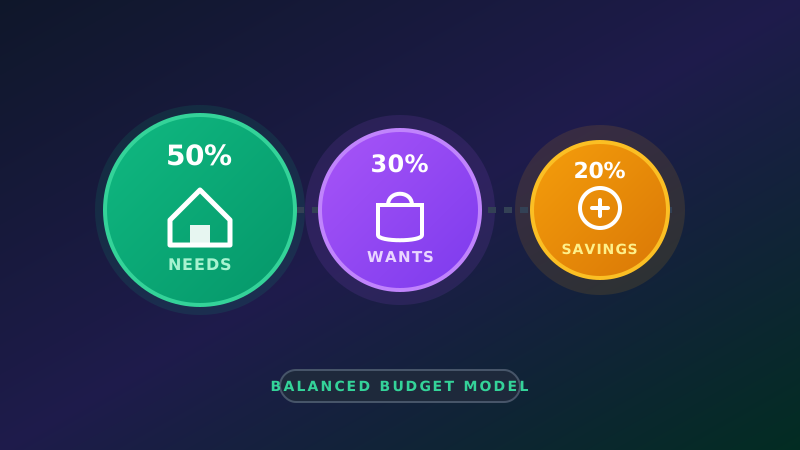
The 50/30/20 budgeting rule is one of the most popular, time-tested financial frameworks in modern personal finance. Originally popularized by Senator Elizabeth Warren and her daughter Amelia Warren Tyagi in their book All Your Worth: The Ultimate Lifetime Money Plan, this intuitive system divides your after-tax income into three straightforward categories: 50% for Needs, 30% for Wants, and 20% for Savings and Debt Repayment.
Unlike traditional zero-based budgets that require tracking every single cup of coffee line item by line item, the 50/30/20 rule provides broad, flexible guardrails. It empowers you to enjoy your life today while systematically securing your financial future tomorrow.
In this definitive guide, we will break down exactly how the 50/30/20 rule works, explore detailed line-item classifications, calculate exact real-world dollar examples across different income levels, address common edge cases, provide step-by-step setup guides, analyze the psychological benefits of percentage-based budgeting, and show you how to customize the rule for your specific financial situation.
Understanding the Core Framework
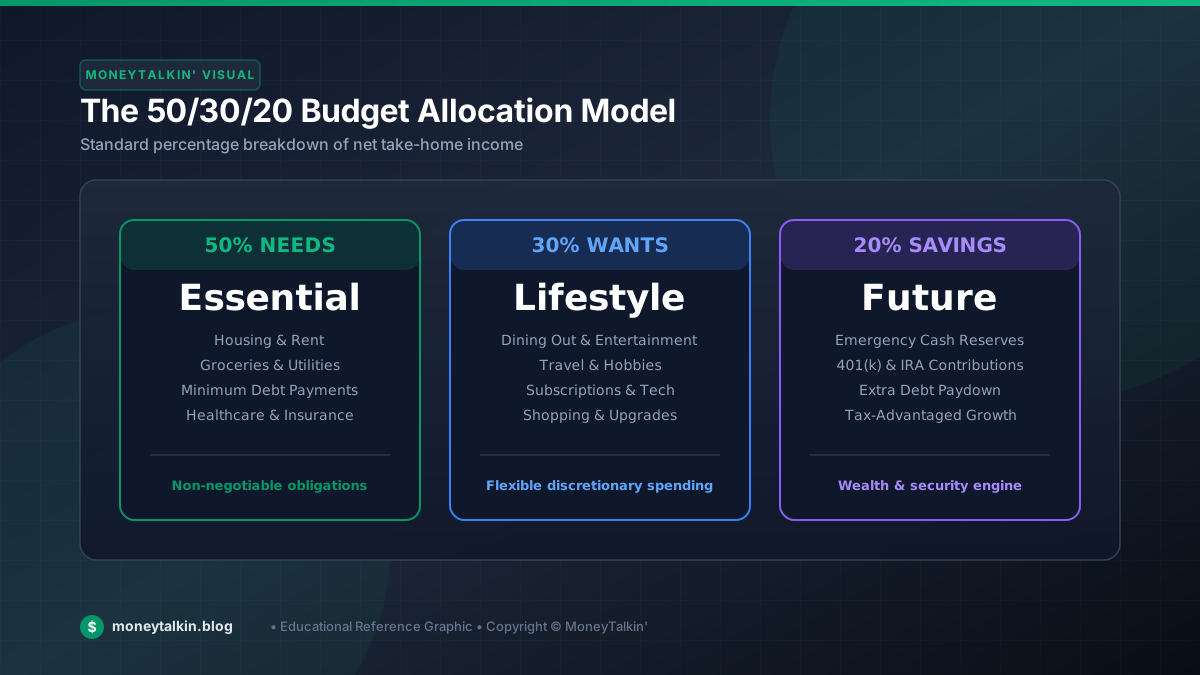
At its core, the 50/30/20 rule is designed to bring structural balance to your personal finances. Many people struggle with money management because they fall into one of two extreme traps: either spending recklessly on current desires with zero long-term planning, or living in extreme frugality and feeling deprived of life's daily pleasures.
The 50/30/20 rule solves this friction by providing clear, percentage-based allocations derived from your net take-home pay (your total income after federal, state, and local income taxes, Social Security, and Medicare deductions have been taken out).
+-----------------------------------------------------------------------+
|                    AFTER-TAX (NET) TAKE-HOME INCOME                   |
+-----------------------------------++----------------------------------+
                                    ||
        +---------------------------++---------------------------+
        |                           |                            |
  50% FOR NEEDS              30% FOR WANTS             20% FOR SAVINGS & DEBT
* Rent / Mortgage          * Dining Out / Takeout      * Emergency Fund
* Essential Utilities      * Subscriptions & Streaming * Retirement Accounts
* Minimum Debt Payments    * Hobbies & Recreation      * High-Interest Debt Boost
* Basic Groceries          * Vacations & Travel        * Wealth Creation
Let's examine each of these three buckets in complete detail.
Bucket 1: 50% for Essential Needs
Your Needs are expenses that you simply cannot avoid without experiencing severe life disruption, loss of shelter, or legal and health consequences. These are non-negotiable living costs required to maintain basic survival, family security, and employment capability.
What Counts as a Need?
- Housing Costs: Rent payments, mortgage payments (principal and interest), property taxes, HOA fees, and basic home insurance.
- Essential Utilities: Electricity, water, natural gas, trash collection, basic home internet (necessary for work), and a basic mobile phone plan.
- Transportation: Minimum car payments, auto insurance, gas, public transit passes, and essential vehicle maintenance.
- Basic Groceries: Staple food products purchased at supermarkets for home meal preparation. (Note: Dining out, takeout, luxury artisanal foods, and alcohol do NOT belong here).
- Healthcare & Insurance: Health insurance premiums, prescription medications, necessary doctor co-pays, term life insurance, and disability insurance.
- Minimum Debt Obligations: The absolute minimum payments required on student loans, credit cards, auto loans, or personal loans to avoid default and severe credit damage.
Key Rule of Thumb: If you were to lose your job tomorrow, a "Need" is an expense that you could not immediately eliminate without putting your living situation, health, or safety at risk.
Common Pitfalls in the Needs Category
The most frequent mistake beginners make is categorizing Wants disguised as Needs. For instance:
- Housing Creep: Renting a luxury high-rise apartment that consumes 45% of your income leaves only 5% for utilities, food, and transportation.
- Vehicle Over-purchasing: Choosing a $45,000 SUV with an $800 monthly payment when a reliable $15,000 sedan would fulfill your transport needs.
- Premium Subscriptions: Classifying high-speed 1 Gbps fiber internet with premium cable TV bundles as a basic utility.
Bucket 2: 30% for Personal Wants
Your Wants represent discretionary spending. These are choices you make to enhance your quality of life, comfort, personal fulfillment, and enjoyment. While wants are optional from a survival standpoint, they are vital for mental well-being and long-term budget sustainability.
What Counts as a Want?
- Dining & Entertainment: Restaurants, cafes, bars, concerts, sporting events, movie tickets, and food delivery services.
- Subscriptions & Services: Streaming platforms (Netflix, Spotify, Hulu), gym memberships, premium digital apps, and magazine subscriptions.
- Lifestyle & Apparel: Designer clothing, electronics upgrades, home decor, beauty treatments, haircuts beyond basic grooming, and spa days.
- Hobbies & Recreation: Sports equipment, gaming gear, craft supplies, courses taken for leisure, and weekend getaways.
- Vacations & Travel: Flights, hotels, rental cars, and tour packages.
Why the 30% Allocation Matters
Budgeting methods that enforce 100% frugality almost always fail due to "budget burnout"—similar to crash diets that eliminate all enjoyable foods. Allocating a dedicated 30% to wants gives you guilt-free permission to spend on things you love, provided your needs are covered and your savings goals are being met on schedule.
Bucket 3: 20% for Savings and Debt Repayment
The final 20% of your income is your engine for financial freedom and wealth building. This category is dedicated to strengthening your financial security, protecting against unexpected emergencies, and accumulating long-term assets.
What Counts in the 20% Bucket?
- Emergency Fund Building: Cash reserves stored in a High-Yield Savings Account (HYSA) covering 3 to 6 months of essential living expenses.
- Retirement Contributions: Contributions to a 401(k), Roth IRA, Traditional IRA, or SEP-IRA. (Note: Employer matching contributions add to your total, but your 20% target is based on your own contributions).
- Accelerated Debt Payoff: Extra principal payments made on high-interest credit card debt, personal loans, or private student loans (beyond the minimum payments counted under Needs).
- General Wealth Investing: Contributions to taxable brokerage accounts, low-cost index funds, real estate investments, or high-yield CDs.
- Sinking Funds for Major Goals: Saving for a home down payment, buying a vehicle in cash, or funding higher education.
Real-World Dollar Breakdown Across Income Levels
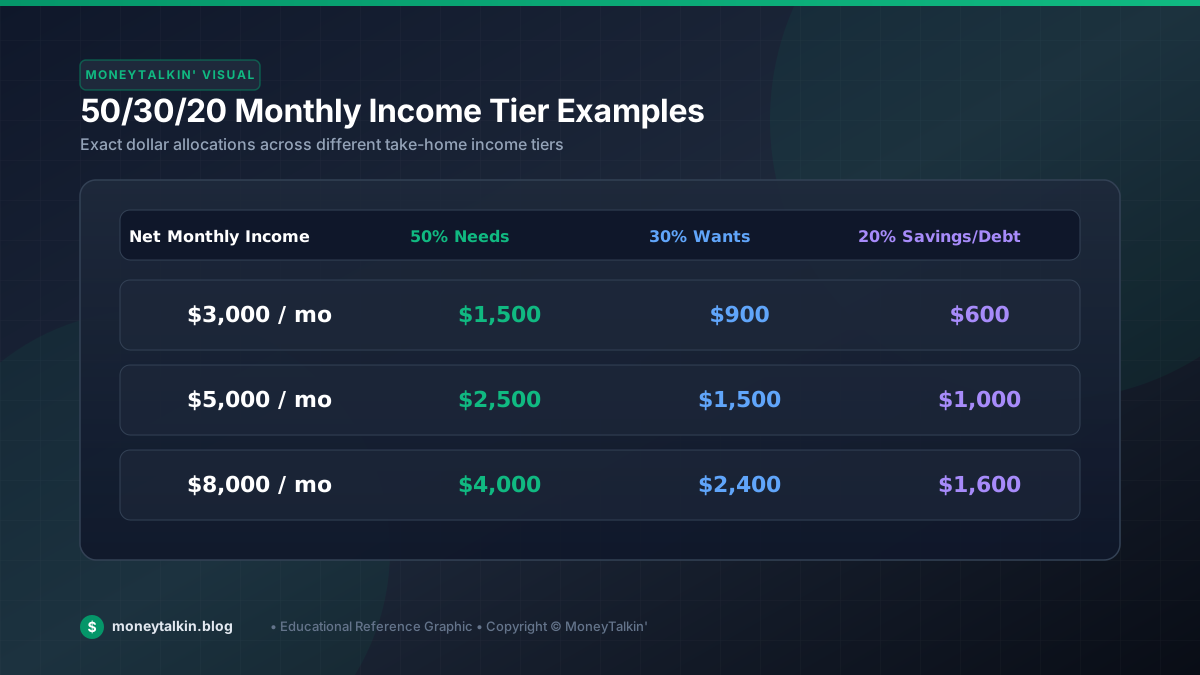
To visualize how the 50/30/20 rule functions in practice, let's examine three monthly net income scenarios: $3,500/month, $5,500/month, and $8,000/month.
| Income & Category | 50% Needs Allocation | 30% Wants Allocation | 20% Savings & Debt Allocation |
|---|---|---|---|
| $3,500 / month Net | $1,750 / month | $1,050 / month | $700 / month |
| $5,500 / month Net | $2,750 / month | $1,650 / month | $1,100 / month |
| $8,000 / month Net | $4,000 / month | $2,400 / month | $1,600 / month |
Detailed Case Study: $5,500 Monthly Net Income
Let's see how a single professional earning $5,500 net per month might structure their actual budget:
- Needs ($2,750 / 50%):
- Rent & Insurance: $1,600
- Utilities & Internet: $250
- Car Payment & Gas: $400
- Basic Groceries: $350
- Minimum Student Loan Payment: $150
- Wants ($1,650 / 30%):
- Dining out & Weekends: $600
- Streaming & Gym: $100
- Shopping & Hobbies: $450
- Vacation Sinking Fund: $500
- Savings & Debt ($1,100 / 20%):
- Roth IRA Contribution: $583 (maxing out annual $7,000 limit)
- High-Yield Savings Account (Emergency Fund): $317
- Extra Principal on Student Loans: $200
Mathematical Deep Dive: The Compound Growth of the 20% Bucket
To understand why allocating 20% to savings is transformative, consider the mathematical impact of compounding over a 30-year career.
Suppose an individual earns a net income of $5,000 per month ($60,000 net annually) and consistently invests 20% ($1,000 per month / $12,000 per year) into a low-cost S&P 500 index fund yielding an average historical return of 8% per year.
$$\text{Future Value} = P \times \frac{(1 + r)^n - 1}{r}$$
Where:
- $P = $1,000 \text{ per month}$
- $r = 0.08 / 12 = 0.006667 \text{ monthly return}$
- $n = 30 \times 12 = 360 \text{ months}$
COMPOUNDING RESULTS OVER TIME (AT $1,000/MONTH AT 8% ANNUAL RETURN):
* Year 5:   $73,476 total balance  (Contributions: $60,000  | Interest: $13,476)
* Year 10:  $182,946 total balance (Contributions: $120,000 | Interest: $62,946)
* Year 20:  $589,020 total balance (Contributions: $240,000 | Interest: $349,020)
* Year 30:  $1,490,359 total balance (Contributions: $360,000 | Interest: $1,130,359)
By sticking to the 20% savings rule, over $1.13 million of the final $1.49 million wealth portfolio is generated purely by compound interest!
Step-by-Step Implementation Guide
Follow these five practical steps to transition your finances to the 50/30/20 budget framework today:
Step 1: Calculate Your Net Income
Look at your pay stubs from the last 2 to 3 months. Sum up your total take-home pay after taxes. If you have pre-tax deductions for health insurance or 401(k) contributions, add them back to get your baseline net earnings before calculating your percentages.
Step 2: Categorize Your Last 90 Days of Spending
Export your bank and credit card statements for the last 90 days. Group every single expense into Needs, Wants, or Savings/Debt.
Step 3: Compare Your Current Percentages to 50/30/20
Calculate your actual current ratios: $$\text{Needs %} = \frac{\text{Total Needs Spending}}{\text{Net Income}} \times 100$$ For many people living in high-cost-of-living (HCOL) areas, initial calculations often reveal ratios like 65% Needs / 25% Wants / 10% Savings.
Step 4: Make Targeted Adjustments
If your Needs exceed 50%, look for major recurring leaks:
- Can you switch to a lower-cost mobile provider or negotiate internet rates?
- Can you meal plan to reduce grocery waste before touching your housing?
- If Needs remain fixed, consider shifting spending from your Wants bucket (e.g., 55% Needs / 25% Wants / 20% Savings) rather than cutting into your 20% Savings goal.
Step 5: Automate Your Allocations
Set up automatic transfers on payday. Direct 20% straight into your savings and investment accounts before you ever have the chance to spend it. This practice, known as "paying yourself first," promotes consistency.
Adapting the 50/30/20 Rule for Special Situations
The 50/30/20 framework is a guiding philosophy, not an inflexible law. Here is how to adjust the percentages based on your specific stage of life:
1. Living in a High-Cost-of-Living (HCOL) Area
In cities like New York, San Francisco, or London, housing alone often consumes 40% to 50% of net income. In this scenario, adapt to a 60/20/20 framework:
- 60% Needs (accommodating elevated rent)
- 20% Wants (reducing lifestyle spending)
- 20% Savings (protecting your financial future)
2. High-Interest Debt Burden
If you carry credit card debt with interest rates above 15-25%, temporarily flip your wants and savings allocations to create a 50/10/40 framework:
- 50% Needs
- 10% Wants (bare essentials for morale)
- 40% Debt Repayment & Savings (aggressively wiping out toxic debt)
3. Pursuing Financial Independence (FIRE)
If your goal is early retirement, a 20% savings rate may not be fast enough. Aggressive savers often implement a 30/20/50 framework:
- 30% Needs (living below your means)
- 20% Wants (mindful discretionary spending)
- 50% Savings & Investments (accelerating compound growth)
Psychological Benefits of Percentage-Based Budgeting
Unlike restrictive budgets that enforce strict dollar caps on micro-categories (e.g., "$40/month on coffee"), percentage-based budgeting offers distinct psychological advantages:
- Scalability with Income Growth: When you receive a salary raise, your dollar allocations for Needs, Wants, and Savings automatically scale proportionally without requiring a complete budget overhaul.
- Reduction of Financial Guilt: Having an explicit 30% bucket dedicated to discretionary spending eliminates shame when spending money on leisure, hobbies, or dining out.
- Cognitive Simplicity: Tracking three macro buckets requires dramatically less time and mental overhead than categorizing dozens of sub-line items every evening.
Frequently Asked Questions (FAQ)
Is 50/30/20 calculated on gross or net income?
The 50/30/20 rule is calculated strictly on net income (after-tax take-home pay). If you have pre-tax retirement contributions (like a traditional 401k) automatically deducted from your paycheck, count those dollars toward your 20% Savings target.
What if my needs take up more than 50% of my income?
This is extremely common for beginners and young professionals. Do not panic. Reduce your Wants allocation temporarily to absorb the extra Needs percentage so that you can maintain your 20% Savings target. Over time, work on increasing your earnings or downsizing major expenses to bring your Needs back down toward 50%.
Where do minimum debt payments belong?
Minimum debt payments are mandatory to protect your credit score, so they belong in the 50% Needs bucket. Any extra payments made to eliminate debt faster belong in the 20% Savings & Debt bucket.
How do I categorize annual or quarterly expenses like auto insurance?
Calculate the annual cost of these recurring bills and divide by 12. Include that monthly sub-amount in your monthly Needs bucket, and transfer it into a dedicated sinking fund savings account so cash is ready when the invoice arrives.
Should I cut my 20% savings bucket if inflation increases my groceries?
Try to reduce discretionary Wants spending first. Inflation impacts food and energy (Needs), so shifting money from dining out (Wants) to groceries preserves your 20% Savings engine.
Editorial Summary & Next Steps
The 50/30/20 rule is a powerful, flexible, and sustainable budgeting system that eliminates the complexity of tracking every penny while ensuring you build real wealth over time. By establishing clear boundaries for your spending, you regain total control over your money.
For further reading on optimizing your budget and accelerating your savings goals, explore our companion guides:
Disclaimer: MoneyTalkin' provides financial educational content for informational purposes only. We are not licensed financial advisors or certified financial planners. Individual financial situations vary widely; please consult with a qualified financial professional before making major investment or debt management decisions.
MoneyTalkin' provides financial education, educational concepts, and general informational guides. Articles do not constitute personalized financial, investment, legal, or tax advice. Financial products, rates, terms, and regulatory rules change frequently; consult a qualified financial professional regarding your specific situation. Read our full Disclaimer Policy.
Written by MoneyTalkin'
MoneyTalkin' researches and publishes objective financial education content, money management fundamentals, and practical financial guides.
Related Technical Articles
Explore related topics in this cluster to deepen your understanding.