Zero-Based Budgeting: A Step-by-Step Beginner''s Guide
Detailed financial analysis and educational guide on Zero-Based Budgeting: A Step-by-Step Beginner's Guide.
Zero-Based Budgeting: A Step-by-Step Beginner's Blueprint
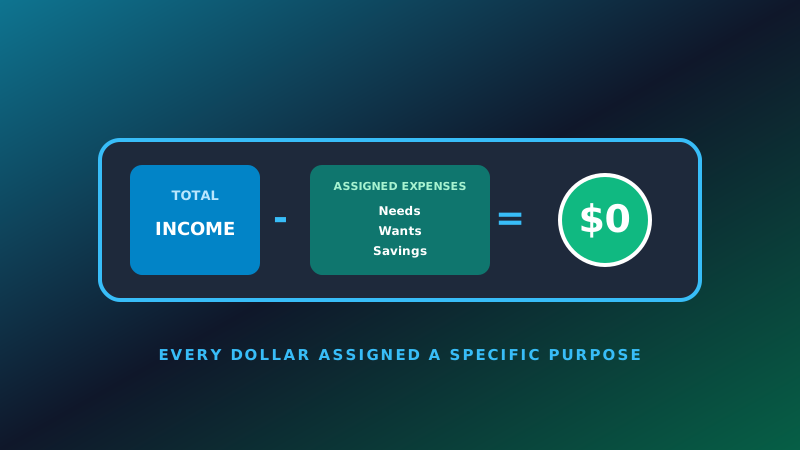
Zero-Based Budgeting (ZBB) is an intentional personal finance strategy where every dollar of monthly income is explicitly assigned a specific purpose before the month begins. The mathematical premise of zero-based budgeting is simple: Income minus Expenses equals Zero ($Income - Expenses = $0$).
Unlike traditional budgeting methods that track money reactively after it is spent, zero-based budgeting forces proactive allocation. Unassigned dollars left sitting in a checking account are vulnerable to impulse purchases and passive spending leakage. By assigning every single dollar to a category—whether for bills, groceries, discretionary fun, or retirement savings—you maintain total control over your financial resources.
Executive Summary: Zero-Based Budgeting Fundamentals
- Core Equation: Total Monthly Income – Total Monthly Allocations (Expenses + Savings + Debt) = $0.
- Primary Benefit: Eliminates wasteful unbudgeted spending by giving every dollar a clear job.
- Ideal For: Individuals looking to aggressively pay off debt, build savings, or stop living paycheck to paycheck.
- Frequency: Prepared monthly before new income is received, and adjusted mid-month as actual expenses occur.
How Zero-Based Budgeting Works
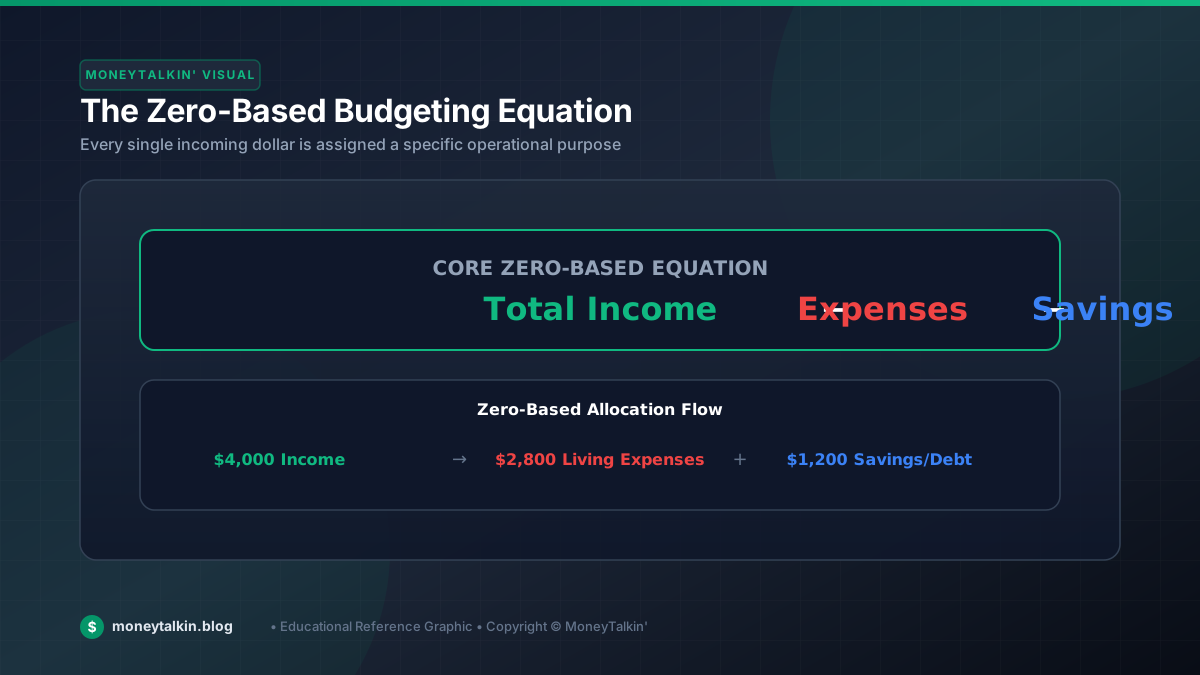
Zero-based budgeting originates from managerial accounting, where business departments must justify all expenses for each new period from a "zero base." In personal finance, it means you do not leave any unallocated margin in your income equation.
                  ZERO-BASED BUDGET ALLOCATION EQUATION
┌─────────────────────────┐     ┌─────────────────────────┐     ┌─────────────────────────┐
│ Total Monthly Take-Home │  ─  │ Expenses + Debt Service │  ─  │ Savings & Investments   │  =  $0
│ Income ($4,500)         │     │ Allocation ($3,300)     │     │ Allocation ($1,200)     │
└─────────────────────────┘     └─────────────────────────┘     └─────────────────────────┘
A common misconception is that a zero-based budget means having $0 in your bank account. In reality, it means that every dollar entering your bank account has been categorized. Dollars allocated to emergency savings, vacation funds, or investment accounts remain in your bank accounts—they are simply designated for specific long-term purposes.
Step-by-Step Zero-Based Budgeting Setup
Step 1: Document Expected Monthly Take-Home Income
Write down your total net monthly income from all sources (salary, freelance earnings, side hustles, rental income, or child support).
Example: Net Monthly Salary = $4,500
Step 2: List Essential Baseline Obligations (Fixed Costs)
Identify all mandatory fixed expenses that recur monthly with predictable amounts:
- Rent / Mortgage: $1,600
- Auto Payment: $350
- Health & Auto Insurance: $300
- Utility Bills (Electric, Water, Gas): $250
- Internet & Basic Phone: $100
- Total Fixed Costs: $2,600
Step 3: Estimate Variable Living Expenses
Estimate fluctuating monthly living costs based on historical bank statement averages:
- Groceries & Food Staples: $550
- Gasoline & Public Transit: $200
- Household Goods & Hygiene: $100
- Total Variable Expenses: $850
Step 4: Allocate Remaining Funds to Savings & Debt Goals
Subtract your fixed and variable costs from your total income to find your remaining balance:
$$\text{Remaining Balance} = $4,500 - ($2,600 + $850) = $1,050$$
Instead of leaving this $1,050 unassigned, allocate every dollar to explicit financial goals:
- High-Yield Savings (Emergency Reserve): $450
- Roth IRA Retirement Contribution: $400
- Extra Debt Principal Payoff: $200
- Total Goal Allocations: $1,050
Step 5: Verify the Zero Equation
$$\text{Income } ($4,500) - \text{Fixed } ($2,600) - \text{Variable } ($850) - \text{Goals } ($1,050) = \mathbf{$0}$$
Managing Variable Incomes with Zero-Based Budgeting
Freelancers, contractors, and commission-based sales professionals often struggle with traditional monthly budgets because income fluctuates unpredictably. Zero-based budgeting can be adapted for variable incomes using the Baseline Hill-and-Valley Strategy:
- Establish a Minimum Income Floor: Calculate the lowest monthly income you earned over the past 12 months. Base your core zero-based budget strictly on this conservative baseline.
- Create a Buffer Account: Open a separate "Hill-and-Valley" checking account. During high-income months, deposit all earnings above your baseline into this buffer account.
- Supplement Low Months: During low-earning months, transfer cash from your buffer account to bring your income up to the baseline budget level.
Practical Category Grouping Framework
To keep your zero-based budget structured and easy to audit, group allocations into four distinct administrative pillars:
| Pillar | Description | Typical Category Share |
|---|---|---|
| 1. Fixed Living | Non-negotiable monthly contractual obligations | 45%–55% of Net Income |
| 2. Variable Living | Daily consumable expenses managed via weekly spending envelopes | 15%–25% of Net Income |
| 3. Financial Goals | Wealth-building transfers (HYSA, IRA, 401k, debt acceleration) | 15%–25% of Net Income |
| 4. Sinking Funds | Monthly allocations for known non-monthly future costs | 5%–10% of Net Income |
Common Zero-Based Budgeting Pitfalls
- Forgetting Irregular Expenses: Annual car insurance renewals, holiday gifts, and quarterly tax payments can break a budget. Solve this by incorporating monthly sinking funds into your zero-based allocation.
- Being Too Rigid Mid-Month: Real life rarely matches predictions. If grocery expenses run $50 over budget, reassign $50 from entertainment or dining out to keep the total budget balanced to zero.
- Abandoning the Budget After One Month: Zero-based budgeting requires a 90-day adjustment period before the process becomes seamless. Expect initial adjustments during months one and two.
Practical Takeaway Checklist
- Calculate net expected income for the upcoming calendar month.
- List all fixed bills and estimate variable categories based on past statements.
- Assign every remaining dollar to savings, debt payoff, or sinking funds.
- Confirm that Income minus Allocations equals exactly $0.
- Perform weekly mid-month check-ins to track spending against category limits.
Sources
- Consumer Financial Protection Bureau (CFPB): Building a Monthly Budgeting Plan
https://www.consumerfinance.gov/consumer-tools/save/ - National Foundation for Credit Counseling (NFCC): Budgeting Strategies & Debt Reduction
https://www.nfcc.org/
Disclaimer
This content is provided for educational purposes only and does not constitute formal financial advice. Individual financial situations vary. Consult a qualified financial advisor for personal guidance.
Zero-Based Envelope Systems & App Integration
Zero-based budgeting allocates every dollar of monthly income to a specific category (savings, bills, debt paydown, discretionary spending) until Income - Outflows = $0.
Digital Envelope Systems
Modern budgeting apps digitize the traditional cash envelope method:
- Assign Income to Digital Envelopes: Upon receiving a paycheck, allocate funds to fixed expense categories, sinking funds, and financial goals.
- Track Category Balances in Real Time: Before making discretionary purchases, check category balances rather than aggregate checking account balances.
- Reallocate Target Categories ("Roll with the Punches"): If dining out exceeds budget targets, reallocate funds from another discretionary category to maintain a zero-based balance.
Review cash flow auditing steps in how to audit your monthly expenses.
Educational Summary & Key Definitions
Understanding financial fundamentals requires mastering core vocabulary and operational definitions:
- Principal: The original amount of money deposited or borrowed, excluding interest earnings or finance charges.
- Annual Percentage Yield (APY): The real rate of return earned on a deposit account, taking into account the effect of compounding interest over a 12-month period.
- Liquidity: The ease and speed with which an asset can be converted into liquid cash without incurring significant capital loss.
- Diversification: An investment risk management strategy that mixes a wide variety of investments within a portfolio to limit exposure to any single asset class.
Consulting official regulatory guidelines—such as disclosures from the CFPB, FDIC, NCUA, and Federal Reserve—ensures you make informed financial decisions backed by verified consumer protections.
MoneyTalkin' provides financial education, educational concepts, and general informational guides. Articles do not constitute personalized financial, investment, legal, or tax advice. Financial products, rates, terms, and regulatory rules change frequently; consult a qualified financial professional regarding your specific situation. Read our full Disclaimer Policy.
Written by MoneyTalkin'
MoneyTalkin' researches and publishes objective financial education content, money management fundamentals, and practical financial guides.
Related Technical Articles
Explore related topics in this cluster to deepen your understanding.