Bank CDs vs. Treasury Bills: How to Compare Safety, Yield, and Liquidity
A neutral financial guide comparing bank CDs and U.S. Treasury bills across deposit insurance, state tax exemptions, early withdrawal penalties, and after-tax returns.
Bank CDs vs. Treasury Bills: How to Compare Safety, Yield, and Liquidity
When building a low-risk cash strategy, investors often seek guaranteed yields beyond standard bank accounts. Two prominent fixed-income instruments available to U.S. savers are bank Certificates of Deposit (CDs) and U.S. Treasury Bills (T-bills).
While both instruments offer capital preservation, they differ in issuer backing, state tax treatment, liquidity options, and yield calculations.
Understanding how bank CDs and Treasury bills compare—including FDIC deposit insurance limits, federal vs. state tax mechanics, early withdrawal penalties vs. secondary market trading, and after-tax yield formulas—helps investors select the optimal vehicle alongside guides on CD laddering strategies, understanding Treasury bill mechanics, evaluating APY vs. interest rate math, and managing liquid cash in high-yield savings accounts.
1. What Is a Bank Certificate of Deposit (CD)?
A Certificate of Deposit (CD) is a time deposit product issued by federally insured banks and credit unions.
Key features include:
- Fixed Interest Rate: You lock in a specific APY for the full duration of the agreement.
- Fixed Term: Terms range from 1 month to 5 years or longer.
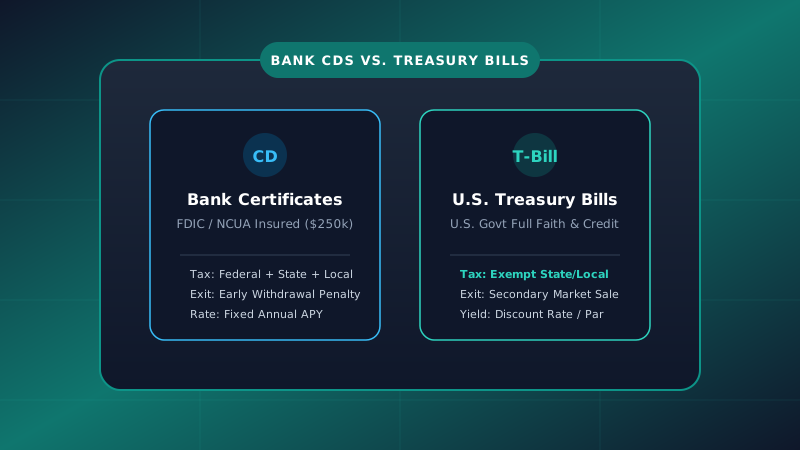
- FDIC / NCUA Insurance: Principal and interest are insured up to statutory limits ($250,000 per depositor, per institution).
- Early Withdrawal Penalty: Withdrawing funds before maturity incurs an early withdrawal penalty (typically forfeiting several months of interest).
2. What Is a U.S. Treasury Bill (T-Bill)?
A Treasury Bill (T-bill) is a short-term debt obligation issued directly by the U.S. Department of the Treasury to fund federal government operations.
Key features include:
- Short-Term Maturities: Issued in terms of 4, 8, 13, 17, 26, and 52 weeks.
- Sovereign Backing: Backed by the full faith and credit of the U.S. government, making T-bills virtually free of credit default risk.
- Discount Pricing: T-bills do not pay periodic interest checks; instead, they are sold at a discount to face value (par) and mature at full face value ($1,000 per bill).
- Secondary Market Liquidity: T-bills can be bought and sold on the secondary bond market prior to maturity through brokerage accounts.
3. Comparing Safety and Backing
Both bank CDs and U.S. Treasury bills represent top-tier credit safety, but their backing mechanisms differ:
[Bank CD]       ➔ Insured by FDIC / NCUA up to $250,000 per bank
[Treasury Bill] ➔ Backed by U.S. Government Full Faith & Credit (Unlimited Amount)
Bank CDs (FDIC / NCUA Coverage)
Bank CDs are protected by federal deposit insurance up to $250,000 per depositor, per insured institution, for each ownership category. Deposits exceeding $250,000 at a single bank carry institutional risk unless structured across multiple insured institutions.
Treasury Bills (Sovereign Backing)
Treasury bills are backed directly by the U.S. federal government. Unlike bank CDs, there is no $250,000 insurance cap on T-bill safety; an investor holding $1 million or $10 million in Treasury bills enjoys direct U.S. government backing across the entire sum.
4. Tax Treatment: The State Tax Advantage of T-Bills
Tax implications represent one of the most critical distinctions when comparing after-tax yields:
| Feature | Bank CDs | U.S. Treasury Bills |
|---|---|---|
| Federal Income Tax | Fully Taxable (Ordinary Income) | Fully Taxable (Ordinary Income) |
| State Income Tax | Fully Taxable (in state of residence) | EXEMPT (State Income Tax Free) |
| Local / Municipal Tax | Fully Taxable | EXEMPT (Local Income Tax Free) |
The After-Tax Yield Impact
Because T-bill interest is 100% exempt from state and local income taxes, a Treasury bill paying a stated rate identical to a bank CD yields a higher after-tax return for investors residing in states with moderate-to-high state income tax rates (such as California, New York, or New Jersey).
Equivalent Taxable Yield Formula:
To determine what bank CD APY you would need to match a Treasury bill's yield in a taxable state:
$$\text{Equivalent Taxable Yield} = \frac{\text{T-Bill Yield}}{1 - \text{State Tax Rate}}$$
If a T-bill yields 5.00% and your state income tax rate is 6.00%:
$$\text{Equivalent Taxable Yield} = \frac{0.0500}{1 - 0.0600} = \mathbf{5.32% \text{ Bank CD APY}}$$
In this scenario, a bank CD must offer an APY above 5.32% to beat a 5.00% T-bill on an after-tax basis.
5. Liquidity and Early Access Rules
Comparing liquidity requires evaluating early exit rules:
A. Bank CD Penalties
If an emergency requires you to access CD funds prior to maturity, banks assess an early withdrawal penalty. The penalty typically consumes 30 to 180 days of earned interest. In some cases, if the CD was opened recently, the penalty can eat into your original principal.
B. Treasury Bill Secondary Market Sales
T-bills carry no early withdrawal penalties because they do not have bank penalty contracts. If you need cash before maturity, you can sell your T-bill on the secondary bond market via your brokerage account.
- Price Risk: Selling a T-bill prior to maturity subjects you to market price fluctuations. If prevailing market interest rates have risen since purchase, the T-bill's market price will be lower (resulting in a potential market loss).
- Maturity Guarantee: If you hold the T-bill until its scheduled maturity date, you receive 100% of the face value regardless of interim price moves.
6. Yield Mechanics: APY vs. Discount Rate
Understanding how yields are quoted prevents misinterpreting returns:
- Bank CDs: Quoted in Annual Percentage Yield (APY), which incorporates compound interest.
- Treasury Bills: Quoted on a Discount Rate basis and converted to a Bond Equivalent Yield (BEY) to allow direct comparison with APY metrics.
$$\text{Discount Rate} = \frac{\text{Par Value} - \text{Purchase Price}}{\text{Par Value}} \times \frac{360}{\text{Days to Maturity}}$$
Because discount rates use a 360-day year and do not reflect full compounding, always look at the Bond Equivalent Yield (BEY) when comparing T-bills to bank CD APYs.
7. Hypothetical Comparison Scenario
Consider a saver holding $10,000 who evaluates a 1-year Bank CD vs. a 1-year Treasury Bill in a state with a 6.0% state income tax:
- Option A (1-Year Bank CD): 5.00% APY ($500 gross interest)
- Option B (1-Year T-Bill): 5.00% Bond Equivalent Yield ($500 gross interest)
- Assumed Federal Tax Rate: 22% | Assumed State Tax Rate: 6%
| Metric | 1-Year Bank CD | 1-Year Treasury Bill | Advantage |
|---|---|---|---|
| Gross Yield | 5.00% ($500.00) | 5.00% ($500.00) | Tied |
| Federal Tax (22%) | -$110.00 | -$110.00 | Tied |
| State Tax (6%) | -$30.00 | $0.00 (Exempt) | T-Bill (+$30.00) |
| Net After-Tax Income | $360.00 | $390.00 | T-Bill (+$30 Net) |
| Net After-Tax Return | 3.60% | 3.90% | +0.30% Real Advantage |
Hypothetical example for illustrative purposes. Actual tax outcomes depend on individual tax brackets and state laws.
8. Summary Comparison Checklist
To decide between a bank CD and a Treasury bill, evaluate these checklist factors:
- State Income Tax Residence: Do you reside in a state with personal income tax? If yes, factor in T-bill state tax exemption.
- Deposit Size: Is your deposit over $250,000? T-bills offer unlimited federal backing without multi-bank structuring.
- Liquidity Needs: Might you need cash before maturity? T-bills provide secondary market access, while CDs assess fixed penalties.
- Convenience vs. Setup: Do you prefer simple bank deposits (CDs) or managing a brokerage/TreasuryDirect account (T-bills)?
- Reinvestment Horizon: Are you building a multi-year cash schedule using a CD laddering strategy?
Sources
- Federal Deposit Insurance Corporation (FDIC): Deposit Insurance Coverage Guidelines https://www.fdic.gov/resources/deposit-insurance/
- U.S. Department of the Treasury (TreasuryDirect): Treasury Bills Overview & Tax Rules https://www.treasurydirect.gov/marketable-securities/treasury-bills/
- Internal Revenue Service (IRS): Publication 550: Investment Income and Expenses https://www.irs.gov/forms-pubs/about-publication-550
Educational Disclaimer
This guide is for educational purposes only and does not constitute formal tax, legal, or investment advice. Yields, tax rates, and market conditions fluctuate. Consult a qualified financial or tax professional regarding your personal portfolio.
MoneyTalkin' provides financial education, educational concepts, and general informational guides. Articles do not constitute personalized financial, investment, legal, or tax advice. Financial products, rates, terms, and regulatory rules change frequently; consult a qualified financial professional regarding your specific situation. Read our full Disclaimer Policy.
Written by MoneyTalkin'
MoneyTalkin' researches and publishes objective financial education content, money management fundamentals, and practical financial guides.
Related Technical Articles
Explore related topics in this cluster to deepen your understanding.