High-Yield Savings Accounts Explained: How They Work and What to Compare
A comprehensive guide explaining high-yield savings accounts, APY calculations, variable interest rates, FDIC protection, fees, and account comparison strategies.
High-Yield Savings Accounts Explained: How They Work and What to Compare
Holding cash reserves in an accessible bank account is a foundational rule of household financial planning. However, storing cash in a traditional brick-and-mortar savings account often yields minimal interest, causing your real buying power to erode against inflation.
To earn higher returns on liquid reserves, many depositors utilize a high-yield savings account (HYSA).
A high-yield savings account functions much like a standard savings account, but it pays an Annual Percentage Yield (APY) that can be significantly higher than national average traditional savings rates. Understanding how HYSAs operate—including APY mechanics, variable rate adjustments, online banking cost models, FDIC insurance guidelines, and account trade-offs—helps savers maximize interest earnings alongside guides on money market accounts, understanding APY vs. interest rate math, building a CD laddering strategy, and establishing a robust emergency fund.
1. What Is a High-Yield Savings Account?
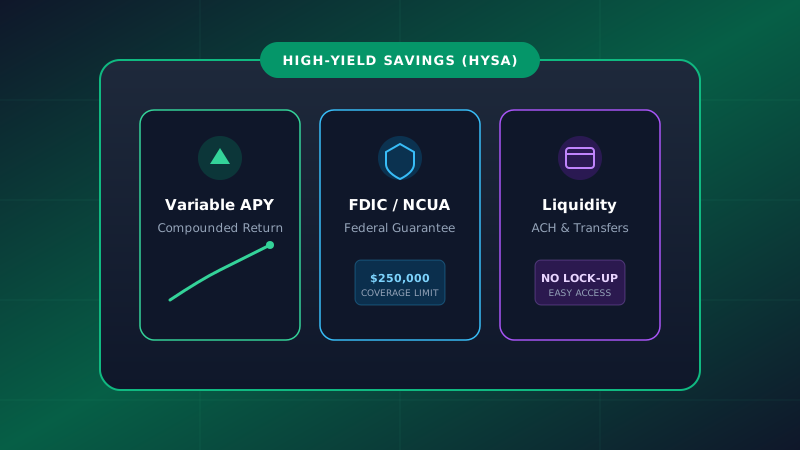
A high-yield savings account (HYSA) is a deposit account offered by federally insured banks and credit unions that pays a competitive interest rate on cash deposits.
Key characteristics include:
- Higher Yields: HYSAs offer interest rates that often exceed traditional bank savings averages by substantial margins.
- Principal Security: Funds are insured by the federal government up to statutory limits.
- High Liquidity: Savers can deposit and withdraw cash without early withdrawal penalties, making HYSAs ideal for short-term goals and emergency funds.
HYSAs are primarily offered by online banks, direct banks, and credit unions that operate with lower overhead costs than traditional branch networks.
2. How APY and Compounding Interest Work
The earning power of a high-yield savings account is expressed as the Annual Percentage Yield (APY).
APY vs. Stated Interest Rate
While the stated interest rate reflects the simple annual rate paid on your principal, the APY reflects the total annual interest earned, taking into account the effect of compounding interest.
$$\text{APY} = \left(1 + \frac{r}{n}\right)^n - 1$$
Where $r$ is the nominal interest rate and $n$ is the number of compounding periods per year (typically 365 for daily compounding).
Compounding Frequency
Most high-yield savings accounts compound interest daily and credit interest to your account monthly. Because interest earned today earns additional interest tomorrow, daily compounding produces a slightly higher total return than simple interest.
3. Variable Rates vs. Fixed Rates
A critical feature of high-yield savings accounts is that their interest rates are variable, not fixed.
- Rate Adjustments: The bank can increase or decrease your account's APY at any time without advance notice.
- Benchmark Influence: HYSA rates generally move in tandem with changes in federal benchmark interest rates set by the Federal Reserve (the federal funds rate).
- No Guarantee: Unlike Certificates of Deposit (CDs), which lock in a fixed interest rate for a set term, an HYSA rate fluctuates based on broader macroeconomic conditions and competitive banking markets.
Note: High-yield savings accounts do not guarantee the highest yield in every economic environment. During low-interest-rate cycles, yields across all deposit accounts compress.
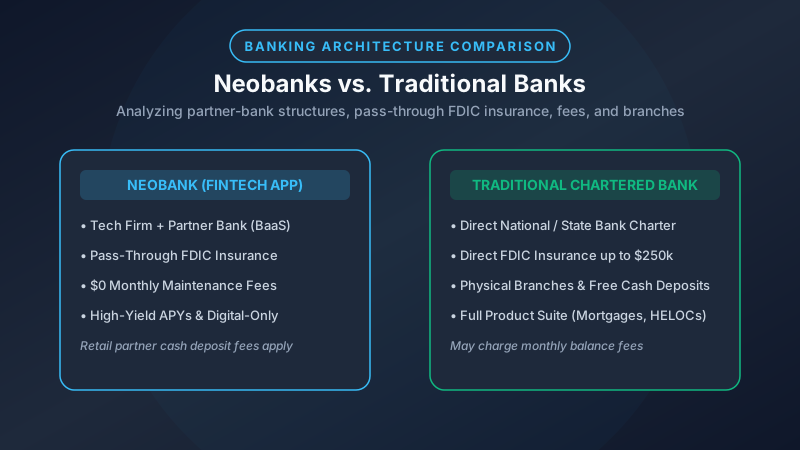
4. Online Banks vs. Traditional Brick-and-Mortar Banks
Why can online banks offer significantly higher APYs than traditional physical banks?
| Feature | Online Banks (HYSA) | Traditional Physical Banks |
|---|---|---|
| Branch Network | Digital only (no physical branches) | Extensive physical branch networks |
| Overhead Expenses | Low (no building rent, branch utility costs) | High (real estate, staffing, branch maintenance) |
| Yield Strategy | Pass cost savings to depositors via higher APYs | Retain lower yields due to branch operational costs |
| Cash Deposit Access | Limited (ACH, mobile check deposit, transfer) | Direct in-person cash teller deposits |
5. Federal Deposit Insurance (FDIC & NCUA)
Safety of principal is a paramount concern when choosing a savings vehicle.
FDIC Insurance (Banks)
Deposit accounts held at federally insured commercial banks are backed by the Federal Deposit Insurance Corporation (FDIC), an independent agency of the U.S. government.
- Coverage Limit: The standard FDIC insurance limit is $250,000 per depositor, per insured bank, for each account ownership category.
- Default Protection: If an FDIC-insured bank fails, the federal government guarantees your principal and accrued interest up to the $250,000 threshold.
NCUA Insurance (Credit Unions)
For credit unions, equivalent protection is provided by the National Credit Union Administration (NCUA) through the National Credit Union Share Insurance Fund (NCUSIF), offering the same $250,000 coverage limit per member.
6. How HYSAs Compare to Other Cash Accounts
Understanding where an HYSA fits within your banking structure requires comparing it against other common accounts:
| Account Type | Primary Purpose | Interest Yield | Liquidity & Access | Insurance |
|---|---|---|---|---|
| Checking Account | Everyday transactions & bill pay | Minimal / Zero | Debit card, checks, ATM, ACH | FDIC / NCUA ($250k) |
| High-Yield Savings (HYSA) | Short-term savings & emergency cash | High (Variable) | ACH transfer, electronic payout | FDIC / NCUA ($250k) |
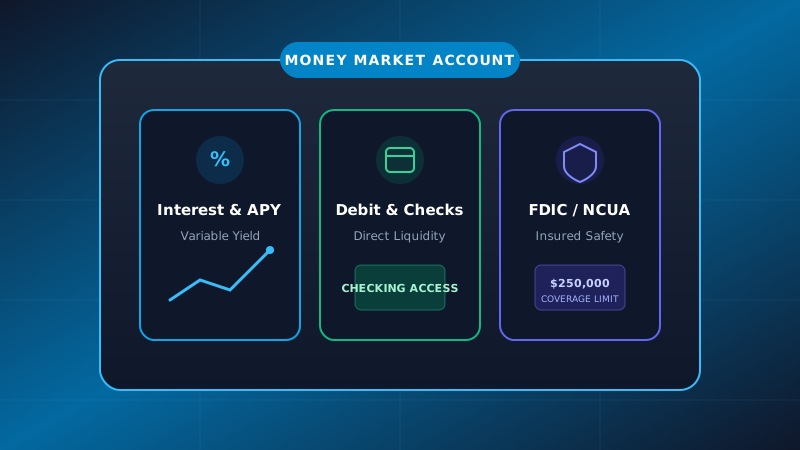
| Money Market Account (MMA) | Tiered savings with check writing | High (Variable) | Debit card, limited checks, ACH | FDIC / NCUA ($250k) |
| Certificate of Deposit (CD) | Fixed-term savings | High (Fixed) | Locked term (early withdrawal penalty) | FDIC / NCUA ($250k) |
While money market accounts offer check-writing features and CDs lock in fixed rates, an HYSA balances competitive yields with penalty-free liquidity.
7. Fees, Minimums, and Promotional Rate Traps
When comparing high-yield savings accounts, evaluate the fine print:
- Monthly Maintenance Fees: High-quality HYSAs charge $0 monthly maintenance fees. Avoid accounts that impose monthly service charges that erode your interest earnings.
- Minimum Balance Requirements: Some banks require a minimum opening deposit (e.g., $100 or $1,000) or require a minimum daily balance to earn the advertised APY.
- Withdrawal Considerations: While federal Regulation D monthly transaction limits were relaxed by the Federal Reserve, individual banks may still limit transfers to 6 per statement cycle or charge excess withdrawal fees.
- Promotional Rate Fine Print: Be cautious of temporary "teaser rates." Some institutions advertise high rates that expire after 3 to 6 months, after which the yield drops to a lower standard tier.
8. Hypothetical Interest Calculation Example
To illustrate the financial impact of choosing an HYSA over a traditional low-yield savings account, consider a saver holding a $10,000 deposit over a 1-year and 5-year period under two hypothetical rate scenarios:
- Scenario A (Traditional Savings): 0.01% APY
- Scenario B (High-Yield Savings): 4.50% APY (compounded daily)
| Time Horizon | Traditional Account (0.01% APY) | High-Yield Account (4.50% APY) | Interest Difference |
|---|---|---|---|
| 1 Year | $10,001.00 | $10,460.27 | +$459.27 |
| 5 Years | $10,005.00 | $12,523.23 | +$2,518.23 |
Hypothetical example for illustrative purposes. Assumes constant interest rates and zero additional deposits or withdrawals.
9. Common Mistakes to Avoid
- Chasing Temporary Teaser Rates: Switching banks constantly for a minor 0.10% rate boost can create unnecessary administrative complexity and tax reporting friction.
- Keeping Too Much Cash Liquid: While HYSAs are secure, holding excess cash beyond your emergency fund and short-term needs can result in lower long-term returns compared to diversified investment portfolios.
- Exceeding FDIC Limits Without Planning: Deposits above $250,000 at a single bank leave excess funds uninsured. Spread larger cash balances across multiple FDIC-insured institutions or joint ownership categories.
- Ignoring Transfer Lag: ACH transfers between an online HYSA and a traditional checking account typically take 1 to 3 business days. Plan transfers in advance to prevent cash flow delays.
Sources
- Federal Deposit Insurance Corporation (FDIC): Deposit Insurance Coverage & Limits https://www.fdic.gov/resources/deposit-insurance/
- National Credit Union Administration (NCUA): Share Insurance Coverage Overview https://www.ncua.gov/
- Consumer Financial Protection Bureau (CFPB): Savings Accounts and Consumer Rights https://www.consumerfinance.gov/
Educational Disclaimer
This guide is for educational purposes only and does not constitute financial, legal, or investment advice. Interest rates, APYs, fee schedules, and account features fluctuate based on market conditions and individual institutional policies. Always verify current terms directly with FDIC- or NCUA-insured financial institutions.
MoneyTalkin' provides financial education, educational concepts, and general informational guides. Articles do not constitute personalized financial, investment, legal, or tax advice. Financial products, rates, terms, and regulatory rules change frequently; consult a qualified financial professional regarding your specific situation. Read our full Disclaimer Policy.
Written by MoneyTalkin'
MoneyTalkin' researches and publishes objective financial education content, money management fundamentals, and practical financial guides.
Related Technical Articles
Explore related topics in this cluster to deepen your understanding.