Treasury Bills (T-Bills) Explained: How They Work, Risks, and Returns
An educational guide to U.S. Treasury bills (T-bills), detailing short-term maturity terms, discount pricing, state tax exemptions, liquidity, and CD comparisons.
Treasury Bills (T-Bills) Explained: How They Work, Risks, and Returns
When investors seek a risk-free home for liquid cash reserves or short-term capital allocations, Treasury bills (T-bills) represent one of the safest financial instruments in the global financial system.
Issued directly by the U.S. Department of the Treasury, T-bills are short-term sovereign debt obligations backed by the full faith and credit of the United States government. In addition to near-zero default risk, T-bills offer a unique tax advantage: interest earned on Treasury securities is 100% exempt from state and local income taxes.
Understanding how T-bills function—including the discount purchase mechanism, available maturity terms, buying options via TreasuryDirect or brokerage accounts, state tax exemptions, and how T-bills compare against high-yield savings accounts, CD ladders, and money market accounts—helps investors structure their short-term cash holdings alongside broad strategies like asset allocation by age.
1. What Is a Treasury Bill (T-Bill)?
A Treasury bill (T-Bill) is a short-term debt security issued by the U.S. Department of the Treasury to fund federal government operations and national debt obligations.
Key features of T-bills include:
- Short-Term Maturities: Issued with maturity terms of 4 weeks, 8 weeks, 13 weeks (3 months), 17 weeks, 26 weeks (6 months), and 52 weeks (1 year).
- Zero Credit Default Risk: Backed by the full faith and credit of the U.S. federal government, making credit default virtually nonexistent.
- Minimum Investment Threshold: Sold in increments of $100, making T-bills accessible to individual retail investors as well as institutional funds.
2. The Discount Purchase Mechanism (How T-Bills Earn Interest)
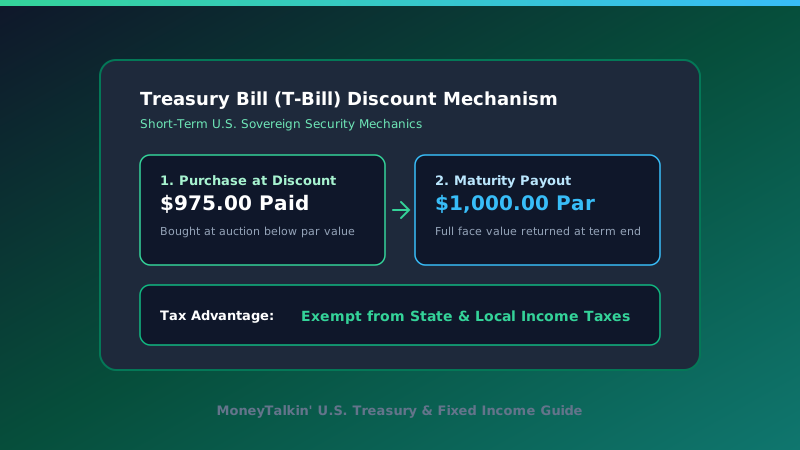
Unlike traditional corporate bonds or Treasury notes that pay periodic semi-annual interest checks (coupons), T-bills are zero-coupon securities sold at a discount to face value (par value).
[Purchase T-Bill at Discount Price] ➔ Hold to Term End ➔ Receive Full $1,000 Par Value at Maturity
How the Discount Pricing Works
- You purchase a T-bill at an auction or secondary market price below its $1,000 face value (for example, paying $975.00 for a 52-week T-bill).
- You hold the T-bill until its maturity date.
- Upon maturity, the U.S. Treasury pays you the full $1,000.00 par value.
- The difference between your discounted purchase price and the $1,000 face value ($1,000 - $975 = $25.00) represents your earned interest income.
Yield Calculation Formula
The annualized yield on a Treasury bill is calculated based on the discount percentage relative to the purchase price and days to maturity:
$$\text{Annualized Yield} = \left( \frac{\text{Par Value} - \text{Purchase Price}}{\text{Purchase Price}} \right) \times \left( \frac{365}{\text{Days to Maturity}} \right) \times 100%$$
3. State and Local Tax Exemptions
A major advantage of investing in U.S. Treasury bills—particularly for investors residing in high-tax states like California, New York, or New Jersey—is their special tax status under federal law (31 U.S.C. § 3124):
- Exempt from State and Local Income Taxes: Interest earned on T-bills is completely free from state, county, and municipal income taxes.
- Subject to Federal Income Tax: Interest income earned from T-bills is subject to federal income tax in the year the security matures (reported on Form 1099-INT).
Tax Efficiency Comparison: T-Bills vs. Bank CDs
If a bank Certificate of Deposit (CD) and a 26-week T-bill both offer a 5.00% nominal yield, a resident paying a 7.00% state income tax rate will achieve a higher net after-tax return from the T-bill because the interest is exempt from state tax.
4. How to Buy Treasury Bills
Retail investors can purchase T-bills through two main distribution channels:
A. Directly via TreasuryDirect.gov
Investors can open an account at TreasuryDirect.gov (the official portal managed by the U.S. Department of the Treasury) to buy non-competitive auction bids directly from the government:
- Zero Commission Fees: No brokerage commissions or account management fees.
- Automatic Reinvestment: You can schedule automatic reinvestment into a new T-bill when your current security matures.
- Holding Period: Securities bought on TreasuryDirect must be held for at least 45 days before transferring to an external brokerage.
B. Secondary Market via Brokerage Accounts
Investors can also buy new-issue auction T-bills or existing secondary market T-bills through major online brokerage firms (such as Fidelity, Schwab, or Vanguard):
- Commission-Free Secondary Purchases: Most major brokerages offer commission-free online Treasury trading.
- Superior Liquidity: Buying via a brokerage account allows you to sell your T-bill on the secondary market at any time before maturity if you need immediate cash.
5. T-Bills vs. Bank CDs vs. High-Yield Savings Accounts
To evaluate where T-bills fit in a cash management strategy, compare them against alternative liquid deposit options:
| Feature | U.S. Treasury Bills (T-Bills) | Certificates of Deposit (CDs) | High-Yield Savings Account (HYSA) |
|---|---|---|---|
| Issuer / Guarantor | U.S. Federal Government | FDIC-Insured Commercial Banks | FDIC-Insured Commercial Banks |
| Insurance / Backing | Full Faith & Credit of U.S. | FDIC / NCUA insured up to $250k | FDIC / NCUA insured up to $250k |
| State Tax Treatment | Exempt from state/local tax | Subject to state/local tax | Subject to state/local tax |
| Liquidity | Tradable on secondary market | Early withdrawal penalty fee | Liquid (with monthly limits) |
| Interest Rate Risk | Price fluctuates prior to maturity | Rate locked for term duration | Variable rate (changes anytime) |
| Minimum Purchase | $100 | Varies ($500 to $1,000+) | Varies ($0 to $100) |
6. Risks to Consider When Investing in T-Bills
While T-bills carry zero credit default risk, investors should understand secondary market risks:
- Interest Rate / Secondary Price Risk: If you hold a T-bill until its final maturity date, you are guaranteed to receive the full $1,000 par value. However, if you choose to sell a T-bill on the secondary market before maturity, its market price fluctuates inversely with prevailing interest rates. If market rates rise, the resale price of an existing T-bill drops.
- Reinvestment Risk: Because T-bills have short maturity horizons (4 to 52 weeks), when your T-bill matures, prevailing market yields may have dropped. Reinvesting maturing proceeds under lower market rates reduces future income.
- Inflation Risk: If consumer price inflation rises above your T-bill yield, the real purchasing power of your investment declines over time.
7. Practical Summary Checklist for Buying T-Bills
To add U.S. Treasury bills to your portfolio, follow this step-by-step checklist:
- Determine Your Cash Timeline: Select maturity terms (4, 8, 13, 26, or 52 weeks) that match your liquidity needs.
- Compare After-Tax Yields: Calculate your state tax rate to compare T-bill after-tax returns against bank CDs or HYSAs.
- Choose a Purchase Method: Use TreasuryDirect.gov for simple automated reinvestment or a brokerage account for secondary trading flexibility.
- Hold to Maturity When Possible: Hold your T-bills until maturity to avoid secondary market price fluctuations and guarantee full par payout.
- Build a T-Bill Ladder: Stagger maturities across 4-week, 13-week, and 26-week terms to maintain continuous monthly liquidity.
Sources
- U.S. Department of the Treasury: TreasuryDirect Official Securities Portal & T-Bill Auction Rules https://www.treasurydirect.gov/marketable-securities/treasury-bills/
- Internal Revenue Service (IRS): Publication 550: State Tax Exemption Rules for U.S. Government Obligations https://www.irs.gov/forms-pubs/about-publication-550
- Federal Reserve Bank of St. Louis (FRED): U.S. Treasury Bill Yield Data https://fred.stlouisfed.org/
Educational Disclaimer
This guide is for educational and informational purposes only and does not constitute formal tax, legal, or investment advisory services. Treasury yields, auction schedules, and secondary market prices change dynamically with market conditions. Consult a qualified financial advisor regarding your investment portfolio.
MoneyTalkin' provides financial education, educational concepts, and general informational guides. Articles do not constitute personalized financial, investment, legal, or tax advice. Financial products, rates, terms, and regulatory rules change frequently; consult a qualified financial professional regarding your specific situation. Read our full Disclaimer Policy.
Written by MoneyTalkin'
MoneyTalkin' researches and publishes objective financial education content, money management fundamentals, and practical financial guides.
Related Technical Articles
Explore related topics in this cluster to deepen your understanding.