Asset Allocation: Balancing Time Horizon, Goals, and Risk Tolerance
Learn how asset allocation works, how stock-to-bond mixes relate to time horizon and risk tolerance, and how rebalancing maintains portfolio targets.
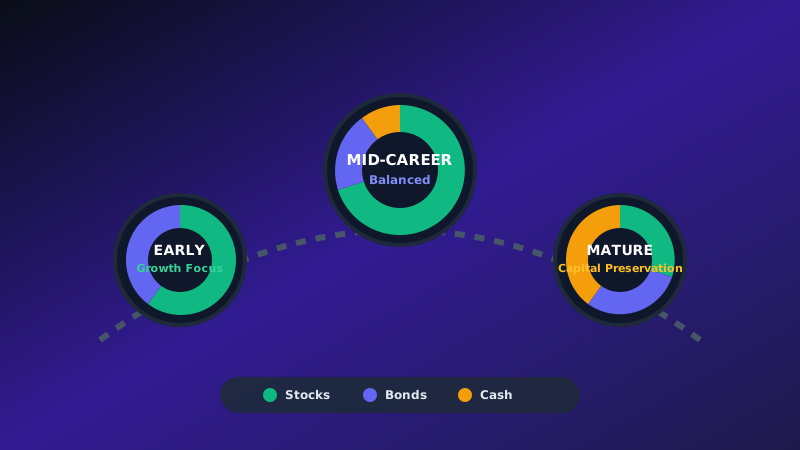
Asset allocation—the strategic division of an investment portfolio among broad asset classes such as stocks, bonds, cash, and real estate—is widely recognized by financial economists as the single most critical determinant of long-term investment performance and portfolio volatility. Studies show that over 90% of a portfolio's return variability is driven by its macro asset allocation, rather than individual stock picking or market timing.
As you progress through life, your financial goals, risk tolerance, and investment horizon fundamentally shift. A 22-year-old starting their first job has decades to recover from market downturns and can afford an aggressive growth strategy. Conversely, a 62-year-old approaching retirement must prioritize capital preservation and income generation.
In this definitive guide, we break down asset allocation principles by age decade, explore classic mathematical formulas, compare risk profiles, provide concrete portfolio models, demonstrate how to rebalance your assets as you age, analyze human capital vs. financial capital, and answer key beginner questions.
Core Concepts of Asset Allocation
Before examining age-based models, it is essential to understand the primary asset classes and their financial characteristics.
+-----------------------------------------------------------------------------------+
|                            PRIMARY ASSET CLASSES                                  |
+---------------------+---------------------+------------------+--------------------+
| STOCKS (EQUITIES)   | BONDS (FIXED INCOME)| CASH EQUIVALENTS | REAL ESTATE / ALT  |
| Growth Potential    | Stability & Income  | Absolute Safety  | Inflation Hedge    |
| High Volatility     | Low-Moderate Return | Zero Capital Gain| Moderate Income    |
+---------------------+---------------------+------------------+--------------------+
1. Equities (Stocks)
- Role: Primary engine of capital growth and inflation protection.
- Risk Profile: High volatility in the short term, but historically high real returns (7%–10% annualized historically after inflation) over multi-decade periods.
- Sub-classes: US Large-Cap, US Small-Cap, Developed International, Emerging Markets.
2. Fixed Income (Bonds)
- Role: Capital preservation, income generation, and volatility damping.
- Risk Profile: Low to moderate volatility. Provides steady interest coupon payments, but lower long-term capital appreciation potential than equities.
- Sub-classes: US Treasury bonds, Investment-grade Corporate bonds, Municipal bonds, Inflation-protected securities (TIPS).
3. Cash and Cash Equivalents
- Role: Immediate liquidity and emergency protection.
- Risk Profile: Zero nominal capital loss risk (when FDIC insured), but suffers real purchasing power erosion due to inflation over time.
- Types: High-Yield Savings Accounts (HYSAs), Money Market Funds, Short-term Treasury Bills.
Traditional Asset Allocation Rules of Thumb
Historically, financial advisors relied on simple mathematical formulas to estimate an investor's stock-to-bond ratio based on their age.
Rule 1: The Classic "100 Minus Your Age" Rule
The traditional rule states that the percentage of your portfolio allocated to stocks should equal 100 minus your current age, with the remaining percentage held in bonds. $$\text{Stock Allocation %} = 100 - \text{Age}$$
- Example at Age 30: $100 - 30 = 70%$ Stocks / $30%$ Bonds.
- Example at Age 60: $100 - 60 = 40%$ Stocks / $60%$ Bonds.
Rule 2: The Modern "110 or 120 Minus Your Age" Rule
Because average life expectancies have increased and interest rates on fixed income have fluctuated, modern financial planners often update the formula to 110 or 120 minus age: $$\text{Stock Allocation %} = 110 - \text{Age} \quad \text{or} \quad 120 - \text{Age}$$ For a 30-year-old under the 110-rule, the target becomes 80% Stocks / 20% Bonds, providing greater growth potential during early career years.
Decade-by-Decade Asset Allocation Models
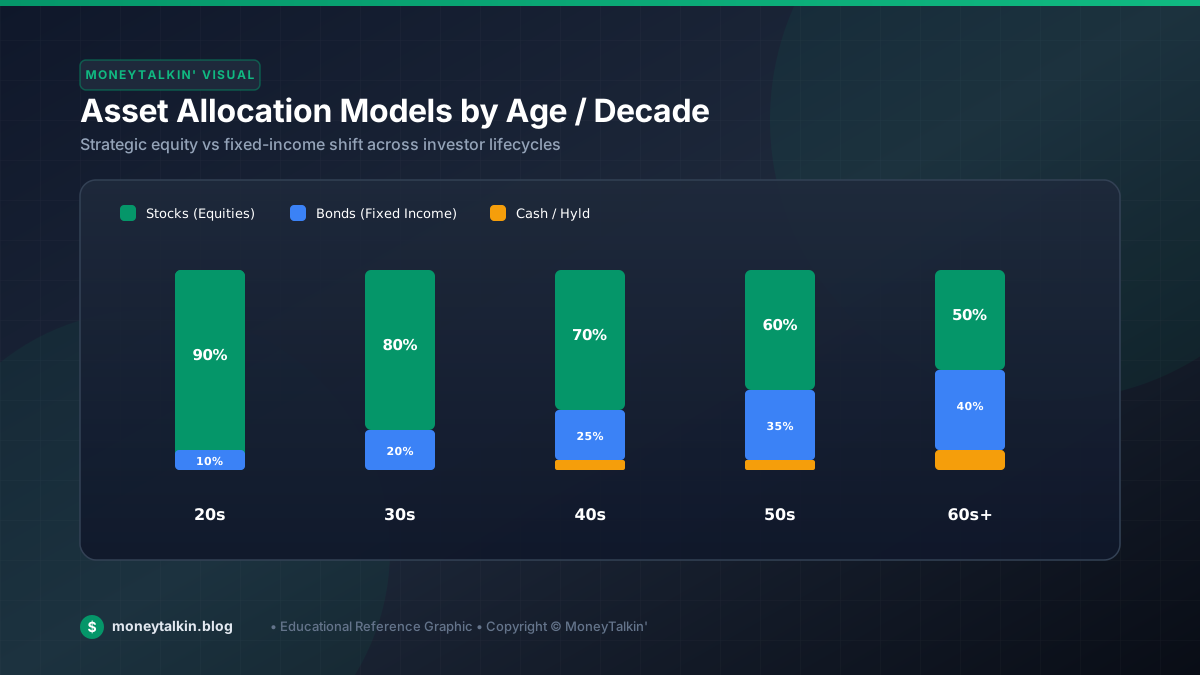
Let's examine recommended baseline asset allocations for each major stage of life.
1. In Your 20s: Maximum Growth Focus (Age 20–29)
- Target Allocation: 90%–100% Stocks | 0%–10% Bonds
- Primary Objective: Maximize long-term compound growth.
- Why it Works: With a 30-to-40-year horizon before retirement, market crashes (such as 2008 or 2020) are actually buying opportunities to accumulate shares at discounted prices.
SAMPLE 20s PORTFOLIO BREAKDOWN:
[ 60% US Total Stock Market Index (VTI/SCHB)     ]
[ 30% International Stock Market Index (VXUS)     ]
[ 10% Cash / Emergency Fund Reserves (HYSA)      ]
2. In Your 30s: Foundation & Consolidation (Age 30–39)
- Target Allocation: 80%–90% Stocks | 10%–20% Bonds
- Primary Objective: Sustained capital accumulation while managing growing financial responsibilities (homeownership, children).
- Why it Works: Introducing a modest 10%–20% bond allocation helps smooth out portfolio drawdowns without significantly dampening long-term compound growth.
3. In Your 40s: Balanced Growth & Risk Awareness (Age 40–49)
- Target Allocation: 70%–80% Stocks | 20%–30% Bonds
- Primary Objective: Balance growth with risk mitigation as peak earning years begin.
- Portfolio Focus: Ensure diversification across US equities, international equities, high-grade core bonds, and real estate investment trusts (REITs).
4. In Your 50s: Pre-Retirement Transition (Age 50–59)
- Target Allocation: 60%–70% Stocks | 30%–40% Bonds & Cash
- Primary Objective: Protect accumulated capital while keeping pace with inflation.
- Why it Works: A major market collapse 5 years before planned retirement can severely disrupt retirement timelines. Increasing bond allocations reduces downside drawdowns during market corrections.
5. In Your 60s and Beyond: Income & Capital Preservation (Age 60+)
- Target Allocation: 40%–50% Stocks | 40%–50% Bonds | 10% Cash Equivalents
- Primary Objective: Generate sustainable retirement income while defending against longevity risk (outliving your money).
Comprehensive Asset Allocation Comparison Table
| Age Decade | Recommended Stocks | Recommended Bonds | Recommended Cash | Primary Investment Goal | Risk Tolerance Level |
|---|---|---|---|---|---|
| 20s | 90% – 100% | 0% – 10% | 0% – 5% | Aggressive Growth | High / Insensitive to dips |
| 30s | 80% – 90% | 10% – 20% | 5% | Long-Term Growth | Moderate High |
| 40s | 70% – 80% | 20% – 30% | 5% – 10% | Balanced Growth | Moderate |
| 50s | 60% – 70% | 30% – 40% | 10% | Growth & Preservation | Moderate Low |
| 60s+ | 40% – 50% | 40% – 50% | 10% – 15% | Income & Preservation | Low / Conservative |
Human Capital vs. Financial Capital Economics
A vital concept in portfolio theory is the relationship between Human Capital and Financial Capital.
CAPITAL SHIFT OVER AN INVESTOR'S LIFESPAN:
[ Early Career (Age 25) ]  ---> High Human Capital (Future Earnings) | Low Financial Capital
[ Mid Career (Age 45)   ]  ---> Equal Human Capital & Financial Capital
[ Late Career (Age 65)  ]  ---> Low Human Capital (Retiring)        | High Financial Capital
- Human Capital: The net present value of all future earnings you will generate over your remaining working years. In your 20s, your human capital is at its peak, acting essentially like a massive bond. Because your future labor provides steady income, your financial portfolio can afford to be 100% equities.
- Financial Capital: As you age, human capital is converted into financial capital through wages, savings, and investments. In your 60s, your human capital reaches zero upon retirement, requiring your financial capital to adopt a safer bond/cash allocation to generate steady income.
How to Rebalance Your Portfolio Over Time
Setting up an age-appropriate asset allocation is not a "set-it-and-forget-it" task. Over time, stock market gains will naturally push your portfolio out of balance.
What Is Rebalancing?
If your target is 80% Stocks / 20% Bonds, and a bull market increases your stock value until your portfolio becomes 90% Stocks / 10% Bonds, you are taking on more market risk than intended. Rebalancing means selling a portion of your outperforming assets (stocks) and buying underperforming assets (bonds) to restore your original target ratios.
Three Methods for Portfolio Rebalancing
- Calendar Rebalancing: Reviewing and adjusting your portfolio at fixed intervals (e.g., once a year every December).
- Threshold Rebalancing: Rebalancing only when an asset class deviates by more than 5% from its target allocation (e.g., stocks moving from 80% to 86%).
- New Money Rebalancing: Directing new monthly savings contributions into the underweighted asset class until target ratios are naturally restored, avoiding taxable sales in non-tax-advantaged accounts.
Frequently Asked Questions (FAQ)
Is a 100% stock portfolio safe for a 25-year-old?
For a young investor with a 30+ year timeline and an established emergency fund, a 100% broad-market equity portfolio (such as total market index funds) is widely considered acceptable, provided the investor has the emotional discipline not to panic-sell during market crashes.
How do Target Date Funds handle asset allocation?
Target Date Funds (TDFs) automate asset allocation using a "glide path." As you get closer to the target year (e.g., Target Date 2060), the fund automatically shifts its holdings from aggressive equities to conservative bonds and cash without requiring manual intervention.
Should housing equity be counted in asset allocation?
Primary residence home equity should generally not be included in your liquid asset allocation matrix, as you cannot easily sell a fraction of your house to pay for daily living expenses or rebalance into bonds.
How does pension or Social Security income affect asset allocation?
Guaranteed income sources like pensions or Social Security act like fixed-income (bond) holdings. If Social Security covers 50% of your baseline living expenses, you may be able to maintain a slightly higher equity percentage in your investment portfolio during retirement.
Editorial Summary & Related Content
Tailoring your asset allocation to your age and risk tolerance is one of the most effective ways to compound wealth while protecting your peace of mind. As you transition through life's milestones, periodically review your targets to stay aligned with your evolving goals.
Explore complementary investing guides on MoneyTalkin':
- The Power of Compound Interest
- Index Funds vs. Individual Stocks
- How Much Money Do You Need to Retire?
Disclaimer: MoneyTalkin' provides financial education for informational purposes only. Asset allocation models are general guidelines and do not constitute individualized investment advice. Past performance is no guarantee of future returns. Consult a registered investment advisor (RIA) for personalized guidance.
MoneyTalkin' provides financial education, educational concepts, and general informational guides. Articles do not constitute personalized financial, investment, legal, or tax advice. Financial products, rates, terms, and regulatory rules change frequently; consult a qualified financial professional regarding your specific situation. Read our full Disclaimer Policy.
Written by MoneyTalkin'
MoneyTalkin' researches and publishes objective financial education content, money management fundamentals, and practical financial guides.
Related Technical Articles
Explore related topics in this cluster to deepen your understanding.