How Much Money Do You Need to Retire? The 4% Framework & Calculation Models
Understand how to estimate retirement savings targets using the 4% historical benchmark, 25x expense multiplier, and dynamic withdrawal concepts.

How Much Money Do You Need to Retire? The 4% Rule and Nest Egg Calculation Models
Determining your retirement target—often referred to as your "FI/RE number" or retirement nest egg—is one of the most critical calculations in financial planning. Rather than picking an arbitrary number like $1,000,000, calculating your personal retirement target requires evaluating your expected annual retirement expenses against proven safe withdrawal rate models.
The primary framework used by financial advisors is the 4% Rule, derived from landmark financial research known as the Trinity Study. This guide breaks down how the 4% rule works, how to calculate your nest egg using the Rule of 25, and how to account for inflation, taxes, and market volatility.
Executive Summary: Retirement Math Fundamentals
- The Rule of 25: Target Nest Egg = Expected Annual Retirement Expenses $\times 25$.
- The 4% Safe Withdrawal Rate (SWR): In your first year of retirement, withdraw 4% of your total portfolio. In subsequent years, adjust that dollar withdrawal upward for inflation.
- Trinity Study Finding: A portfolio of 50% to 75% equities historically survived 30-year retirement periods in over 95% of market scenarios.
- Key Adjustments: Early retirees (retiring before age 55) should use a more conservative 3.25% to 3.5% withdrawal rate.
The Rule of 25: Calculating Your Target Nest Egg
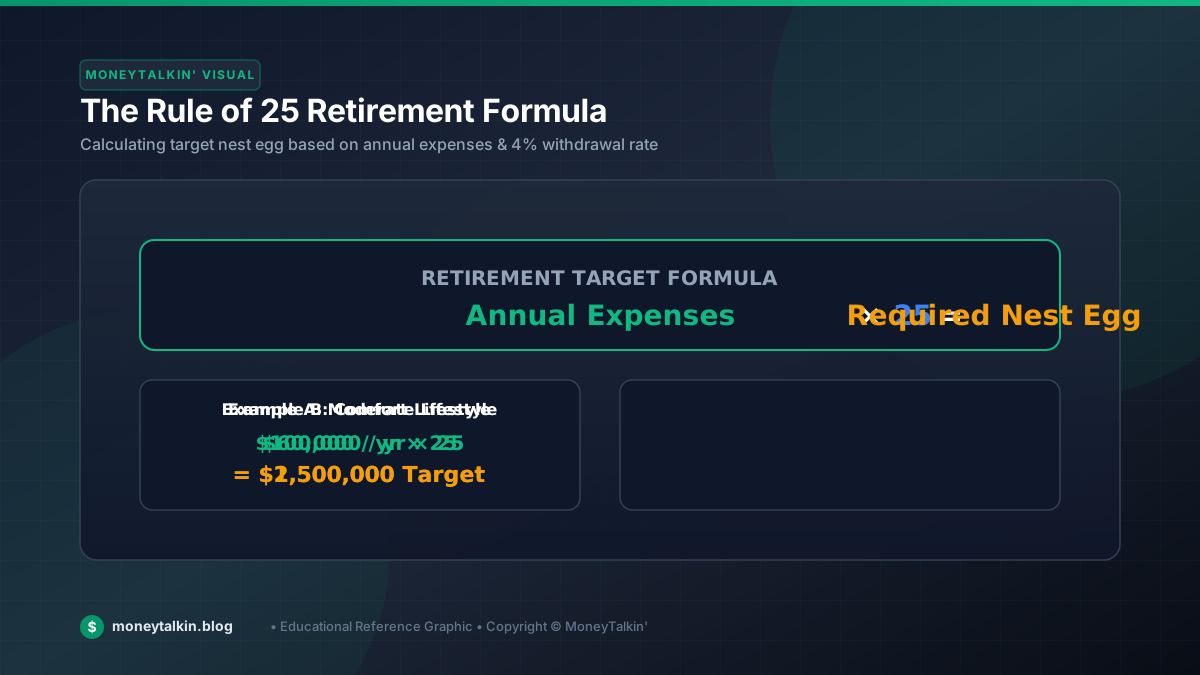
The simplest way to calculate your required retirement savings is the Rule of 25, which is the mathematical inverse of the 4% withdrawal rate ($1 / 0.04 = 25$).
$$\text{Target Retirement Nest Egg} = \text{Annual Retirement Expenses} \times 25$$
                   THE RULE OF 25 NEST EGG CALCULATION
┌───────────────────────────┐     ┌───────────────────────────┐     ┌───────────────────────────┐
│ Expected Annual Expenses  │  ×  │ Multiplier Constant (25)  │  =  │ Required Nest Egg Target  │
│ $60,000 / Year            │     │ 25                        │     │ $1,500,000                │
└───────────────────────────┘     └───────────────────────────┘     └───────────────────────────┘
Step-by-Step Mathematical Example
Consider a couple estimating their post-retirement spending needs:
- Desired Monthly Living Expenses: $4,500
- Annual Living Expenses ($4,500 \times 12$): $54,000
- Estimated Annual Taxes & Healthcare: $10,000
- Expected Social Security / Pension Income: -$18,000/year
- Net Annual Portfolio Withdrawal Need: $$64,000 - $18,000 = \mathbf{$46,000/\text{year}}$
Target Nest Egg Calculation
$$\text{Required Nest Egg} = $46,000 \times 25 = \mathbf{$1,150,000}$$
Understanding the 4% Rule and Trinity Study Background
The 4% rule originated from a 1998 study by Trinity University finance professors (Bicknell, Cooley, and Hubbard). They analyzed historical U.S. stock and bond market returns over overlapping 30-year periods from 1926 to 1995.
They evaluated whether a retiree withdrawing 4% in Year 1 (and adjusting for inflation annually) would run out of money:
| Portfolio Allocation | 30-Year Success Rate (4% Withdrawal) |
|---|---|
| 100% Equities (Stocks) | 98% Success |
| 75% Stocks / 25% Bonds | 100% Success |
| 50% Stocks / 50% Bonds | 96% Success |
| 100% Fixed Income (Bonds) | 40% Success (Failed due to inflation erosion) |
Key Limitations and Sequence-of-Returns Risk
While the 4% rule provides a solid starting point, retirees must account for three major real-world complications:
1. Sequence-of-Returns Risk
If a severe bear market occurs during the first 3 years of retirement, withdrawing 4% from a shrinking portfolio permanently damages its compounding capacity.
Mitigation: Maintain a 1-to-2-year cash buffer in an HYSA to avoid selling equities during market crashes.
2. Flexible Withdrawal Ratios
Rather than rigidly withdrawing 4% plus inflation every year, flexible strategies (like cutting discretionary travel spending by 10% during bear markets) dramatically increase portfolio survival rates.
3. Longer Retirement Horizons
The Trinity Study evaluated a 30-year timeframe. For early retirees planning for a 40-to-50-year retirement, using a 3.25% to 3.50% withdrawal rate (Rule of 28 to 30) provides greater safety.
Practical Takeaway Checklist
- Estimate your expected annual retirement expenses (excluding paid-off mortgage costs).
- Subtract guaranteed income sources (Social Security, pensions).
- Multiply your net annual expense need by 25 to establish your baseline target.
- Build a 1-to-2-year cash buffer to mitigate sequence-of-returns risk.
Sources
- Journal of Financial Planning / Trinity Study: Retirement Savings: Choosing a Withdrawal Rate That Is Sustainable (Cooley, Hubbard, Walz)
- Social Security Administration (SSA): Retirement Estimator & Benefit Calculations
https://www.ssa.gov/benefit-calculators/
Disclaimer
Educational content only. Consult a certified financial planner (CFP) for personalized retirement income modeling.
The 4% Rule & Sequence of Returns Risk
The 4% Rule—originating from the Trinity Study—suggests that retirees can withdraw 4% of their initial portfolio balance in year one of retirement, adjust that dollar amount for inflation annually, and maintain a high probability of portfolio survival over a 30-year horizon.
Sequence of Returns Risk
Sequence of returns risk refers to the danger of experiencing severe market downturns in the early years of retirement. If a retiree encounters a 20% equity market decline in Years 1 and 2 while continuing to withdraw 4%, the portfolio's principal base shrinks permanently, accelerating capital depletion.
Mitigating sequence of returns risk requires maintaining 2 to 3 years of living expenses in liquid cash or short-term fixed income assets, as covered in asset allocation rebalancing explained.
Key Factors Influencing Your Personal Retirement Target
Your specific retirement target depends on personal lifestyle and geographic variables:
- Planned Healthcare Expenses: Budgeting for Medicare premiums, supplemental insurance policies, and out-of-pocket medical costs prior to age 65.
- Housing Tax & Debt Status: Entering retirement with a fully paid-off mortgage significantly lowers mandatory baseline cash flow needs.
- Social Security Claiming Age: Delaying Social Security benefits from age 62 to age 70 increases monthly benefit payouts by up to 8% per year.
Core Retirement Readiness Checklist
- Estimate Annual Retirement Expenses: Calculate baseline spending requirements, factoring in housing, healthcare, and discretionary travel.
- Subtract Guaranteed Income: Offset spending target with expected Social Security or pension benefits.
- Determine Portfolio Target: Multiply remaining net annual expense needs by 25 to establish your baseline 4% rule portfolio goal.
Educational Summary & Key Definitions
Understanding financial fundamentals requires mastering core vocabulary and operational definitions:
- Principal: The original amount of money deposited or borrowed, excluding interest earnings or finance charges.
- Annual Percentage Yield (APY): The real rate of return earned on a deposit account, taking into account the effect of compounding interest over a 12-month period.
- Liquidity: The ease and speed with which an asset can be converted into liquid cash without incurring significant capital loss.
- Diversification: An investment risk management strategy that mixes a wide variety of investments within a portfolio to limit exposure to any single asset class.
Consulting official regulatory guidelines—such as disclosures from the CFPB, FDIC, NCUA, and Federal Reserve—ensures you make informed financial decisions backed by verified consumer protections.
MoneyTalkin' provides financial education, educational concepts, and general informational guides. Articles do not constitute personalized financial, investment, legal, or tax advice. Financial products, rates, terms, and regulatory rules change frequently; consult a qualified financial professional regarding your specific situation. Read our full Disclaimer Policy.
Written by MoneyTalkin'
MoneyTalkin' researches and publishes objective financial education content, money management fundamentals, and practical financial guides.
Related Technical Articles
Explore related topics in this cluster to deepen your understanding.