Portfolio Rebalancing Explained: When and How to Rebalance
A practical investment guide explaining portfolio rebalancing, drift mechanics, calendar and threshold strategies, tax implications, and behavioral discipline.
Portfolio Rebalancing Explained: When and How to Rebalance
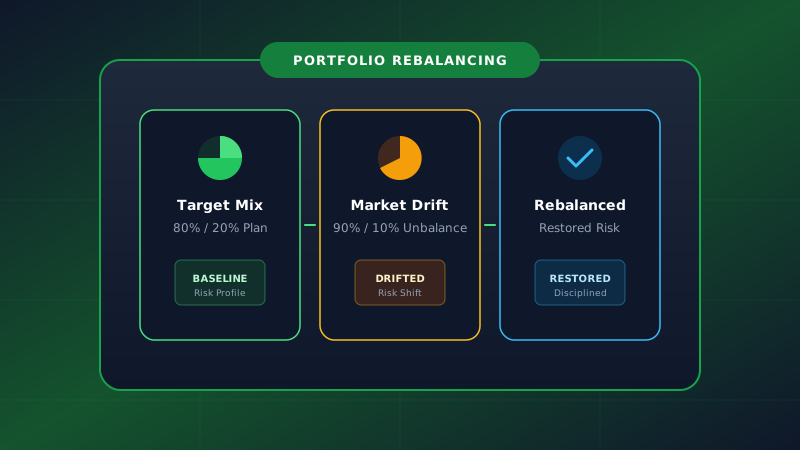
Establishing an initial asset allocation is one of the most important decisions an investor makes. However, creating a target portfolio split—such as 80% equities and 20% fixed income—is not a set-it-and-forget-it event. As stock and bond prices fluctuate, your portfolio's actual weights shift away from your target. This process is known as portfolio drift.
To bring your portfolio back into alignment with your target risk profile, you must execute portfolio rebalancing.
While choosing a target allocation reflects your long-term risk capacity—as detailed in our guide on asset allocation by age—this guide focuses specifically on the mechanics, timing strategies, tax implications, and execution methods of rebalancing.
Understanding how to rebalance effectively—including calendar vs. threshold triggers, cash flow rebalancing, tax-advantaged vs. taxable account rules, and behavioral discipline—helps investors maintain portfolio control alongside resources on choosing index funds vs. individual stocks, managing taxable brokerage accounts, and utilizing tax-advantaged retirement accounts.
1. What Is Portfolio Rebalancing and Why Does Allocation Drift?
Portfolio rebalancing is the process of buying or selling assets within a portfolio to restore holdings to your target asset allocation weights.
Why Allocations Drift
Different asset classes generate different returns over time:
- During stock market bull runs, equities outpace bonds, causing the stock portion of your portfolio to expand beyond your target percentage.
- During market pullbacks, equities decline relative to bonds, causing your portfolio to become unintentionally conservative.
[Target: 80% Stocks / 20% Bonds] ➔ [Bull Market Drift: 90% Stocks / 10% Bonds] ➔ [Rebalance Back to 80/20]
Purpose of Rebalancing: Risk Control, Not Return Maximization
A common misconception is that rebalancing is designed to maximize investment returns.
In reality, rebalancing is a risk-management tool. Its primary objective is to maintain your portfolio's risk exposure within your intended comfort zone. If a 80/20 stock/bond portfolio drifts to 90/10, the investor is unknowingly taking on significantly higher risk and potential drawdowns during the next market decline.
2. Primary Rebalancing Strategies
Investors utilize three primary methods for determining when to rebalance:
| Rebalancing Strategy | How It Works | Advantages | Potential Disadvantages |
|---|---|---|---|
| Calendar-Based | Rebalance at fixed time intervals (e.g., annually or semi-annually) | Simple, predictable, eliminates daily monitoring | May trigger unnecessary trades during low-volatility periods |
| Threshold-Based (Tolerance Bands) | Rebalance when an asset class drifts by a specific percentage (e.g., ±5% or ±10%) | Responds directly to market movements; avoids trading when drift is minor | Requires ongoing monitoring of account weights |
| Hybrid Approach | Check allocations on a fixed schedule (e.g., annually), but rebalance only if threshold is breached | Combines structure with trading efficiency | Requires basic discipline and routine checks |
Rule of Thumb: Financial research suggests that rebalancing annually or setting a ±5% absolute threshold band balances portfolio control with minimal trading friction.
3. Execution Methods: Cash Flow vs. Re-allocation Trades
Once a rebalancing need is identified, investors can restore target weights using two different execution methods:
Method A: Cash Flow Rebalancing (No Asset Sales)
For investors who are actively contributing new money to their portfolios (such as monthly 401(k) or IRA contributions), the most efficient way to rebalance is through new cash inflows:
- Direct incoming monthly contributions entirely toward the asset classes that are currently underweight.
- Let fresh capital restore your target proportions over time without selling any existing positions.
Key Benefit: Cash flow rebalancing avoids selling appreciated assets, eliminating capital gains taxes in taxable brokerage accounts and avoiding transaction fees.
Method B: Re-allocation Trades (Selling Overweight & Buying Underweight)
If new cash inflows are insufficient to correct a large drift (or during retirement drawdown phases), you must execute re-allocation trades:
- Sell a portion of the overweight asset class that has outperformed.
- Direct the sale proceeds to buy the underweight asset class that has lagged behind.
4. Rebalancing in Tax-Advantaged vs. Taxable Accounts
Where you rebalance makes a substantial difference in tax efficiency:
A. Tax-Advantaged Accounts (401(k)s, IRAs, HSAs)
Inside tax-sheltered accounts like Traditional IRAs, Roth IRAs, and 401(k)s, asset sales do not trigger taxable events. You can sell appreciated stock funds and buy bond funds freely without incurring capital gains taxes.
Best Practice: Perform re-allocation trades primarily inside your tax-advantaged accounts to keep your overall household allocation balanced without tax friction.
B. Taxable Brokerage Accounts
Inside a taxable brokerage account, selling appreciated assets triggers realized capital gains subject to federal and state capital gains taxes.
Strategies for Taxable Accounts:
- Use Cash Flow Rebalancing First: Route dividends and new savings into underweight assets.
- Harvest Tax Losses: Execute tax-loss harvesting to offset capital gains generated from rebalancing trades.
- Donate Appreciated Shares: Donate appreciated stock shares to qualified charities to reduce overweight equity exposure without triggering capital gains tax.
5. Behavioral Challenges: Buying Low and Selling High
While the rule "buy low and sell high" is universally accepted, executing it through rebalancing requires emotional discipline:
- Selling "Winners": Rebalancing requires selling a portion of the asset class that has performed best recently. During a strong stock market rally, selling equities to buy bonds feels counterintuitive.
- Buying "Losers": Rebalancing requires shifting capital into asset classes that have underperformed. During a market crash, buying equities requires courage to act against prevailing fear.
Following a systematic, rule-based rebalancing plan eliminates emotional decision-making and automates buying low and selling high over multi-year cycles.
6. Hypothetical Rebalancing Example
To see how rebalancing operates in practice, consider an investor with a $100,000 portfolio:
Initial Target Allocation
- Stock Index Funds (80% Target): $80,000
- Bond Index Funds (20% Target): $20,000
- Total Portfolio: $\mathbf{$100,000}$
Year-End Market Movement (Bull Market Run)
After a strong equity rally, stocks gain +25% ($80k grows to $100k) while bonds gain 0% ($20k stays $20k):
- Stock Value: $100,000 (83.3% of total)
- Bond Value: $20,000 (16.7% of total)
- New Total Portfolio: $\mathbf{$120,000}$
- Market Drift: Stocks are +3.3% overweight; bonds are -3.3% underweight.
Rebalancing Action (Restoring 80/20 Target)
To restore the 80/20 target ratio on a $120,000 portfolio, target holdings are:
- Target Stocks (80% of $120k): $96,000
- Target Bonds (20% of $120k): $24,000
Execution Trade:
The investor sells $4,000 of stock index funds (reducing stock holdings from $100,000 to $96,000) and purchases $4,000 of bond index funds (increasing bond holdings from $20,000 to $24,000), restoring the portfolio to its 80/20 target ratio.
Hypothetical example for illustrative purposes.
7. Practical Summary Checklist for Rebalancing
Follow this practical checklist to maintain your portfolio allocation:
- Establish Written Target Allocations: Define explicit percentage targets for stocks, bonds, and cash based on your asset allocation by age.
- Choose a Rebalancing Strategy: Select a calendar interval (e.g., once every December) or a drift threshold (e.g., ±5%).
- Utilize New Contributions First: Direct incoming monthly savings toward underweight assets to minimize selling.
- Prioritize Rebalancing Inside Tax-Sheltered Accounts: Conduct trades inside 401(k)s and IRAs to avoid capital gains taxes.
- Check Transaction Costs: Verify that your brokerage charges $0 commissions on index fund and ETF rebalancing trades.
- Stick to the Plan Emotionally: Resist the temptation to modify target allocations based on short-term market headlines or market noise.
Sources
- U.S. Securities and Exchange Commission (SEC): Beginner's Guide to Asset Allocation, Diversification, and Rebalancing https://www.investor.gov/introduction-investing/investing-basics/asset-allocation-diversification-and-rebalancing
- FINRA Investor Education Foundation: Understanding Portfolio Drift & Rebalancing Strategies https://www.finra.org/investors/learn-to-invest/manage-your-money/rebalancing-your-portfolio
- Vanguard Research: Best Practices for Portfolio Rebalancing https://corporate.vanguard.com/
Educational Disclaimer
This guide is for educational purposes only and does not constitute formal tax, legal, or investment advice. Rebalancing strategies, tax consequences, and market outcomes vary based on individual portfolio structures and tax jurisdictions. Consult a qualified fee-only financial planner or CPA for personalized guidance.
MoneyTalkin' provides financial education, educational concepts, and general informational guides. Articles do not constitute personalized financial, investment, legal, or tax advice. Financial products, rates, terms, and regulatory rules change frequently; consult a qualified financial professional regarding your specific situation. Read our full Disclaimer Policy.
Written by MoneyTalkin'
MoneyTalkin' researches and publishes objective financial education content, money management fundamentals, and practical financial guides.
Related Technical Articles
Explore related topics in this cluster to deepen your understanding.