Taxable Brokerage Accounts Explained: How They Work and How Taxes Apply
A beginner-friendly U.S. investing guide explaining taxable brokerage accounts, capital gains taxation, dividend rules, tax-loss harvesting, and account flexibilities.
Taxable Brokerage Accounts Explained: How They Work and How Taxes Apply
Building wealth requires investing capital in financial markets. While tax-advantaged accounts like 401(k)s and IRAs offer valuable tax shelters, they impose annual contribution limits and early withdrawal penalties prior to age 59½.
To invest without contribution caps or age restrictions, investors utilize taxable brokerage accounts (also called individual taxable accounts).
Understanding how taxable brokerage accounts operate—including short-term vs. long-term capital gains, qualified dividend rules, realized vs. unrealized gains, tax-loss harvesting, and the IRS wash-sale rule—helps investors integrate taxable accounts alongside tax-advantaged retirement accounts, core assets like index funds vs. individual stocks, strategies like dollar-cost averaging, and cost metrics like fund expense ratios.
1. What Is a Taxable Brokerage Account?
A taxable brokerage account is a standard investment account opened with a financial institution or brokerage firm.
Key features include:
- No Contribution Caps: You can deposit and invest an unlimited amount of money each year.
- Full Liquidity & Flexibility: Sell assets and withdraw cash at any age for any reason without IRS early withdrawal penalties.
- Annual Tax Obligations: Dividend income, interest, and realized capital gains are subject to annual federal and state taxes in the year generated.
Brokerage accounts support individual stocks, ETFs, mutual funds, corporate and municipal bonds, U.S. Treasury securities, money market funds, and cash equivalents.
2. Realized vs. Unrealized Capital Gains
Tax rules distinguish between realized and unrealized capital gains:
- Unrealized Capital Gain ("Paper Gain"): Occurs when an asset appreciates in market value while you hold it. Under IRS rules, unrealized gains are not taxed. You pay no tax simply because stock prices rose.
- Realized Capital Gain: Occurs when you sell an asset for more than your original purchase price (cost basis). Realized gains must be reported on your tax return (Schedule D / Form 8949) and are subject to capital gains tax.
Record-Keeping and Cost Basis Methods
Maintaining accurate cost-basis records (using accounting methods such as FIFO, Specific Identification, or Average Cost Basis) is essential for accurately calculating realized gains or losses when selling shares purchased at different times and prices.
3. Short-Term vs. Long-Term Capital Gains Tax Rates
When selling an investment for profit, the IRS classifies gains by holding period:
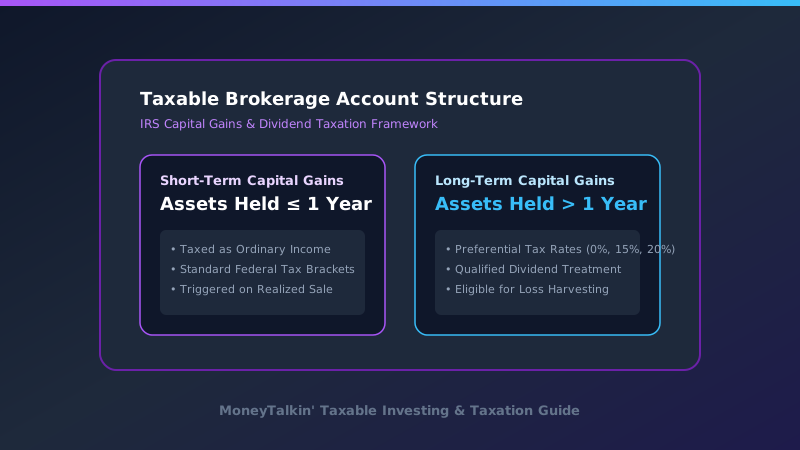
[Asset Held ≤ 1 Year] ➔ Short-Term Capital Gain ➔ Taxed at Ordinary Income Rates (10%–37%)
[Asset Held > 1 Year] ➔ Long-Term Capital Gain  ➔ Taxed at Preferential Capital Gains Rates (0%, 15%, 20%)
A. Short-Term Capital Gains (1 Year or Less)
Assets held 365 days or less incur short-term capital gains taxed at your ordinary income tax rate (10% to 37%), plus state income taxes.
B. Long-Term Capital Gains (More Than 1 Year)
Assets held at least 366 consecutive days qualify for preferential long-term capital gains tax rates:
- 0% Rate: Applies to lower income thresholds.
- 15% Rate: Applies to most middle-to-upper-income investors.
- 20% Rate: Applies to high-income filers.
- (Net Investment Income Tax): High earners may incur an additional 3.8% Net Investment Income Tax (NIIT).
Holding assets over one year offers a significant tax advantage, allowing long-term investors to keep more of their returns.
4. Taxation of Dividends and Interest Income
In addition to capital gains realized upon selling appreciated investments, assets held inside a taxable brokerage account often generate ongoing annual investment income in the form of dividends and interest distributions:
A. Qualified Dividends vs. Ordinary Dividends
- Qualified Dividends: Paid by domestic corporations and qualified foreign firms meeting IRS holding rules. Taxed at lower long-term capital gains rates (0%, 15%, or 20%).
- Ordinary (Non-Qualified) Dividends: Include REIT payouts or short-term holdings. Taxed at higher ordinary income tax rates.
B. Bond Interest Income
- Corporate Bond Interest: Taxed as ordinary income at federal and state levels.
- U.S. Treasury Interest: Exempt from state/local taxes; subject to federal tax.
- Municipal Bond Interest: Generally exempt from federal income tax (and state tax if issued in your home state).
Brokerages issue Form 1099-DIV, 1099-INT, and 1099-B each January detailing taxable distributions.
5. Tax-Loss Harvesting and the Wash-Sale Rule
Investors can use investment losses to offset taxable capital gains through tax-loss harvesting.
How Tax-Loss Harvesting Works
- Realized investment losses offset realized capital gains dollar-for-dollar.
- Net Loss Deduction: If losses exceed gains, you can deduct up to $3,000 of net capital losses against ordinary earned income on Form 1040. Unused losses carry forward indefinitely to future tax years.
The IRS Wash-Sale Rule
To prevent artificial loss harvesting while maintaining asset exposure, the IRS enforces the Wash-Sale Rule (IRC Section 1091):
[Sell Security at Loss] ➔ Buy "Substantially Identical" Security within 30 Days ➔ Loss Disallowed
- If you sell a security at a loss and buy a substantially identical security within 30 days before or after the sale date (a 61-day window), the tax loss is disallowed.
- The disallowed loss is added to the cost basis of the newly repurchased security.
6. Taxable Brokerage vs. Tax-Advantaged Accounts
Compare key characteristics across account types:
| Feature | Taxable Brokerage Account | Traditional IRA / 401(k) | Roth IRA / 401(k) |
|---|---|---|---|
| Annual Contribution Limit | Unlimited | Statutory limits apply | Statutory limits apply |
| Upfront Tax Deduction | None | Yes (if eligible) | None |
| Growth Taxation | Annual tax on dividends/gains | Tax-deferred growth | 100% Tax-free growth |
| Withdrawal Flexibility | 100% liquid at any age | 10% penalty before 59½ | 10% penalty on earnings before 59½ |
| Required Minimum Distributions | None | Mandatory RMDs at age 73/75 | None (original owner) |
Investors typically max out tax-sheltered retirement accounts first, directing remaining savings into taxable brokerage accounts for medium-term goals or early retirement bridge funds.
7. Practical Summary Checklist for Taxable Investing
To manage taxable investments effectively:
- Prioritize Tax-Sheltered Accounts: Maximize 401(k) matches and annual IRA limits before funding taxable accounts.
- Hold Assets Over 1 Year: Aim for 366+ day holding periods to qualify for long-term capital gains rates.
- Choose Tax-Efficient Assets: Prefer broad index ETFs over turnover-heavy mutual funds to minimize annual capital gains distributions.
- Harvest Tax Losses: Realize losses at year-end to offset capital gains and up to $3,000 of ordinary income.
- Observe Wash-Sale Rules: Wait 31+ days before repurchasing sold securities to preserve tax deductions.
Sources
- Internal Revenue Service (IRS): Publication 550: Investment Income and Expenses https://www.irs.gov/forms-pubs/about-publication-550
- Internal Revenue Service (IRS): Topic No. 409 Capital Gains and Losses https://www.irs.gov/taxtopics/tc409
- U.S. Securities and Exchange Commission (SEC): Investor Bulletin: Opening a Brokerage Account https://www.sec.gov/oiea/investor-alerts-bulletins/
Educational Disclaimer
This article is for educational purposes only and does not constitute tax, legal, or investment advice. Tax codes, capital gains brackets, and wash-sale rules vary by state law and change over time. Consult a CPA or financial advisor regarding your tax situation.
For health spending tax advantages, read our guide on Health Savings Accounts (HSAs).
MoneyTalkin' provides financial education, educational concepts, and general informational guides. Articles do not constitute personalized financial, investment, legal, or tax advice. Financial products, rates, terms, and regulatory rules change frequently; consult a qualified financial professional regarding your specific situation. Read our full Disclaimer Policy.
Written by MoneyTalkin'
MoneyTalkin' researches and publishes objective financial education content, money management fundamentals, and practical financial guides.
Related Technical Articles
Explore related topics in this cluster to deepen your understanding.