Dollar-Cost Averaging (DCA) Explained with Real Examples
Learn how dollar-cost averaging works, review a step-by-step mathematical example, and understand the trade-offs between DCA and lump-sum investing.
Dollar-Cost Averaging (DCA) Explained with Real-World Examples
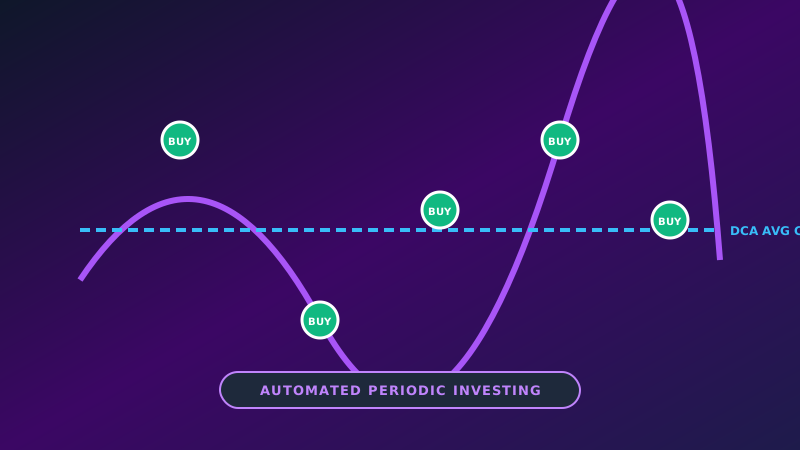
Dollar-Cost Averaging (DCA) is an investment strategy where an investor divides a total sum of money into equal, periodic purchases of a target asset (such as an index fund or stock) at regular time intervals, regardless of asset price.
Instead of trying to time the market—hoping to buy at the exact lowest price—a DCA investor invests a fixed dollar amount monthly or weekly. As a result, they automatically purchase more shares when prices are low and fewer shares when prices are high, smoothing out the average purchase cost per share over time.
Executive Summary: DCA Overview
- Core Mechanism: Investing a fixed dollar amount (e.g., $500) at regular intervals (e.g., the 1st of every month).
- Primary Benefit: Eliminates emotional market timing and reduces the impact of short-term price volatility.
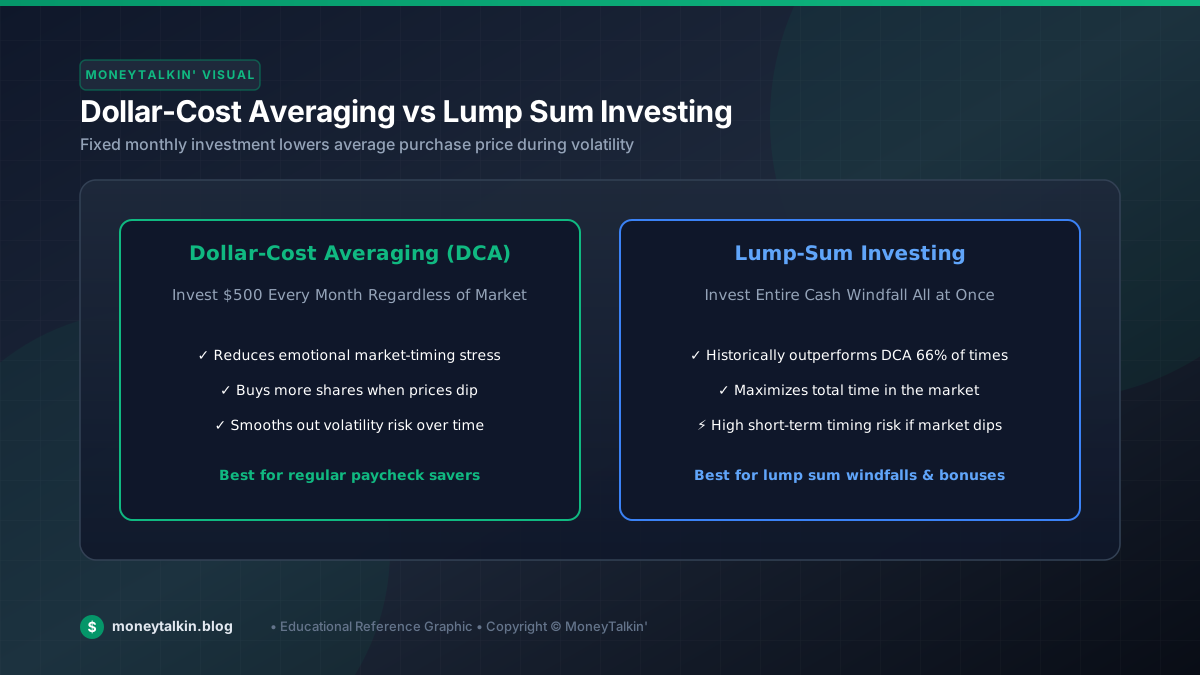
- DCA vs. Lump-Sum: Lump-sum investing historically outperforms DCA 66% of the time because markets rise over long horizons; however, DCA provides critical psychological protection against immediate market crashes.
- Best Applied To: 401(k) payroll contributions, monthly IRA deposits, and automated index fund investing.
How Dollar-Cost Averaging Works
                   DOLLAR-COST AVERAGING IN ACTION
┌────────────────────────────────────────────────────────────────────────┐
│ Month 1: Share Price = $100  ──►  $500 Investment Buys 5.0 Shares      │
│ Month 2: Share Price = $50   ──►  $500 Investment Buys 10.0 Shares     │
│ Month 3: Share Price = $125  ──►  $500 Investment Buys 4.0 Shares      │
├────────────────────────────────────────────────────────────────────────┤
│ Total Invested: $1,500 | Total Shares Purchased: 19.0 Shares          │
│ Average Share Price: $91.67 | Average Cost Per Share: $78.95          │
└────────────────────────────────────────────────────────────────────────┘
Notice the key mathematical outcome in the example above: because your $500 bought 10 shares when the price dipped to $50, your average cost per share ($78.95) is significantly lower than the average market price of the asset ($91.67).
Mathematical Comparison: DCA vs. Market Timing
Consider an investor with $1,200 to invest during a volatile 4-month market cycle:
- Month 1: Share Price = $10.00
- Month 2: Share Price = $5.00 (Market Crash)
- Month 3: Share Price = $8.00 (Partial Recovery)
- Month 4: Share Price = $10.00 (Full Recovery)
Investor Strategy A: Lump-Sum $1,200 in Month 1
- Shares Bought: $$1,200 / $10.00 = \mathbf{120 \text{ shares}}$
- Portfolio Value in Month 4 (Price $10.00): $120 \times $10.00 = \mathbf{$1,200}$ (Break even)
Investor Strategy B: Dollar-Cost Averaging $300 Monthly for 4 Months
- Month 1 ($300 at $10.00): 30 shares
- Month 2 ($300 at $5.00): 60 shares (Dipped price allows buying 2x shares!)
- Month 3 ($300 at $8.00): 37.5 shares
- Month 4 ($300 at $10.00): 30 shares
- Total Shares Accumulated: 157.5 shares
- Portfolio Value in Month 4 (Price $10.00): $157.5 \times $10.00 = \mathbf{$1,575}$
Result: By continuing to invest during the market crash in Month 2, the DCA investor accumulated 37.5 more shares, generating a $375 profit (25% gain) even though the stock ended at the exact same price where it started!
Practical Benefits of Dollar-Cost Averaging
- Eliminates Behavioral Friction: Trying to "wait for the bottom" often leads investors to sit in cash while markets rally. DCA automates investing.
- Reduces Regret Risk: If you invest a lump sum right before a market downturn, you experience immediate regret. DCA spreads timing risk.
- Seamless Automation: Fits naturally with recurring paychecks and automated 401(k) or IRA deposits.
Practical Takeaway Checklist
- Automate a monthly or bi-weekly transfer from checking to your investment account.
- Set up automatic investment instructions so cash is invested into index funds upon arrival.
- Maintain your DCA schedule during market downturns to buy shares at discounted prices.
Sources
- U.S. Securities and Exchange Commission (SEC Investor.gov): Dollar-Cost Averaging Basics
https://www.investor.gov/ - Vanguard Research: Lump-Sum vs. Dollar-Cost Averaging Analysis
https://corporate.vanguard.com/
Disclaimer
Educational content only. Past performance does not guarantee future results.
Dollar-Cost Averaging vs. Lump-Sum Investing
A central debate in investment management is comparing Dollar-Cost Averaging against Lump-Sum Investing (investing a large windfall immediately):
Dollar-Cost Averaging:   Distributes $12,000 capital into $1,000 monthly tranches over 12 months.
Lump-Sum Investing:      Invests $12,000 capital in 100% upfront on day one.
Academic Research Insights
Academic studies examining historical stock market data indicate that Lump-Sum Investing outperforms DCA approximately 66% of the time over multi-decade horizons. This occurs because equity markets trend upward over time, making immediate market exposure statistically advantageous.
However, for investors receiving a major windfall (such as an inheritance or business sale), Dollar-Cost Averaging provides vital psychological protection against market timing anxiety and sudden short-term drawdowns.
Practical DCA Implementation Rules
To execute a Dollar-Cost Averaging strategy effectively:
- Automate Recurring Transfers: Establish automatic recurring weekly or monthly transfers into your low-cost index fund or ETF portfolio inside your brokerage or IRA account.
- Maintain Investment Discipline During Volatility: Continue scheduled contributions during market pullbacks to acquire shares at lower average valuations.
Educational Summary & Key Definitions
Understanding financial fundamentals requires mastering core vocabulary and operational definitions:
- Principal: The original amount of money deposited or borrowed, excluding interest earnings or finance charges.
- Annual Percentage Yield (APY): The real rate of return earned on a deposit account, taking into account the effect of compounding interest over a 12-month period.
- Liquidity: The ease and speed with which an asset can be converted into liquid cash without incurring significant capital loss.
- Diversification: An investment risk management strategy that mixes a wide variety of investments within a portfolio to limit exposure to any single asset class.
Consulting official regulatory guidelines—such as disclosures from the CFPB, FDIC, NCUA, and Federal Reserve—ensures you make informed financial decisions backed by verified consumer protections.
Summary Principles for Long-Term Investors
- Automate Contributions: Remove emotion from investing by establishing automated recurring monthly contributions.
- Focus on Broad Market Indexes: Apply DCA to broad, low-cost index funds rather than speculative individual stocks.
MoneyTalkin' provides financial education, educational concepts, and general informational guides. Articles do not constitute personalized financial, investment, legal, or tax advice. Financial products, rates, terms, and regulatory rules change frequently; consult a qualified financial professional regarding your specific situation. Read our full Disclaimer Policy.
Written by MoneyTalkin'
MoneyTalkin' researches and publishes objective financial education content, money management fundamentals, and practical financial guides.
Related Technical Articles
Explore related topics in this cluster to deepen your understanding.