Tax-Advantaged Retirement Accounts: Traditional vs. Roth IRAs & 401(k)s
Understand how tax-deferred and tax-exempt retirement accounts work, contribution rules, withdrawal constraints, and tax diversification strategies.
Tax-Advantaged Retirement Accounts: Traditional vs. Roth IRAs & 401(k)s
Tax-advantaged retirement accounts are investment vehicles designed under tax code provisions to incentivize long-term retirement saving. In the United States, the two primary account structures are Traditional (Tax-Deferred) and Roth (Tax-Exempt) accounts, available through employer-sponsored plans (like 401(k)s and 403(b)s) or Individual Retirement Accounts (IRAs).
Choosing between Traditional and Roth contributions hinges on a fundamental economic question: Will your marginal income tax rate be higher now, or during retirement?
Executive Summary: Traditional vs. Roth Comparison
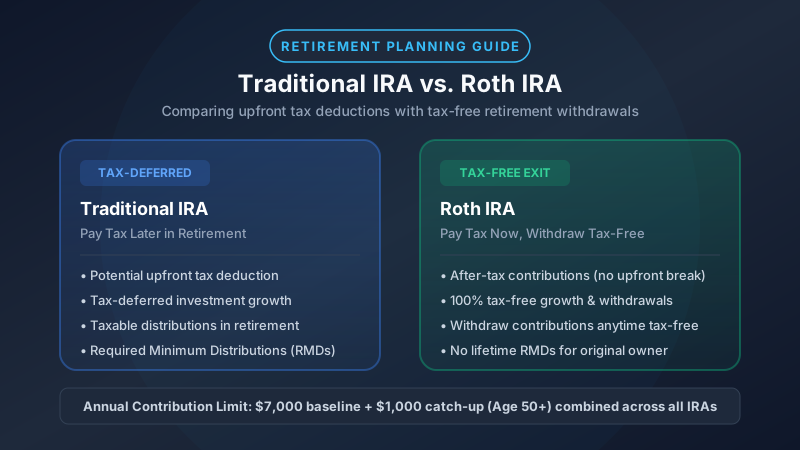
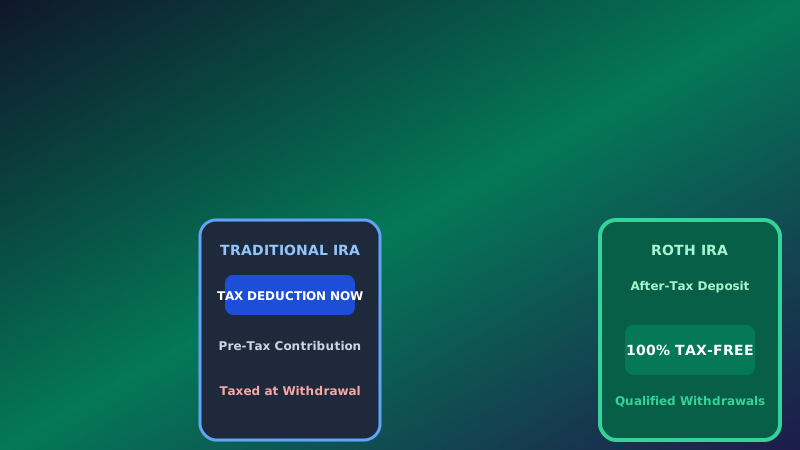
- Traditional (Pre-Tax): Contributions are tax-deductible upfront, lowering current income tax. Growth is tax-deferred. Withdrawals in retirement are taxed as ordinary income.
- Roth (Post-Tax): Contributions are made with after-tax dollars (no upfront tax deduction). Growth and qualified withdrawals in retirement are 100% tax-free.
- 2026 Contribution Limits:
- 401(k) / 403(b) Employee Limit: $23,500/year (plus $7,500 catch-up for age 50+).
- IRA Limit (Roth or Traditional combined): $7,000/year (plus $1,000 catch-up for age 50+).
Traditional vs. Roth: Structural Comparison
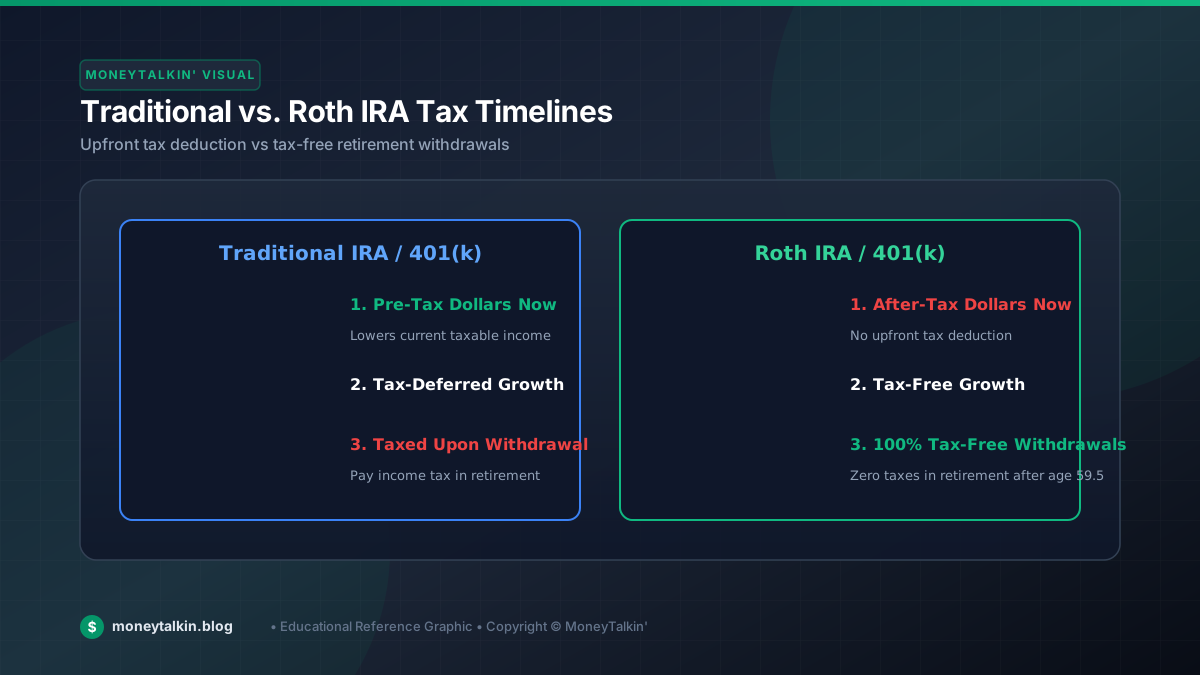
                  TAX ADVANTAGE STRUCTURE COMPARISON
┌────────────────────────────────────────────────────────────────────────┐
│ TRADITIONAL (Tax-Deferred)                                            │
│ Pay No Tax Now (Pre-Tax Contribution) ──► Tax-Deferred Growth ──► Pay Ordinary Tax in Retirement │
├────────────────────────────────────────────────────────────────────────┤
│ ROTH (Tax-Exempt)                                                     │
│ Pay Tax Now (Post-Tax Contribution) ──► Tax-Free Growth ───────► Pay $0 Tax in Retirement       │
└────────────────────────────────────────────────────────────────────────┘
| Feature | Traditional Accounts (IRA / 401k) | Roth Accounts (IRA / 401k) |
|---|---|---|
| Upfront Tax Break | Yes (Reduces taxable income today) | No (Contributions made after tax) |
| Growth Taxation | Tax-Deferred | 100% Tax-Free |
| Retirement Withdrawal Tax | Taxed as Ordinary Income | $0 (Tax-Free qualified withdrawals) |
| Required Minimum Distributions (RMDs) | Mandatory starting at Age 73/75 | None for Roth IRA during owner's lifetime |
| Income Eligibility Limits | No limit for 401k; IRA deduction limits apply | Roth IRA phase-out limits apply |
Mathematical Case Study: Current vs. Future Tax Brackets
Consider an investor, Investor A, deciding where to allocate $6,000 in gross earnings:
- Current Income Tax Bracket: 24% marginal tax rate.
- Expected Retirement Income Tax Bracket: 12% effective tax rate.
Option 1: Traditional IRA / 401(k)
- Upfront Contribution: Full $6,000 pre-tax.
- Grows 4x over 25 years at 7% compound return $\rightarrow$ $24,000 balance at retirement.
- Taxed at 12% retirement rate upon withdrawal: $$24,000 \times 0.12 = $2,880 \text{ tax}$.
- Net After-Tax Retirement Cash: $21,120
Option 2: Roth IRA / 401(k)
- Upfront Contribution: Pays 24% tax now ($1,440 tax), leaving $4,560 post-tax invested.
- Grows 4x over 25 years at 7% compound return $\rightarrow$ $18,240 balance at retirement.
- Taxed at 0% retirement rate $\rightarrow$ Net After-Tax Cash: $18,240
Decision Rule: Because Investor A's tax bracket was higher during working years (24%) than in retirement (12%), the Traditional account yielded more net spendable income. Conversely, if your current tax bracket is lower than your expected retirement bracket, Roth is mathematically superior.
Practical Takeaway Checklist
- Capture 100% of any employer 401(k) matching contribution first (this is an instant 100% return).
- Choose Roth if you are currently in a lower tax bracket (e.g., early career).
- Choose Traditional if you are currently in a high marginal tax bracket (e.g., peak earning years).
- Diversify across both account types to maintain tax flexibility in retirement.
Sources
- Internal Revenue Service (IRS): Retirement Topics: IRA Contribution Limits & 401(k) Limits
https://www.irs.gov/retirement-plans
Disclaimer
Educational material only. Consult a CPA or tax professional for tax guidance.
Traditional vs. Roth Tax Rules & Conversion Ladders
Tax-advantaged accounts fall into two main tax categories:
- Tax-Deferred (Traditional 401(k) & Traditional IRA): Contributions reduce current-year taxable income. Account assets grow tax-deferred, and withdrawals in retirement are taxed as ordinary income. Required Minimum Distributions (RMDs) begin at age 73 or 75.
- Tax-Free Growth (Roth 401(k) & Roth IRA): Contributions are made with after-tax dollars. Qualified withdrawals in retirement—including all compound investment gains—are 100% tax-free. Roth IRAs have no lifetime RMD requirements.
Roth Conversion Ladders
Early retirees frequently utilize Roth Conversion Ladders—converting traditional IRA assets into Roth IRAs in low-income years, paying income tax on the converted amount, and accessing converted principal tax-free after a 5-year waiting period. Learn key account rules in traditional ira vs roth ira.
Priority Order for Retirement Contributions
To optimize tax savings across accounts, follow a disciplined contribution waterfall:
- Capture Employer 401(k) Match: Contribute enough to secure 100% of any employer matching funds (free money return).
- Fund Health Savings Account (HSA): If enrolled in an HDHP, maximize HSA contributions for triple-tax benefits.
- Maximize Roth or Traditional IRA: Contribute up to statutory annual limits ($7,000+).
- Return to 401(k) to Maximize Limit: Direct remaining savings toward 401(k) limits ($23,000+).
Key Account Selection Guidelines
- Traditional vs Roth Decision: Favor Roth accounts if in a low current tax bracket; favor Traditional accounts if in a peak current tax bracket.
- Avoid Early Withdrawal Penalties: Keep retirement assets locked until age 59½ unless utilizing authorized IRS exceptions.
Educational Summary & Key Definitions
Understanding financial fundamentals requires mastering core vocabulary and operational definitions:
- Principal: The original amount of money deposited or borrowed, excluding interest earnings or finance charges.
- Annual Percentage Yield (APY): The real rate of return earned on a deposit account, taking into account the effect of compounding interest over a 12-month period.
- Liquidity: The ease and speed with which an asset can be converted into liquid cash without incurring significant capital loss.
- Diversification: An investment risk management strategy that mixes a wide variety of investments within a portfolio to limit exposure to any single asset class.
Consulting official regulatory guidelines—such as disclosures from the CFPB, FDIC, NCUA, and Federal Reserve—ensures you make informed financial decisions backed by verified consumer protections.
For education savings, explore our guide on 529 College Savings Plans.
MoneyTalkin' provides financial education, educational concepts, and general informational guides. Articles do not constitute personalized financial, investment, legal, or tax advice. Financial products, rates, terms, and regulatory rules change frequently; consult a qualified financial professional regarding your specific situation. Read our full Disclaimer Policy.
Written by MoneyTalkin'
MoneyTalkin' researches and publishes objective financial education content, money management fundamentals, and practical financial guides.
Related Technical Articles
Explore related topics in this cluster to deepen your understanding.