529 College Savings Plans Explained: How They Work and What They Cover
An educational guide to 529 college savings plans, detailing tax benefits, qualified education expenses, state tax deductions, and 529-to-Roth IRA rollover rules.
529 College Savings Plans Explained: How They Work and What They Cover
Funding higher education is a primary long-term financial goal for millions of American families. To encourage education savings, federal tax law under Section 529 of the Internal Revenue Code provides a specialized, tax-advantaged investment vehicle: the 529 Plan.
Understanding how a 529 plan operates—including federal and state tax advantages, qualified education expense rules, beneficiary flexibilities, and recent federal rollover provisions under SECURE 2.0—can help families build an effective education savings strategy alongside broader tax-advantaged retirement accounts and an established 50/30/20 budget framework.
1. What Is a 529 Plan?
A 529 plan (officially called a Qualified Tuition Program) is a tax-advantaged savings and investment account sponsored by individual U.S. states, state agencies, or educational institutions.
Created by Congress in 1996, 529 plans allow parents, grandparents, and other account owners to contribute post-tax dollars into age-based target-date funds or index portfolios. Earnings grow tax-deferred, and withdrawals are 100% tax-free when used for qualified higher education expenses.
2. The Two Types of 529 Plans
States offer two primary types of 529 programs:
A. 529 Education Savings Plans
The most common type of 529 plan. The account owner invests contributions into a selection of mutual funds, index funds, or age-based portfolios. Account growth depends directly on market performance, and funds can be used at any eligible post-secondary institution nationwide (and many foreign universities).
B. Prepaid Tuition Plans
Prepaid tuition plans allow account owners to purchase tuition credits at participating in-state public universities at current locked-in rates, protecting against future higher education inflation. These plans are less common and typically feature strict residency and school applicability rules.
3. Federal and State Tax Advantages
529 plans offer significant tax incentives designed to accelerate compound growth over time:
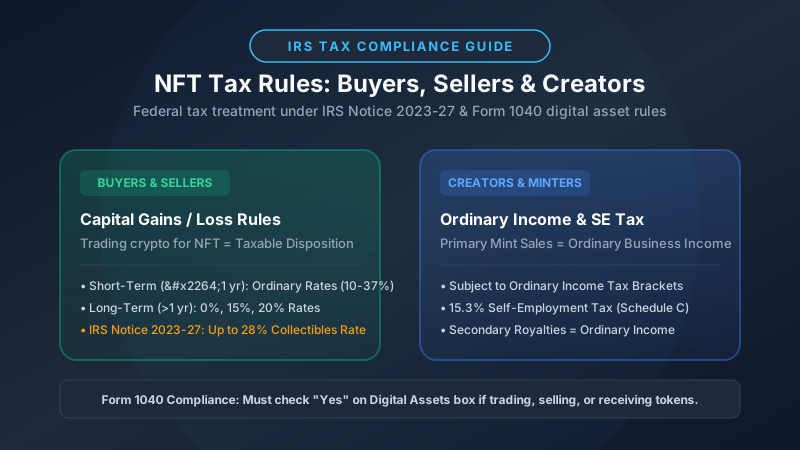
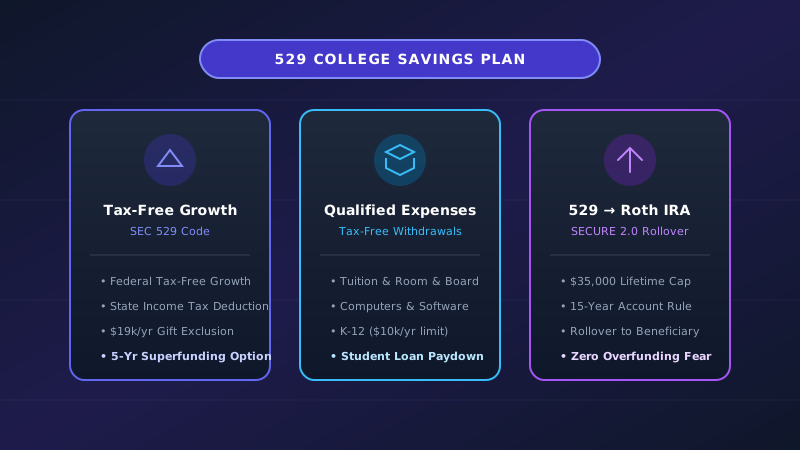
- Federal Tax-Deferred Growth: Investments inside a 529 plan grow tax-free from federal capital gains and dividend taxes.
- Tax-Free Withdrawals for Qualified Expenses: Earnings withdrawn to pay for qualified education expenses are completely exempt from federal income tax.
- State Income Tax Deductions or Credits: Over 30 states offer state income tax deductions or matching credits for state residents who contribute to their home state's sponsored 529 plan.
- Gift and Estate Tax Benefits: Contributions qualify for the federal annual gift tax exclusion ($19,000 per donor per beneficiary for 2026). Furthermore, federal tax rules permit 5-year front-loading (superfunding), allowing a donor to contribute up to $95,000 in a single year ($190,000 for married couples filing jointly) without triggering gift tax, treated as if given over five years.
4. What Count as Qualified Education Expenses?
To maintain tax-free status, withdrawals must be used strictly for IRS-qualified higher education expenses (QHEE) under Internal Revenue Code Section 529:
Fully Qualified Higher Education Expenses
- College & University Tuition and Mandatory Fees: At accredited 2-year, 4-year, graduate, and trade schools.
- Room and Board: Housing and meal plans for students enrolled at least half-time.
- Textbooks, Software, and Equipment: Computers, laptops, internet access, and required course supplies.
- K-12 Tuition: Up to $10,000 per student, per year for tuition at public, private, or religious elementary and secondary schools.
- Apprenticeship Programs: Fees, books, and equipment required for registered apprenticeship programs certified by the U.S. Department of Labor.
- Student Loan Repayment: Up to a $10,000 lifetime maximum limit per beneficiary (and an additional $10,000 lifetime for each of the beneficiary's siblings) to pay down qualified federal or private student loans.
5. Non-Qualified Withdrawals and Penalties
If a 529 withdrawal is used for non-qualified expenses (e.g., purchasing a personal vehicle, general travel, or discretionary spending):
- Principal Contributions: Can be withdrawn tax-free at any time, as contributions were made with post-tax dollars.
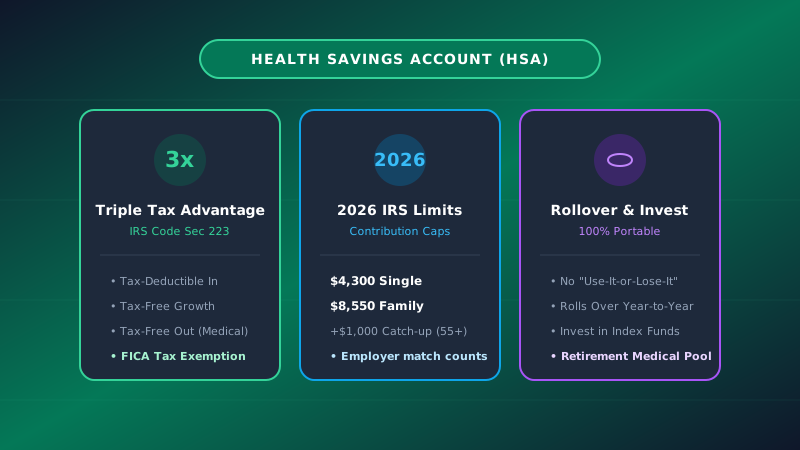
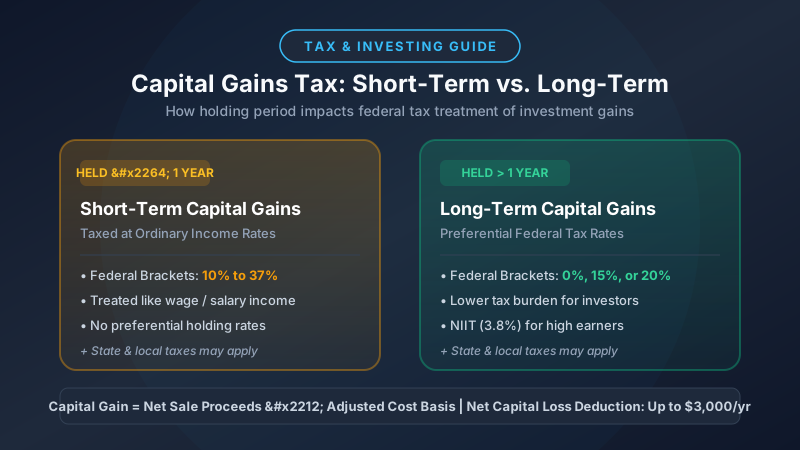
- Earnings Portion: Subject to ordinary federal and state income tax plus a 10% federal penalty fee.
Penalty Exceptions
The 10% federal penalty fee (though not ordinary income tax on earnings) is waived under specific qualifying circumstances:
- The beneficiary receives a tax-free college scholarship (withdrawals up to the scholarship amount are penalty-free).
- The beneficiary attends a U.S. Military Academy.
- The beneficiary becomes disabled or passes away.
6. The 529-to-Roth IRA Rollover Rule (SECURE 2.0 Act)
A historic concern for parents was "overfunding" a 529 plan if a child decided not to attend college or received significant scholarships.
Under Section 126 of the SECURE 2.0 Act, account owners can execute a direct, tax-free rollover of unused 529 funds into a Roth IRA for the beneficiary, subject to strict statutory rules:
- Lifetime Cap: Maximum lifetime rollover limit of $35,000 per beneficiary.
- Account Age Requirement: The 529 account must have been open for at least 15 years prior to the rollover date.
- Contribution Recency: Contributions made to the 529 plan within the last 5 years (and their associated earnings) are ineligible for rollover.
- Annual Roth Limits Apply: The annual rollover amount cannot exceed the annual Roth IRA contribution limit for that tax year, and the beneficiary must have earned income at least equal to the rollover amount.
7. Account Ownership and Financial Aid Impact
Account ownership structure plays a critical role in financial aid formulas:
- Full Owner Control: The account owner (parent or grandparent) retains complete legal control over the account, investment allocations, and beneficiary designations—not the student.
- Changing Beneficiaries: Owners can change the beneficiary at any time without tax penalty to a qualified family member of the original beneficiary (including siblings, children, first cousins, or the owner themselves).
- FAFSA Treatment: On the Free Application for Federal Student Aid (FAFSA), a parent-owned 529 plan is reported as a parent asset. Under the Student Aid Index (SAI) formula, parent assets receive a significant asset protection allowance and are assessed at a maximum rate of up to 5.64%, compared to the 20% assessment rate applied to student-owned assets (such as UTMA/UGMA accounts).
8. Practical 529 Planning Checklist
To manage a 529 college savings plan effectively, follow this step-by-step checklist:
- Evaluate In-State Tax Incentives: Check if your home state offers a state income tax deduction or credit for using the state-sponsored 529 plan.
- Choose Low-Cost Index Portfolios: Select age-based target-date portfolios that automatically shift from growth equities to conservative fixed income as college approaches.
- Automate Monthly Contributions: Set up recurring transfers from your checking account to capture compound growth over time.
- Track Qualified Receipts: Keep itemized digital receipts for tuition, room and board, and required laptops to substantiate tax-free distributions.
- Leverage SECURE 2.0 Provisions: If unused funds remain after graduation, evaluate the 15-year account rule for tax-free Roth IRA rollovers.
Sources
- Internal Revenue Service (IRS): Publication 970: Tax Benefits for Education https://www.irs.gov/forms-pubs/about-publication-970
- U.S. Department of Education: Federal Student Aid (FAFSA) Guidelines https://studentaid.gov/
- U.S. Senate Finance Committee: SECURE 2.0 Act Section 126 Provisions https://www.finance.senate.gov/
Educational Disclaimer
This guide is for informational and educational purposes only and does not constitute formal tax, legal, or investment advice. 529 plan rules, state tax deductions, qualified expense definitions, and financial aid treatment vary by state and individual tax circumstances. Consult a qualified CPA or financial advisor regarding your education funding plan.
MoneyTalkin' provides financial education, educational concepts, and general informational guides. Articles do not constitute personalized financial, investment, legal, or tax advice. Financial products, rates, terms, and regulatory rules change frequently; consult a qualified financial professional regarding your specific situation. Read our full Disclaimer Policy.
Written by MoneyTalkin'
MoneyTalkin' researches and publishes objective financial education content, money management fundamentals, and practical financial guides.
Related Technical Articles
Explore related topics in this cluster to deepen your understanding.