Traditional IRA vs. Roth IRA: Key Differences and Tax Considerations
A comprehensive, U.S.-focused guide comparing Traditional and Roth IRAs, highlighting tax timing, income phaseout limits, withdrawal rules, conversions, and RMDs.
Traditional IRA vs. Roth IRA: Key Differences and Tax Considerations
Individual Retirement Arrangements (IRAs) are among the most effective tax-advantaged vehicles available to U.S. workers building long-term wealth. The two primary personal IRA types—Traditional IRAs and Roth IRAs—offer powerful growth benefits, but they differ fundamentally in when you pay taxes on your money.
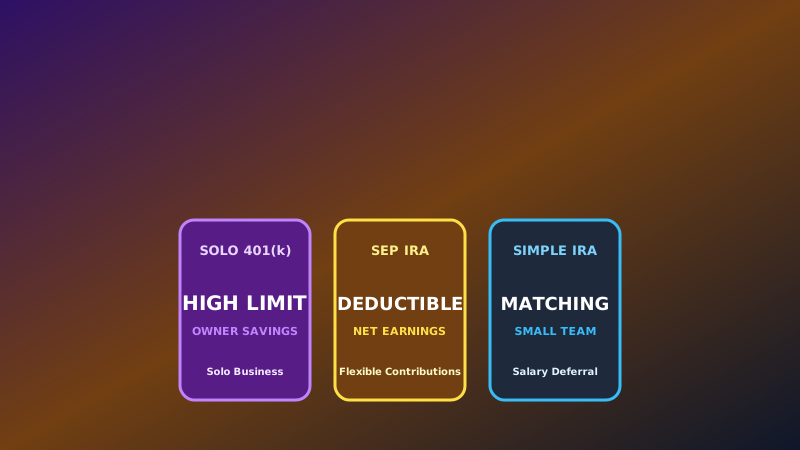
Deciding between a Traditional and Roth IRA involves analyzing your current tax bracket, projected retirement income, liquidity needs, and rules governing tax-advantaged retirement accounts. Understanding these core mechanics helps investors coordinate retirement funding alongside broader plans for how much money to retire, options for self-employed retirement planning, and taxable investments in a taxable brokerage account.
1. Traditional IRA vs. Roth IRA: Overview
| Feature | Traditional IRA | Roth IRA |
|---|---|---|
| Tax Break Timing | Upfront (potential tax deduction on contributions) | Delayed (tax-free qualified withdrawals in retirement) |
| Contribution Funding | Pre-tax or non-deductible after-tax dollars | After-tax dollars only (no upfront deduction) |
| Investment Growth | Tax-deferred | Tax-free |
| Retirement Distributions | Taxed as ordinary income | 100% Tax-Free (if qualified) |
| Income Eligibility Limit | No income limit to contribute (deduction limits apply) | Income limits restrict direct contributions |
| Required Minimum Distributions | Yes (starts at age 73/75 per SECURE Act 2.0) | None during the original account owner's lifetime |
| Early Withdrawal Flexibility | Earnings & contributions subject to tax/penalty | Direct contributions can be withdrawn anytime tax/penalty-free |
2. Annual Contribution Limits (Tax Year 2026 / 2025 Rules)
The Internal Revenue Service (IRS) establishes combined annual contribution limits for IRAs:
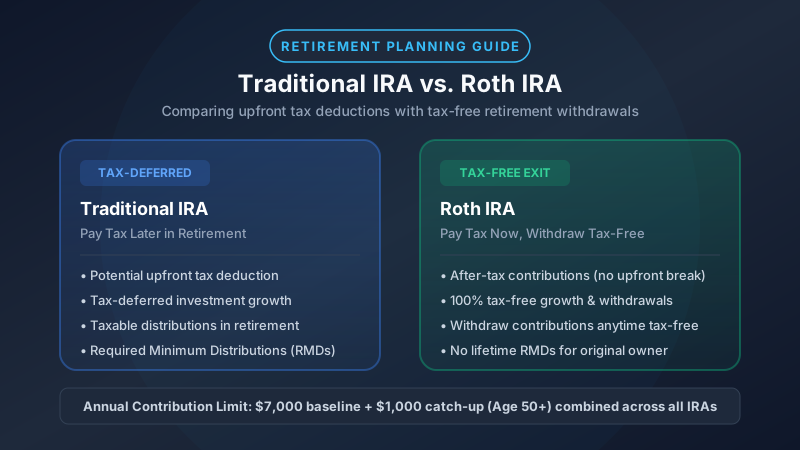
- Baseline Limit: $7,000 per eligible individual.
- Catch-Up Contribution: Additional $1,000 for individuals aged 50 and older (total limit: $8,000).
- Combined Limit: The dollar limit represents the total aggregate amount you can contribute across all IRAs (Traditional + Roth combined) in a single tax year.
- Earned Income Requirement: Contributions cannot exceed your total earned income (W-2 wages or self-employment net earnings) for the tax year.
3. Traditional IRA: Deductibility & Tax Rules
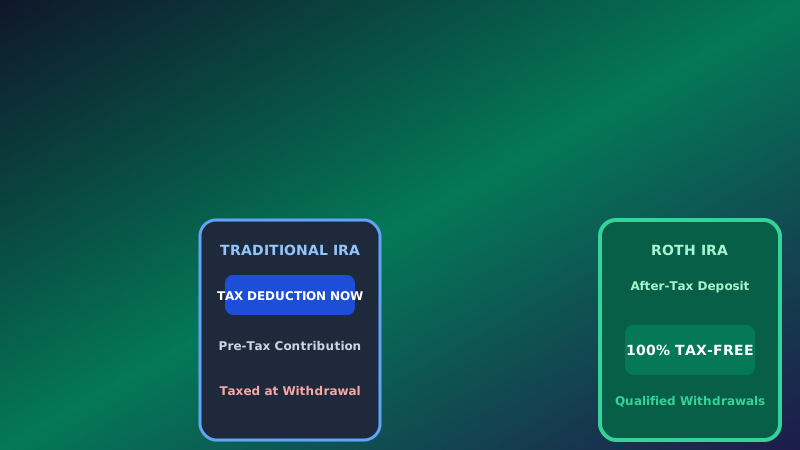
Contributions to a Traditional IRA may be deductible from your taxable income in the year they are made, lowering your current income tax bill.
Deduction Phaseout Rules
If neither you nor your spouse is covered by an active workplace retirement plan (such as a 401(k) or 403(b)), your Traditional IRA contribution is fully tax-deductible regardless of income.
However, if you or your spouse are covered by an employer plan, your ability to deduct contributions phases out based on your Modified Adjusted Gross Income (MAGI):
- Single / Head of Household Filers: Full deduction below lower MAGI threshold; partial deduction within phaseout range; no deduction above upper phaseout limit.
- Married Filing Jointly (Covered Spouse): Separate phaseout range applies.
- Married Filing Jointly (Non-Covered Spouse): Higher income phaseout applies if one spouse is covered by an employer plan and the other is not.
Note: Non-deductible Traditional IRA contributions can still be made regardless of income, building a non-deductible basis.
4. Roth IRA: Eligibility & Tax-Free Growth
With a Roth IRA, you contribute after-tax dollars. You receive no upfront tax deduction, but your investments grow 100% tax-free, and qualified withdrawals in retirement are completely tax-free.
Roth Contribution Income Phaseouts
Unlike Traditional IRAs, high earners are restricted from making direct contributions to a Roth IRA. Direct contribution eligibility phases out at higher MAGI levels:
- Single / Head of Household Filers: Full contribution below phaseout start; reduced contribution within phaseout band; zero direct contribution allowed above upper MAGI limit.
- Married Filing Jointly: Higher joint MAGI phaseout range applies.
5. Withdrawal Rules & RMDs
Retirement accounts enforce specific distribution rules to govern how and when funds are withdrawn.
Traditional IRA Withdrawals
- Qualified Withdrawals: Distributions taken after age 59½ are taxed as ordinary income at your marginal tax bracket in the year received.
- Early Withdrawals: Withdrawals prior to age 59½ incur ordinary income tax plus a 10% early withdrawal penalty, unless an qualifying IRS exception applies (e.g., up to $10,000 for a qualified first-time home purchase, qualified higher education expenses, or certain medical expenses).
- Required Minimum Distributions (RMDs): Traditional IRA owners must begin taking annual RMDs starting at age 73 (increasing to age 75 for individuals reaching 74 after 2032 under SECURE Act 2.0).
Roth IRA Withdrawals
- Contributions vs. Earnings: You can withdraw your original direct contributions from a Roth IRA at any time, for any reason, completely tax-free and penalty-free.
- Qualified Earnings Withdrawals: Investment earnings are 100% tax-free and penalty-free if the withdrawal occurs after age 59½ AND at least 5 years have passed since your first Roth IRA contribution (the 5-Year Rule).
- Lifetime RMDs: Original Roth IRA owners are exempt from RMDs during their lifetime, allowing funds to compound indefinitely.
6. The Roth Conversion Concept
If your income exceeds the Roth IRA phaseout limits, or if you want to move pre-tax funds into a tax-free vehicle, you can execute a Roth Conversion:
- How It Works: Assets in a Traditional IRA are transferred or converted into a Roth IRA.
- Tax Impact: The converted pre-tax amount is treated as taxable ordinary income in the year of conversion.
- Backdoor Roth IRA Strategy: Investors high above Roth income limits often make non-deductible Traditional IRA contributions and immediately convert them to a Roth IRA (provided they navigate the IRS Pro-Rata Rule across all pre-tax IRAs).
7. Beneficiary Rules Overview
Under the SECURE Act, most non-spouse beneficiaries inheriting a Traditional or Roth IRA must fully distribute the account contents within 10 years of the owner's death:
- Inherited Traditional IRA: Distributions taken by non-spouse beneficiaries are subject to ordinary income tax.
- Inherited Roth IRA: Distributions are tax-free, provided the original account satisfied the 5-year holding requirement.
8. Hypothetical Comparison Example
Hypothetical example for illustrative purposes only:
Two 30-year-old investors each contribute $7,000 per year for 30 years ($210,000 total contributions) achieving a hypothetical 7% average annual return, resulting in a portfolio balance of approximately $660,000 at age 60:
- Investor A (Traditional IRA): Received an upfront tax deduction each year. At age 60, as they withdraw $40,000 per year, every dollar is taxed as ordinary income at their retirement tax rate.
- Investor B (Roth IRA): Paid taxes upfront on their $7,000 contributions. At age 60, their entire $660,000 balance—including $450,000 in investment growth—is available 100% tax-free.
9. Common IRA Mistakes to Avoid
- Exceeding Income Limits: Contributing directly to a Roth IRA when your MAGI exceeds the threshold without utilizing a backdoor strategy triggers a 6% excess contribution penalty per year.
- Violating the 5-Year Rule: Withdrawing earnings from a Roth IRA before holding a Roth IRA for 5 years can trigger taxes even if you are over age 59½.
- Ignoring the Pro-Rata Rule: Executing a Backdoor Roth conversion while holding large pre-tax balances in rollover IRAs creates unexpected tax liabilities.
- Forgetting Aggregation Rules: Contributing $7,000 to a Traditional IRA and another $7,000 to a Roth IRA in the same year exceeds the single combined annual limit.
10. How to Choose Between Traditional and Roth
- Expect Higher Taxes in Retirement? A Roth IRA locks in today's tax rates and yields tax-free retirement income.
- In Your Peak Earning Years Today? A Traditional IRA provides an immediate tax deduction when your tax rate is highest.
- Value Estate & Tax Flexibility? A Roth IRA offers penalty-free contribution access and no lifetime RMDs.
MoneyTalkin' provides financial education, educational concepts, and general informational guides. Articles do not constitute personalized financial, investment, legal, or tax advice. Financial products, rates, terms, and regulatory rules change frequently; consult a qualified financial professional regarding your specific situation. Read our full Disclaimer Policy.
Written by MoneyTalkin'
MoneyTalkin' researches and publishes objective financial education content, money management fundamentals, and practical financial guides.
Related Technical Articles
Explore related topics in this cluster to deepen your understanding.