Self-Employed Retirement Options: SEP IRA, Solo 401(k) & SIMPLE IRA
A comprehensive guide for freelancers and business owners on self-employed retirement accounts, contribution limits, tax deductions, and eligibility.
Self-Employed Retirement Options: SEP IRA, Solo 401(k), and SIMPLE IRA
Self-employed individuals, freelancers, independent contractors, and small business owners do not have access to employer-sponsored 401(k) plans with automatic company matches. However, the tax code provides highly advantageous self-employed retirement accounts that allow sole proprietors to save significantly higher tax-deferred amounts than standard IRAs.
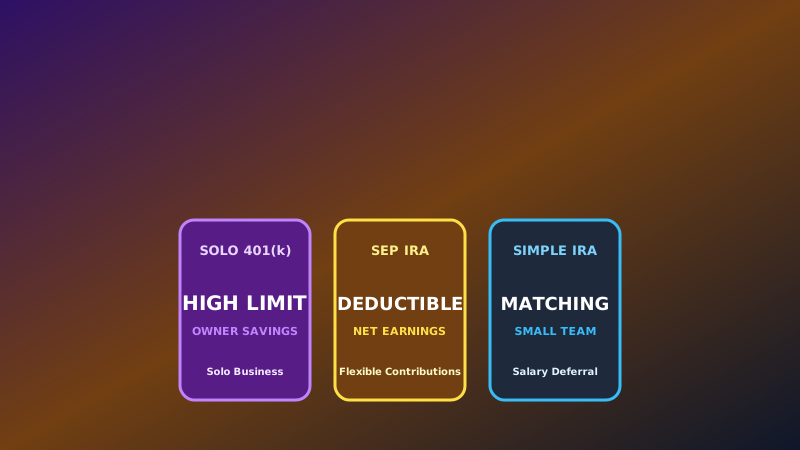
The three primary self-employed retirement options are the Solo 401(k), the SEP IRA (Simplified Employee Pension), and the SIMPLE IRA. Understanding the eligibility rules, contribution limits, and administrative requirements of each enables business owners to minimize tax liabilities while building wealth.
Executive Summary: Self-Employed Account Comparison
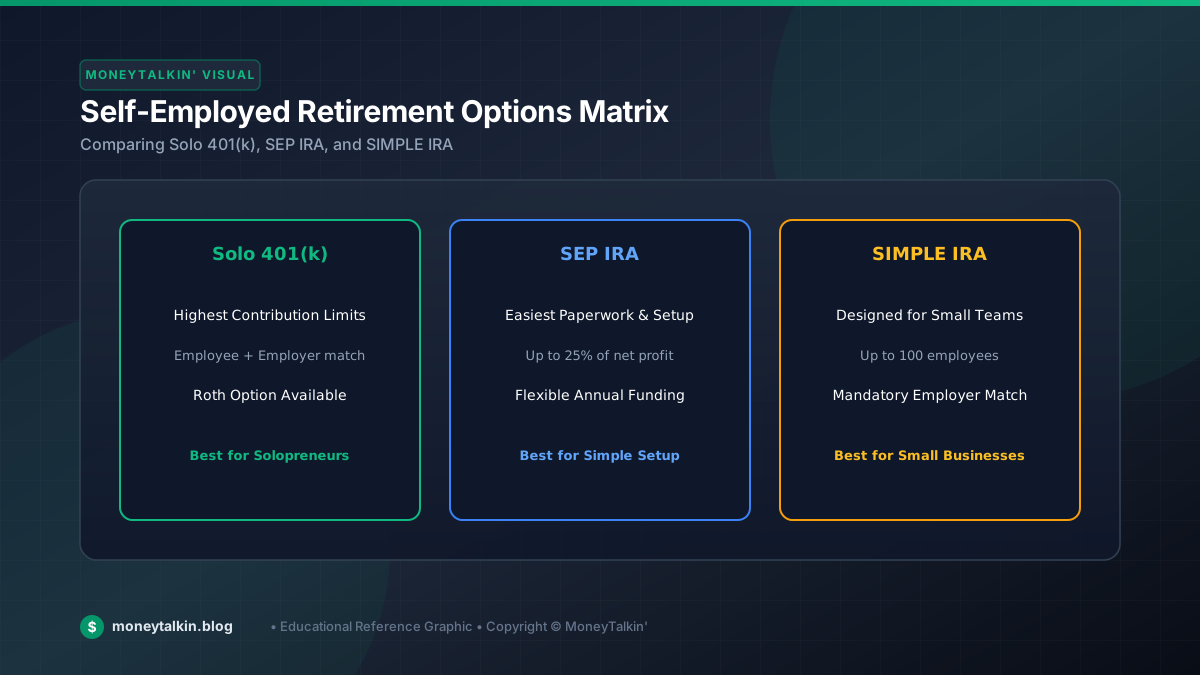
- Solo 401(k): Ideal for sole proprietors with zero employees (other than a spouse). Highest contribution potential at lower income levels.
- SEP IRA: Simple administration, zero annual IRS reporting required, flexible employer-only contributions up to 25% of net self-employment income.
- SIMPLE IRA: Designed for small businesses with 1 to 100 employees; requires mandatory employer matching or non-elective contributions.
Comparative Matrix: Self-Employed Plans
| Feature | Solo 401(k) | SEP IRA | SIMPLE IRA |
|---|---|---|---|
| Eligible Business Structure | Owner + Spouse ONLY (No employees) | Sole Proprietors, LLCs, S-Corps | Small Businesses (<100 employees) |
| Max Contribution Limit (2026) | Up to $69,000 (or $76,500 if age 50+) | Up to $69,000 (capped at 25% net profit) | Up to $16,000 employee elective deferral |
| Contribution Types Allowed | Both Employee & Employer contributions | Employer contributions ONLY | Employee deferrals + mandatory Match |
| Roth Option Available? | Yes (Roth Solo 401k available) | Yes (Recently authorized under SECURE 2.0) | Yes (SECURE 2.0 authorized) |
| Annual Reporting Requirement | Form 5500-EZ required if balance > $250k | None | Basic annual administrative reporting |
How the Solo 401(k) Maximizes Savings
The Solo 401(k) is uniquely powerful because a business owner wears two hats: the Employee and the Employer. This allows dual contributions into a single account:
- Employee Elective Deferral: Up to 100% of earned income up to $23,500 (plus $7,500 catch-up if 50+).
- Employer Profit-Sharing Contribution: Up to 20% of net self-employment income (or 25% of W-2 salary for S-Corps).
                     SOLO 401(k) DUAL CONTRIBUTION ENGINE
┌────────────────────────────────────────────────────────────────────────┐
│ Employee Deferral: Up to $23,500 (100% of earned income up to cap)    │
├────────────────────────────────────────────────────────────────────────┤
│ Employer Profit Share: Up to 20% of Net Self-Employment Profit         │
├────────────────────────────────────────────────────────────────────────┤
│ Combined Maximum Contribution Cap: Up to $69,000 / Year                │
└────────────────────────────────────────────────────────────────────────┘
Mathematical Example: Solo 401(k) vs. SEP IRA at $80,000 Net Profit
Consider a self-employed consultant with $80,000 in net business profit:
- SEP IRA Max Contribution: Limited to 20% of net adjusted self-employment profit $\approx \mathbf{$14,800}$.
- Solo 401(k) Max Contribution:
- Employee Deferral: $23,500
- Employer Profit Share (20% of net): $14,800
- Total Solo 401(k) Contribution: $\mathbf{$38,300}$
Result: At an $80,000 net profit level, the Solo 401(k) allows the business owner to shelter over $23,000 more income from taxes than the SEP IRA.
Practical Takeaway Checklist
- Choose a Solo 401(k) if you have no employees and want maximum contribution flexibility.
- Choose a SEP IRA if you want simple administrative setup without IRS Form 5500 requirements.
- Establish your Solo 401(k) plan by December 31st to execute employee deferrals for the tax year.
Sources
- Internal Revenue Service (IRS): Retirement Plans for Self-Employed People
https://www.irs.gov/businesses/small-businesses-self-employed/one-participant-401k-plans
Disclaimer
Educational content only. Consult a CPA or tax advisor for tax preparation guidance.
Comparing Solo 401(k), SEP IRA, and SIMPLE IRA
Self-employed business owners and independent contractors can utilize powerful tax-advantaged retirement accounts:
| Retirement Account | Maximum Annual Contribution Limit | Best Suited For |
|---|---|---|
| Solo 401(k) | Up to $69,000+ (Employer + Employee elective deferral) | Sole proprietors with no full-time employees |
| SEP IRA | Up to 25% of net self-employment earnings (max $69,000) | High-earning freelancers seeking simple paperwork |
| SIMPLE IRA | Up to $16,000 elective deferral + employer match | Small business owners with 1 to 100 employees |
Tax Deduction Benefits
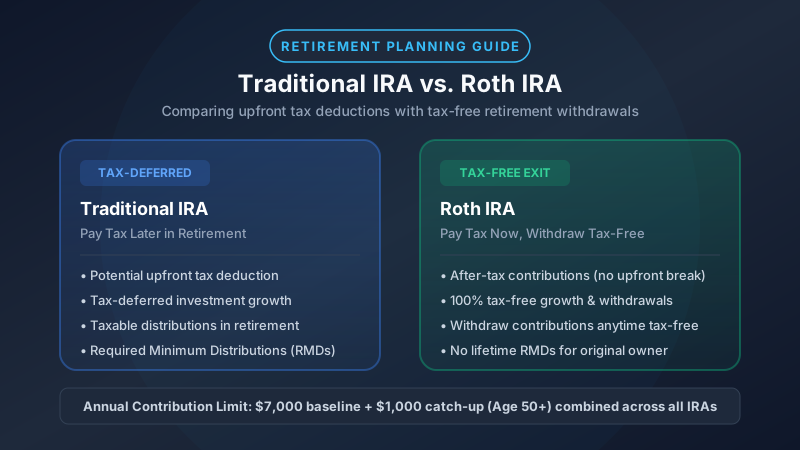
Contributions to traditional Solo 401(k) or SEP IRA accounts are pre-tax, reducing current-year adjusted gross income (AGI) and lowering federal tax obligations. Compare traditional vs Roth structures in traditional ira vs roth ira.
Key Tax Deadlines for Self-Employed Accounts
Self-employed business owners must track annual contribution and account setup deadlines:
- Solo 401(k) Establishment: Must be formally established by December 31 of the tax year, though employee elective deferrals and employer profit-sharing contributions can be funded up to your tax filing deadline (including extensions).
- SEP IRA Flexibility: SEP IRAs can be opened and fully funded up to your tax filing deadline (April 15 or October 15 with extension).
Summary Action Items for Freelancers
- Choose the Right Account: Select a Solo 401(k) for maximum contribution limits or a SEP IRA for minimal administrative paperwork.
- Set Aside Estimated Taxes: Transfer 25-30% of gross earnings into a high-yield savings tax reserve account.
Educational Summary & Key Definitions
Understanding financial fundamentals requires mastering core vocabulary and operational definitions:
- Principal: The original amount of money deposited or borrowed, excluding interest earnings or finance charges.
- Annual Percentage Yield (APY): The real rate of return earned on a deposit account, taking into account the effect of compounding interest over a 12-month period.
- Liquidity: The ease and speed with which an asset can be converted into liquid cash without incurring significant capital loss.
- Diversification: An investment risk management strategy that mixes a wide variety of investments within a portfolio to limit exposure to any single asset class.
Consulting official regulatory guidelines—such as disclosures from the CFPB, FDIC, NCUA, and Federal Reserve—ensures you make informed financial decisions backed by verified consumer protections.
MoneyTalkin' provides financial education, educational concepts, and general informational guides. Articles do not constitute personalized financial, investment, legal, or tax advice. Financial products, rates, terms, and regulatory rules change frequently; consult a qualified financial professional regarding your specific situation. Read our full Disclaimer Policy.
Written by MoneyTalkin'
MoneyTalkin' researches and publishes objective financial education content, money management fundamentals, and practical financial guides.
Related Technical Articles
Explore related topics in this cluster to deepen your understanding.