Index Funds vs. Individual Stocks: How They Compare for Beginners
Understand the differences between broad index funds and individual stocks, including diversification, risk exposure, costs, and management approaches.
Index Funds vs. Individual Stocks: How They Compare for Beginners
When starting an investment portfolio, investors face a fundamental strategic choice: should they buy individual company stocks or invest in broad-market index funds?
While purchasing individual stocks (such as Apple, Microsoft, or Amazon) offers the potential for market-outperforming returns, it exposes investors to single-stock risk and financial volatility. Conversely, index funds (such as S&P 500 or Total Stock Market index funds) provide instant diversification across hundreds or thousands of companies, delivering broad market returns with lower volatility.
Executive Summary: Core Differences
- Index Funds: A basket of securities designed to track a market benchmark (e.g., S&P 500). Offers instant diversification, low cost, and passive market returns.
- Individual Stocks: Ownership shares in a single corporation. Offers high upside potential, but exposes investors to business failure and extreme price swings.
- Diversification Benefit: Holding 500 companies in an index fund eliminates single-company bankruptcy risk.
- Performance Reality: Over 15-year periods, over 85% of professional active fund managers fail to beat broad market index benchmarks.
Structural Comparison: Index Funds vs. Stocks
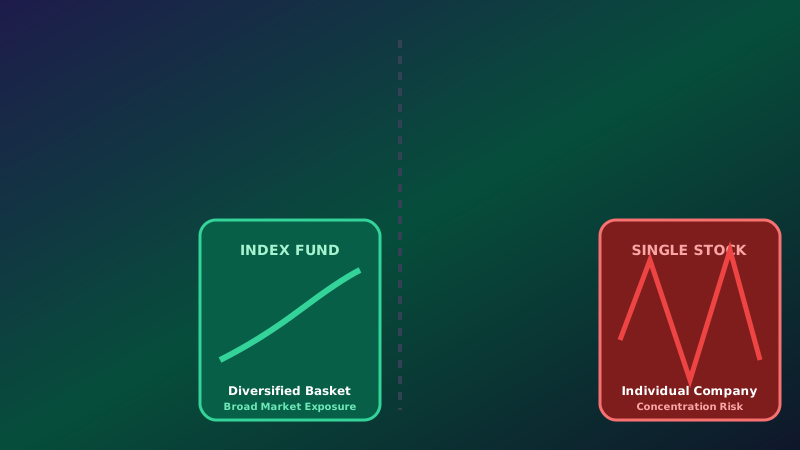
                   DIVERSIFICATION SPECTRUM
┌─────────────────────────────┐        ┌─────────────────────────────┐
│  Single Stock (High Risk)   │        │   Index Fund (Low Risk)     │
│ • Dependent on 1 company    │  ───►  │ • Spread across 500+ companies│
│ • Volatile price swings     │        │ • Tracks broad market growth│
└─────────────────────────────┘        └─────────────────────────────┘
| Attribute | Broad Market Index Funds | Individual Stocks |
|---|---|---|
| Diversification Level | High (Hundreds/thousands of holdings) | None (1 single business entity) |
| Risk Profile | Market risk only (Systematic risk) | Company-specific risk (Unsystematic risk) |
| Time Required | Minimal ("Set-and-forget" passive investing) | Substantial (Researching earnings reports) |
| Expected Return | Matches market benchmark (~7%–10% historical average) | Variable (-100% total loss to 1,000%+) |
| Volatile Swings | Moderate overall market fluctuations | Extreme price swings based on news |
The Power of Diversification: Eliminating Unsystematic Risk
In portfolio theory, investment risk is divided into two categories:
- Unsystematic Risk (Company-Specific Risk): The risk that a specific company suffers financial failure due to bad management, lawsuits, or declining sales (e.g., Enron, Kodak, or Sears). Index funds eliminate unsystematic risk by spreading capital across hundreds of companies.
- Systematic Risk (Market Risk): The risk that the entire economy declines during a recession. Broad market index funds remain exposed to market risk, but historically recover as the broader economy grows over multi-year horizons.
Mathematical Example: The Impact of Stock Selection Risk
Consider two investors, Investor X and Investor Y, who each invest $10,000 for 20 years.
- Investor X (Index Fund Investor): Invests $10,000 in an S&P 500 index fund earning an 8% compound annual return.
- Investor Y (Stock Picker): Splits $10,000 equally across 4 individual stock picks ($2,500 each):
- Stock 1 (Winner): Grows at 14% annually $\rightarrow$ $34,440
- Stock 2 (Average): Grows at 6% annually $\rightarrow$ $8,017
- Stock 3 (Stagnant): 0% return $\rightarrow$ $2,500
- Stock 4 (Bankrupt): Company fails $\rightarrow$ $0
20-Year Results Comparison
- Investor X (Index Fund):
$$$10,000 \times (1 + 0.08)^{20} = \mathbf{$46,610}$$ - Investor Y (Stock Picker):
$$$34,440 + $8,017 + $2,500 + $0 = \mathbf{$44,957}$$
Insight: Even though Investor Y picked one spectacular winner, company failures and underperforming stocks dragged down their overall portfolio, causing them to underperform the simple index fund.
Practical Takeaway Checklist
- Build a core portfolio foundation using low-cost index funds (e.g., Total Stock Market or S&P 500 index funds).
- Keep individual stock picks capped at 5% to 10% of total portfolio value if you enjoy stock research.
- Check expense ratios; choose low-cost index funds with expense ratios below 0.10%.
Sources
- U.S. Securities and Exchange Commission (SEC Investor.gov): Mutual Funds and Index Funds
https://www.investor.gov/ - S&P Dow Jones Indices: SPIVA Scorecard (Active vs. Passive Performance)
https://www.spglobal.com/spdji/en/research-insights/spiva/
Disclaimer
Educational content only. Past performance does not guarantee future results. Consult a financial advisor for investment advice.
Single-Stock Concentration Risk vs. Market Diversification
Holding individual stocks exposes investors to unsystematic risk—company-specific operational risks, executive turnover, competitive disruption, or legal liabilities that can cause severe stock price declines independent of the broader economy.
Unsystematic Risk (Company-Specific) ──► Eliminated through Index Diversification
Systematic Risk (Broad Market Risk)   ──► Remains inherent in broad equity markets
Expense Ratios and Tracking Error
When selecting index funds or ETFs, compare expense ratios—the annual management fee deducted from fund assets. Low-cost S&P 500 index funds feature expense ratios as low as 0.03% ($3 per $10,000 invested annually), maximizing long-term compound growth. Read our detailed analysis on index fund vs etf explained.
Building a Diversified Core Portfolio
For long-term wealth accumulation, financial advisers frequently recommend a core-and-satellite portfolio structure:
- Core Allocation (80-90%): Broad-market index funds (such as total stock market index funds and international index funds) providing low-cost diversified exposure.
- Satellite Allocation (10-20%): Optional individual growth stocks or specialized sector ETFs for targeted market research interests.
Educational Summary & Key Definitions
Understanding financial fundamentals requires mastering core vocabulary and operational definitions:
- Principal: The original amount of money deposited or borrowed, excluding interest earnings or finance charges.
- Annual Percentage Yield (APY): The real rate of return earned on a deposit account, taking into account the effect of compounding interest over a 12-month period.
- Liquidity: The ease and speed with which an asset can be converted into liquid cash without incurring significant capital loss.
- Diversification: An investment risk management strategy that mixes a wide variety of investments within a portfolio to limit exposure to any single asset class.
Consulting official regulatory guidelines—such as disclosures from the CFPB, FDIC, NCUA, and Federal Reserve—ensures you make informed financial decisions backed by verified consumer protections.
Summary Principles for Portfolio Construction
- Diversify Across Asset Classes: Combine US stock index funds, international equity funds, and fixed-income assets to manage portfolio risk.
- Keep Costs Low: Select index funds with expense ratios under 0.10% to preserve compound returns.
MoneyTalkin' provides financial education, educational concepts, and general informational guides. Articles do not constitute personalized financial, investment, legal, or tax advice. Financial products, rates, terms, and regulatory rules change frequently; consult a qualified financial professional regarding your specific situation. Read our full Disclaimer Policy.
Written by MoneyTalkin'
MoneyTalkin' researches and publishes objective financial education content, money management fundamentals, and practical financial guides.
Related Technical Articles
Explore related topics in this cluster to deepen your understanding.