Index Funds vs. ETFs: What's the Difference?
A comprehensive guide explaining the relationship between index funds and ETFs, comparing trading mechanics, investment minimums, tax efficiency, and cost structures.
Index Funds vs. ETFs: What's the Difference?
When building a low-cost portfolio, investors often encounter two popular terms: index funds and exchange-traded funds (ETFs). Beginners frequently treat these as mutually exclusive choices. However, comparing an index fund to an ETF is like comparing an "electric vehicle" to a "sedan"—one describes what the engine does (strategy), while the other describes the vehicle structure (trading format).
An index fund can exist as an index mutual fund or an index ETF. Similarly, an ETF can track an index passively or be actively managed.
Understanding how index funds and ETFs intersect—including trading mechanics, investment minimums, tax efficiency, and cost structures—helps investors build efficient portfolios alongside guides on index funds vs. individual stocks, understanding fund expense ratios, implementing dollar-cost averaging, and designing asset allocation by age.
1. Defining Strategy vs. Structure
To evaluate these options, separate investment strategy from fund structure:
                  ┌──────────────────────────────────────────────┐
                  │              INVESTMENT STRATEGY             │
                  │   Passive Indexing vs. Active Management     │
                  └──────────────────────┬───────────────────────┘
                                         │
                   ┌─────────────────────┴─────────────────────┐
                   ▼                                           ▼
      ┌─────────────────────────┐                 ┌─────────────────────────┐
      │   MUTUAL FUND STRUCTURE │                 │       ETF STRUCTURE     │
      │  (Trades 1x Daily NAV)  │                 │  (Trades Intraday Stock)│
      └─────────────────────────┘                 └─────────────────────────┘
A. Indexing Is an Investment Strategy
An index fund tracks a financial market index (such as the S&P 500 or Bloomberg U.S. Aggregate Bond Index). Index funds practice passive management, holding underlying securities with minimal active trading.
B. ETF Is a Fund Structure
An Exchange-Traded Fund (ETF) is an investment fund traded on public stock exchanges throughout the trading day, like an individual stock.
C. Four Fund Combinations
Because "index" defines strategy and "ETF" defines structure, investors encounter four combinations:
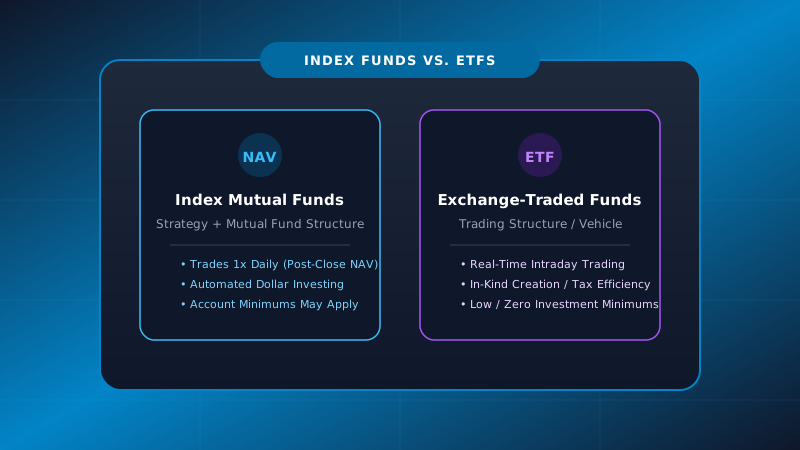
- Index Mutual Funds: Passively track an index and trade once daily after market close at Net Asset Value (NAV).
- Index ETFs: Passively track an index and trade continuously on stock exchanges during market hours.
- Active Mutual Funds: Actively managed by portfolio managers, trading once daily at NAV.
- Active ETFs: Actively managed by portfolio managers, but traded continuously on stock exchanges.
2. Trading Mechanics: Real-Time vs. End-of-Day NAV
The primary operational difference between mutual funds and ETFs lies in how shares are bought and sold:
A. Mutual Fund Trading (End-of-Day NAV)
- Pricing: Mutual fund shares do not trade in real time. All orders placed during the day are executed at a single price—the Net Asset Value (NAV)—calculated after the stock market closes (4:00 PM Eastern Time).
- Order Execution: Whether you place your buy order at 9:30 AM or 3:00 PM, you receive the exact same end-of-day NAV price.
B. ETF Trading (Intraday Market Pricing)
- Real-Time Pricing: ETF shares trade continuously throughout market hours at fluctuating market prices.
- Order Types: Investors can use market orders, limit orders, stop-loss orders, and limit-on-close orders when buying or selling ETFs.
- Bid-Ask Spreads: Because ETFs trade on open exchanges, transactions involve a bid-ask spread (the difference between the highest price a buyer is willing to pay and the lowest price a seller is willing to accept). For highly liquid broad-market ETFs, bid-ask spreads are a fraction of a penny.
3. Minimum Investments and Fractional Shares
Access requirements vary between mutual funds and ETFs:
A. Mutual Fund Minimums
Traditional mutual funds often require a minimum initial investment (e.g., $1,000, $3,000, or more) to open a position in a taxable account, though additional contributions can be made in any custom dollar amount (e.g., $25).
- Exception: Employer-sponsored 401(k) plans generally waive mutual fund minimums.
B. ETF Minimums
ETFs have no fund-imposed minimum investment requirement. You can purchase as little as a single share (or a fractional share if your brokerage supports fractional trading) for the market price of that single share (e.g., $50).
4. Tax Efficiency: In-Kind Creation and Redemption
Inside a taxable brokerage account, ETFs generally provide superior tax efficiency compared to traditional mutual funds due to their underlying structural mechanics.
A. Mutual Fund Capital Gains Distributions
When investors redeem mutual fund shares, the fund manager may be forced to sell underlying stocks to generate cash. If those stocks have appreciated, the mutual fund generates realized capital gains, distributed to all shareholders at year-end—even those who held firm.
B. ETF In-Kind Mechanism
ETFs utilize an institutional process called the in-kind creation and redemption mechanism:
- When ETF shares are sold, Authorized Participants exchange underlying stocks directly "in-kind" without open-market sales.
- This in-kind exchange is not a taxable event under IRS codes, preventing internal capital gains distributions.
Result: ETF shareholders generally pay capital gains taxes only when selling their own individual ETF shares.
5. Cost Comparison: Expense Ratios and Trading Costs
Both structures offer ultra-low annual fees, with minor cost differences:
| Cost Component | Index Mutual Funds | Index ETFs |
|---|---|---|
| Expense Ratio | Ultra-low for passive index funds (0.02%–0.08%) | Ultra-low for passive index ETFs (0.02%–0.06%) |
| Commissions | $0 at primary brokerages | $0 online commissions at major brokerages |
| Bid-Ask Spread | None (traded directly at NAV) | Minor spread cost (negligible for major ETFs) |
Both structures allow investors to keep annual fund management fees (expense ratios) extremely low.
6. Automated Investing vs. Intraday Flexibility
Choosing between index mutual funds and index ETFs often comes down to individual investor workflow preferences:
Why Savers Choose Index Mutual Funds
- Automated Dollar-Cost Averaging: Mutual funds make it simple to set up automated, recurring investments of exact dollar amounts (e.g., $250 every payday) directly from a bank account into partial shares.
- No Intraday Distractions: End-of-day pricing prevents investors from attempting to time short-term market swings.
Why Savers Choose Index ETFs
- Portability Across Brokerages: Index ETFs can be held or transferred freely across any major brokerage platform without incurring proprietary fund transfer fees.
- Real-Time Execution & Options: Active traders appreciate intraday execution, limit orders, and options availability.
- Tax Efficiency in Taxable Accounts: Exceptional tax efficiency makes ETFs the preferred structure for taxable brokerage accounts.
7. Side-by-Side Summary Comparison
| Feature | Index Mutual Fund | Index ETF |
|---|---|---|
| Primary Category | Strategy (Passive) + Structure | Strategy (Passive/Active) + Structure |
| Trading Hours | Once per day (4:00 PM NAV) | Continuous intraday stock exchange hours |
| Purchase Method | Exact dollar amounts | Shares or fractional shares |
| Initial Minimums | Often $1,000–$3,000 in taxable accounts | Price of 1 share (or fractional share) |
| Tax Efficiency | Good (May distribute capital gains) | Excellent (In-kind creation/redemption) |
| Automated Transfers | Highly seamless across all brokerages | Supported by select modern brokerages |
8. Practical Checklist for Deciding Between Index Funds and ETFs
Follow this practical checklist when selecting your fund structure:
- Account Type Check: Are you investing inside a tax-sheltered account (401k/IRA) or a taxable brokerage account? ETFs offer extra tax efficiency in taxable accounts.
- Automated Investing Needs: Do you want to set up automatic, recurring $50 weekly transfers? Index mutual funds excel at automated fixed-dollar investing.
- Initial Capital Available: Starting with a small initial deposit? Index ETFs allow you to start with the price of a single share.
- Check Expense Ratios: Compare the expense ratio of the index mutual fund against its ETF equivalent (e.g., VFIAX vs. VOO).
- Maintain Discipline: Avoid using ETF intraday liquidity to engage in emotional market-timing trades.
Sources
- U.S. Securities and Exchange Commission (SEC): Mutual Funds and ETFs: A Guide for Investors https://www.investor.gov/introduction-investing/investing-basics/investment-products/mutual-funds-and-exchange-traded
- FINRA Investor Education Foundation: Understanding Exchange-Traded Funds (ETFs) https://www.finra.org/investors/learn-to-invest/types-investments/exchange-traded-funds
- Investment Company Institute (ICI): ICI Fact Book: Mutual Funds & ETF Industry Structure https://www.ici.org/fact-book
Educational Disclaimer
This guide is for educational purposes only and does not constitute formal tax, legal, or investment advice. Fund structures, expense ratios, trading features, and tax treatments vary by brokerage platform and individual fund prospectus. Consult a qualified financial advisor before investing.
MoneyTalkin' provides financial education, educational concepts, and general informational guides. Articles do not constitute personalized financial, investment, legal, or tax advice. Financial products, rates, terms, and regulatory rules change frequently; consult a qualified financial professional regarding your specific situation. Read our full Disclaimer Policy.
Written by MoneyTalkin'
MoneyTalkin' researches and publishes objective financial education content, money management fundamentals, and practical financial guides.
Related Technical Articles
Explore related topics in this cluster to deepen your understanding.