Health Savings Account (HSA) Explained: Rules, Benefits, and How It Works
A current U.S. guide to Health Savings Accounts (HSAs), detailing HDHP rules, 2026 IRS limits, triple tax benefits, HSA vs FSA differences, and investment strategies.
Health Savings Account (HSA) Explained: Rules, Benefits, and How It Works
Healthcare costs represent one of the largest ongoing expenses for American households. To help individuals manage medical out-of-pocket costs while accumulating long-term savings, the U.S. tax code provides a uniquely advantaged account: the Health Savings Account (HSA).
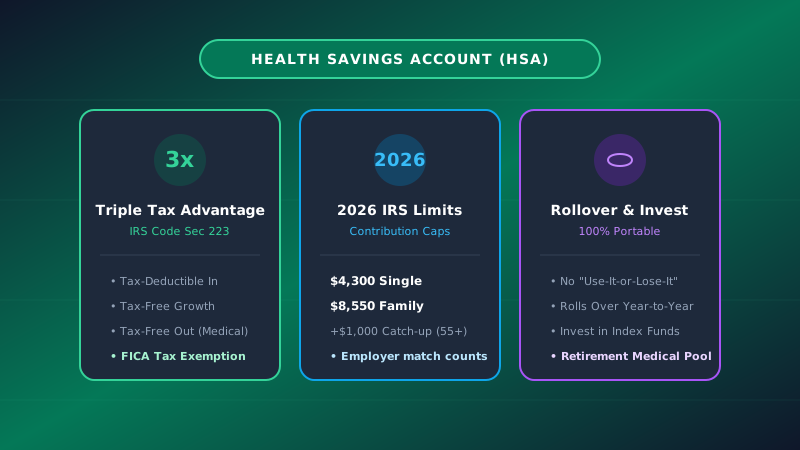
An HSA offers an unmatched triple tax advantage that makes it one of the most powerful tax-sheltered accounts available under IRS regulations. Understanding HSA eligibility criteria, 2026 contribution limits, qualified medical expense rules, and investment features can help account holders integrate an HSA alongside their broader tax-advantaged retirement accounts and baseline 50/30/20 budgeting rule.
1. What Is a Health Savings Account (HSA)?
A Health Savings Account (HSA) is a tax-exempt personal savings account created under the Medicare Prescription Drug, Improvement, and Modernization Act of 2003. HSAs are designed specifically for individuals enrolled in a qualifying High Deductible Health Plan (HDHP) to pay for out-of-pocket qualified medical expenses on a tax-favored basis.
Unlike Flexible Spending Accounts (FSAs), an HSA is individually owned and fully portable. Money deposited into an HSA belongs to the account holder permanently. Unused balances roll over from year to year without expiration, allowing HSA funds to be saved or invested for long-term health and retirement needs.
2. IRS HSA Eligibility Requirements
To legally contribute to an HSA under IRS rules (Publication 969), an individual must satisfy all of the following criteria on the first day of the month:
- Qualifying HDHP Enrollment: You must be covered under an HSA-qualified High Deductible Health Plan (HDHP).
- No Disqualifying Coverage: You cannot be covered by any non-HDHP secondary health plan (including a spouse's general-purpose FSA or standard PPO plan).
- Not Enrolled in Medicare: You cannot be enrolled in Medicare Part A, Part B, or Part D.
- Not Claimed as a Dependent: You cannot be claimed as a dependent on another individual's tax return.
2026 HDHP Statutory Minimums and Maximums
Under IRS Revenue Procedure guidelines for the 2026 tax year:
- Self-Only HDHP: Minimum annual deductible is $1,650; maximum out-of-pocket limit is $8,300.
- Family HDHP: Minimum annual deductible is $3,300; maximum out-of-pocket limit is $16,600.
3. The Triple Tax Advantage Explained
Financial planners frequently highlight the HSA as superior to traditional or Roth IRAs due to its triple tax advantage:
- Tax-Deductible Contributions (Pre-Tax): Contributions made through payroll deductions are made on a pre-tax basis, exempt from federal income tax, state income tax in most states (excluding California and New Jersey, which do not conform to federal HSA tax treatment), and FICA payroll taxes (Social Security and Medicare). Direct individual contributions are 100% tax-deductible on Form 1040 (Schedule 1).
- Tax-Deferred Growth: Interest, dividends, and capital gains generated inside an HSA grow entirely tax-free.
- Tax-Free Withdrawals for Qualified Expenses: Withdrawals used to pay for IRS-qualified medical expenses are completely free from federal and state income taxes.
4. 2026 IRS HSA Contribution Limits
The IRS sets statutory annual contribution limits for HSAs. The maximum combined contribution (including employer and employee contributions) for the 2026 tax year (pursuant to IRS Revenue Procedure 2025-23) is:
| Coverage Category | 2026 IRS Annual Limit | Catch-Up Limit (Age 55+) | Total Potential 2026 Limit |
|---|---|---|---|
| Self-Only Coverage | $4,300 | +$1,000 | $5,300 |
| Family Coverage | $8,550 | +$1,000 | $9,550 |
Employer Contribution Rule: Any contributions made by your employer count toward your total annual IRS contribution cap. Excess contributions above statutory limits are subject to a 6% excise tax penalty per year until corrected.
5. Qualified Medical Expenses vs. Non-Medical Withdrawals
HSA funds can be withdrawn at any time to pay for IRS-qualified medical expenses incurred by the account holder, spouse, or eligible tax dependents (even if those family members are not covered under the HDHP).
Qualified Medical Expenses (IRS Publication 502)
- Doctor co-pays, hospital visits, and diagnostic lab tests
- Prescription medications and insulin
- Over-the-counter medications and menstrual care products
- Dental care, braces, teeth cleanings, and oral surgery
- Vision care, eye exams, eyeglasses, contact lenses, and LASIK surgery
- Mental health therapy and physical therapy
Non-Medical Withdrawal Penalties
If HSA funds are withdrawn for non-qualified expenses (e.g., vacation, electronics, or non-medical retail purchases):
- Before Age 65: The withdrawal is subject to ordinary income tax plus a 20% IRS penalty fee.
- After Age 65: The 20% penalty fee dissolves. Non-medical withdrawals after age 65 are subject only to ordinary income tax (functioning identical to a traditional IRA).
6. HSA vs. FSA: Key Differences
Consumers frequently confuse Health Savings Accounts (HSAs) with Flexible Spending Accounts (FSAs). While both cover health expenses, their structural rules differ significantly:
| Feature | Health Savings Account (HSA) | Flexible Spending Account (FSA) |
|---|---|---|
| Required Health Plan | Qualifying HDHP required | Offered with various health plans |
| Account Ownership | Owned by the individual | Owned by the employer |
| Rollover Rules | 100% rollover year-to-year | Use-it-or-lose-it (small rollover cap) |
| Portability | Retained if changing jobs | Forfeited upon job separation |
| Investment Option | Can be invested in stocks/funds | Cannot be invested |
| 2026 Contribution Limit | $4,300 (Single) / $8,550 (Family) | Statutory cap (~$3,300) |
7. Investing Your HSA for Long-Term Wealth Growth
Many HSA providers allow account holders to invest balances above a specified threshold (e.g., $1,000) in index funds, mutual funds, or ETFs.
Because HSA funds roll over indefinitely, healthy individuals can pay current out-of-pocket medical bills using regular cash flow while allowing their invested HSA balance to compound tax-free over decades.
The "Shoebox" Strategy
Under current IRS rules, there is no deadline for reimbursing yourself for qualified medical expenses incurred after opening your HSA. Account holders can save digital copies of medical receipts today, allow their invested HSA balance to compound for 10 or 20 years, and execute tax-free HSA withdrawals decades later to reimburse those historical receipts.
8. Practical HSA Management Checklist
To maximize the benefits of a Health Savings Account, follow this practical checklist:
- Confirm HDHP Eligibility: Verify that your health plan meets 2026 IRS minimum deductible and maximum out-of-pocket limits.
- Maximize Pre-Tax Contributions: Contribute up to the 2026 IRS limit ($4,300 self-only / $8,550 family) via payroll deductions.
- Enable Investment Options: Invest funds above your immediate cash deductible into low-cost index funds.
- Digitize Medical Receipts: Maintain digital scans of all out-of-pocket medical receipts in cloud storage.
- Designate Beneficiaries: Ensure your spouse or primary beneficiary is named on the HSA account.
Sources
- Internal Revenue Service (IRS): Publication 969: Health Savings Accounts and Other Tax-Favored Health Plans https://www.irs.gov/forms-pubs/about-publication-969
- Internal Revenue Service (IRS): Revenue Procedure 2025-23 (2026 HSA Contribution Limits and HDHP Guidelines) https://www.irs.gov/
- U.S. Department of the Treasury: Health Savings Account Guidelines https://home.treasury.gov/
Educational Disclaimer
This guide is for informational and educational purposes only and does not constitute formal tax, legal, or health advisory services. HSA rules, contribution limits, and eligible expenses are subject to federal legislative updates and individual tax circumstances. Consult a qualified CPA or tax advisor for guidance regarding your specific situation.
MoneyTalkin' provides financial education, educational concepts, and general informational guides. Articles do not constitute personalized financial, investment, legal, or tax advice. Financial products, rates, terms, and regulatory rules change frequently; consult a qualified financial professional regarding your specific situation. Read our full Disclaimer Policy.
Written by MoneyTalkin'
MoneyTalkin' researches and publishes objective financial education content, money management fundamentals, and practical financial guides.
Related Technical Articles
Explore related topics in this cluster to deepen your understanding.