Crypto Taxes Explained: What Investors Should Know
An educational guide to cryptocurrency taxation globally, covering capital gains tax events, ordinary income events, staking, mining, and record-keeping principles.
Crypto Taxes Explained: What Investors Should Know
As digital assets gain global adoption, tax authorities around the world—including the IRS (United States), HMRC (United Kingdom), ATO (Australia), CRA (Canada), and European tax agencies—have established clear regulatory frameworks for taxing transactions in what-is-cryptocurrency.
Because tax treatment varies by country, holding period, transaction type, and individual circumstances, market participants must understand foundational taxation concepts. This guide provides a neutral, global educational framework explaining how tax authorities generally classify and tax digital assets.
1. Capital Gains vs. Ordinary Income Tax Events
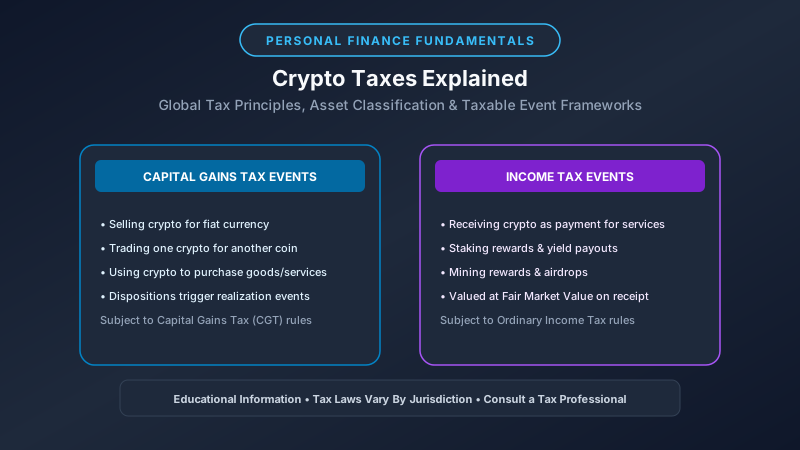
Most major tax jurisdictions categorize digital asset transactions into two distinct buckets: Capital Gains Tax (CGT) Events and Ordinary Income Tax Events.
                           ┌── Capital Gains Tax Events (Disposals)
                           │   • Selling crypto for fiat cash
                           │   • Swapping crypto for another token
                           │   • Spending crypto to purchase goods/services
Digital Asset Tax Classification ┼
                           └── Ordinary Income Tax Events (Receipts)
                               • Receiving crypto as wages / freelance payment
                               • Staking rewards & yield distributions
                               • Mining block rewards & promotional airdrops
| Transaction Type | General Tax Classification | Calculation Basis |
|---|---|---|
| Selling Crypto for Fiat | Capital Gains Tax (Gain/Loss) | Sale Proceeds minus Cost Basis (Purchase price + fees). |
| Crypto-to-Crypto Swaps | Capital Gains Tax (Gain/Loss) | Fair Market Value of received coin minus Cost Basis of disposed coin. |
| Paying for Goods with Crypto | Capital Gains Tax (Gain/Loss) | Fair Market Value of item minus Cost Basis of spent crypto. |
| Earning Crypto Wages | Ordinary Income Tax | Fair Market Value in fiat currency on the date of receipt. |
| Staking / Mining Rewards | Ordinary Income Tax | Fair Market Value in fiat currency on the date received. |
| Transferring Between Own Wallets | Non-Taxable Transfer | No disposal occurs; track transaction network gas fees. |
2. Understanding Cost Basis and Accounting Methods
Calculating capital gains requires determining your cost basis—the total original purchase price of the asset plus eligible transaction fees:
$$\text{Capital Gain / Loss} = \text{Fair Market Value at Disposal} - \text{Cost Basis}$$
Cost Basis Identification Methods
Tax authorities permit or mandate specific accounting methods for matching disposed tokens with historical purchases:
- FIFO (First-In, First-Out): Assumes the earliest tokens purchased are the first ones disposed of.
- LIFO (Last-In, First-Out): Assumes the most recently acquired tokens are disposed of first (where allowed).
- HIFO (Highest-In, First-Out): Matches disposals against the highest cost-basis tokens to minimize immediate capital gain.
- Specific Identification / Share Pooling: Some jurisdictions (such as the UK HMRC "Same Day" and "30-Day" pooling rules) require specific mathematical pooling calculations.
3. Global Differences and Evolving Tax Standards
Because MoneyTalkin' serves a global readership, it is essential to highlight that tax rules vary substantially across jurisdictions:
                            ┌── 1. Property / Capital Asset Treatment (e.g., US, UK, Canada, Australia)
                            │   • Standard capital gains & income rates
                            │
Global Taxation Frameworks ─┼── 2. Holding Period Exemptions (e.g., Germany, Austria)
                            │   • Tax-free capital gains after holding un-staked tokens for 1+ years
                            │
                            └── 3. Flat Wealth or Financial Transaction Taxes (e.g., Switzerland, India)
                                • Wealth tax inclusion or specific flat transaction deductions
- Jurisdictional Rules Change: A rule applicable in the U.S. (such as tracking cost basis for every crypto-to-crypto swap) may operate differently under German, Singaporean, or UAE tax codes.
- Global Reporting (OECD CARF): Under the OECD's Crypto-Asset Reporting Framework, tax agencies automatically share transaction data cross-border to ensure tax compliance across participating countries.
4. Record-Keeping Best Practices
Because public blockchain ledgers track transaction hashes rather than taxpayer real names, maintaining complete financial records is essential:
- Track Dates & Times: Record the exact date and UTC timestamp of every transaction.
- Record Fair Market Values: Save fiat currency valuations at the exact moment of every trade, reward receipt, or disposal.
- Log Wallet Addresses & TxIDs: Keep detailed records of your public wallet addresses and transaction IDs to substantiate non-taxable wallet-to-wallet transfers. See how-cryptocurrency-transactions-work.
5. Key Takeaways
- Simply buying and holding cryptocurrency with fiat cash is generally not a taxable event.
- Selling crypto for cash, swapping tokens, or paying for items triggers capital gains tax calculations.
- Earning staking rewards, mining tokens, or receiving crypto income is generally taxed as ordinary income.
- Tax laws vary significantly by country and are enforced through global data sharing.
6. Frequently Asked Questions
What happens if I make a net capital loss on my crypto trades?
In most capital gains tax systems, net capital losses can be used to offset capital gains realized from other investments (such as traditional stock sales). Some tax jurisdictions also permit limited net losses to offset ordinary income or carry forward into future tax years. For general investment tax principles, review capital-gains-tax-explained.
Does transferring crypto between my own hardware and software wallets trigger tax?
No. Moving assets between self-custody wallets or exchange accounts that you own is a non-taxable transfer because no disposal or change of beneficial ownership occurs.
Educational & Tax Disclaimer
This article is provided strictly for general educational and informational purposes and does not constitute individualized tax, accounting, or legal advice. MoneyTalkin' is not a registered tax advisory firm. Tax laws vary by jurisdiction, change frequently, and depend on personal financial circumstances. Readers must consult a licensed tax professional or certified accountant in their local jurisdiction before making tax filing decisions.
MoneyTalkin' provides financial education, educational concepts, and general informational guides. Articles do not constitute personalized financial, investment, legal, or tax advice. Financial products, rates, terms, and regulatory rules change frequently; consult a qualified financial professional regarding your specific situation. Read our full Disclaimer Policy.
Written by MoneyTalkin'
MoneyTalkin' researches and publishes objective financial education content, money management fundamentals, and practical financial guides.
Related Technical Articles
Explore related topics in this cluster to deepen your understanding.