Capital Gains Tax Explained: Short-Term vs. Long-Term Gains
A practical, U.S.-focused guide to capital gains tax—explaining holding periods, cost basis, preferential rates, tax-loss harvesting rules, and recordkeeping.
Capital Gains Tax Explained: Short-Term vs. Long-Term Gains
When you sell an asset like a stock, exchange-traded fund, or real estate for more than you paid, the profit is recognized as a capital gain. Under United States tax law, capital gains are subject to taxation when realized. However, not all gains are taxed equally. The length of time you hold an investment before selling determines whether your profit receives standard ordinary income treatment or preferential long-term tax rates.
Understanding capital gains tax rules allows investors managing a taxable brokerage account to structure transactions efficiently, differentiate taxable investments from tax-advantaged retirement accounts, and understand tax mechanics when holding index funds vs. individual stocks.
1. What Is a Capital Gain?
A capital gain occurs when you sell a capital asset—such as corporate shares, mutual funds, cryptocurrency, bonds, or real estate—for a price higher than its cost basis.
Cost Basis vs. Net Proceeds
- Cost Basis: The original purchase price of an asset, adjusted for commissions, transaction fees, stock splits, reinvested dividends, or capital improvements (for real estate).
- Net Proceeds: The gross sale price minus allowable selling costs, such as brokerage commissions or transaction fees.
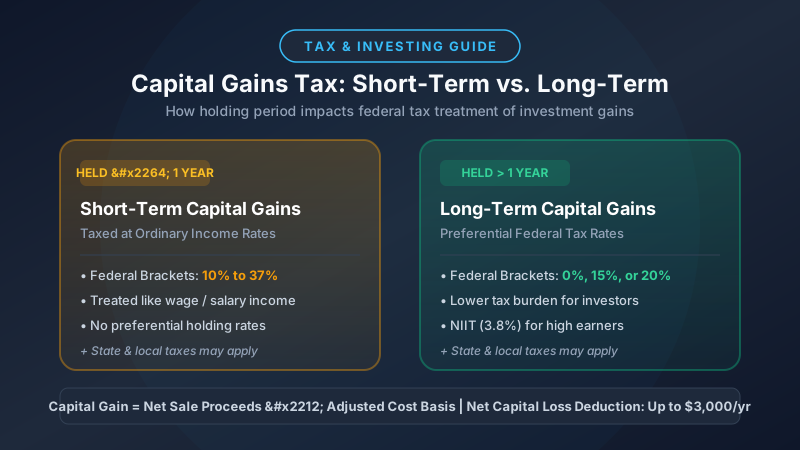
Capital Gain or Loss = Net Sale Proceeds − Adjusted Cost Basis
Realized vs. Unrealized Gains
- Unrealized Gain ("Paper Profit"): An increase in the market value of an asset you still own. Unrealized gains are generally not subject to capital gains tax.
- Realized Gain: A profit triggered when you complete an arms-length transaction selling or exchanging the asset. Tax obligations apply only to realized gains.
2. Short-Term vs. Long-Term Holding Periods
The Internal Revenue Service (IRS) divides capital gains into two distinct categories based on the holding period:
| Feature | Short-Term Capital Gains | Long-Term Capital Gains |
|---|---|---|
| Holding Period | 1 year or less (365 days or fewer) | More than 1 year (365+ days) |
| Tax Rate Treatment | Ordinary income tax rates | Preferential long-term rates |
| Federal Tax Rates | 10%, 12%, 22%, 24%, 32%, 35%, or 37% | 0%, 15%, or 20% |
| Primary Advantage | None (taxed like regular salary/wages) | Lower marginal tax rates for most brackets |
Note: Holding period begins on the day after you acquire the asset and ends on the day you sell it.
3. Federal Capital Gains Tax Rates (Tax Year 2026 / 2025 Rules)
Federal long-term capital gains tax rates are determined by taxable income thresholds and filing status. For the current tax year, federal long-term tax brackets are structured into three main tiers:
Federal Long-Term Tax Tiers
- 0% Rate: Applies to investors whose total taxable income falls below specific lower income thresholds.
- 15% Rate: Applies to most middle-income investors.
- 20% Rate: Applies to high-income taxpayers reaching top federal tax brackets.
Additional Tax Considerations
- Net Investment Income Tax (NIIT): High-earning taxpayers (e.g., single filers with modified adjusted gross income over $200,000, or married filing jointly over $250,000) may owe an additional 3.8% NIIT on investment income, including capital gains and taxable payouts alongside dividend investing.
- State and Local Taxes: Federal rates do not reflect state taxes. Most U.S. states tax capital gains as regular income, though rates and exemptions vary widely by jurisdiction.
4. Capital Losses and the Netting Process
When an asset is sold for less than its adjusted cost basis, you incur a capital loss. IRS rules allow taxpayers to offset capital gains with capital losses through a step-by-step netting process:
The Netting Rules
- Net Short-Term Positions: Combine short-term gains and short-term losses to determine net short-term profit or loss.
- Net Long-Term Positions: Combine long-term gains and long-term losses to determine net long-term profit or loss.
- Cross-Netting: If one category results in a net gain and the other a net loss, offset the two against each other.
The $3,000 Annual Net Loss Deduction
If your total capital losses exceed total capital gains for the tax year:
- Up to $3,000 of net capital losses ($1,500 if married filing separately) can be deducted against ordinary taxable income (such as W-2 wages) on your federal tax return.
- Any remaining excess capital loss cannot be fully deducted in a single year but can be carried forward indefinitely to future tax years to offset future gains or ordinary income.
5. The Wash-Sale Rule Overview
Investors attempting to harvest tax losses while maintaining market exposure must comply with the wash-sale rule:
- 30-Day Window: If you sell a security at a loss and purchase a "substantially identical" security within 30 days before or 30 days after the sale (a 61-day window), the tax loss is disallowed for current tax reporting.
- Cost Basis Adjustment: The disallowed loss is added to the cost basis of the newly purchased security, postponing the tax benefit until that new position is eventually sold.
6. Special Asset Class Tax Rules
Not all assets qualify for standard 0%/15%/20% long-term capital gains treatment:
- Primary Residence Exclusion (Section 121): Homeowners who own and occupy a primary home for at least 2 out of the 5 years preceding sale may exclude up to $250,000 of capital gains ($500,000 for married couples filing jointly) from federal income tax.
- Collectibles: Gains on physical gold, silver, art, antiques, and coins are taxed at a maximum federal rate of 28%, even if held long term.
- Unrecaptured Section 1250 Gain: Real estate depreciation recapture is subject to a maximum federal tax rate of 25%.
7. Hypothetical Capital Gains Calculation
Hypothetical example for illustrative purposes only:
An investor in a taxable account completes two transactions in the same tax year:
- Asset A (Short-Term): Purchased stock for $4,000 and sold 6 months later for $6,500.
- Net Short-Term Gain = $6,500 − $4,000 = +$2,500
- Asset B (Long-Term Loss): Purchased ETF shares for $10,000 three years ago and sold for $5,500.
- Net Long-Term Loss = $5,500 − $10,000 = −$4,500
Netting Calculation:
- Overall Position = +$2,500 (Short-Term Gain) − $4,500 (Long-Term Loss) = −$2,000 Net Loss
- Tax Impact: The investor pays $0 in capital gains tax for the year and can deduct the $2,000 net loss directly against ordinary income on Form 1040.
8. Essential Recordkeeping & Reporting
Proper tax reporting requires accurate documentation:
- Form 1099-B: Issued annually by brokerages detailing proceeds, cost basis, and holding periods.
- Form 8949: Used to list individual capital asset sales and adjust basis if necessary.
- Schedule D: Summarizes overall capital gains and losses attached to Form 1040.
9. Common Capital Gains Mistakes
- Ignoring Holding Dates: Selling an asset on day 365 instead of day 366 converts a long-term gain into a short-term gain taxed at higher ordinary rates.
- Triggering Wash Sales in IRAs: Selling a stock at a loss in a taxable account and buying it back inside a Roth IRA disallows the loss permanently without adjusting basis.
- Forgetting Dividend Reinvestments: Failing to add reinvested dividends to your cost basis results in double taxation when shares are sold.
10. Summary Checklist
- Differentiate realized gains from unrealized gains before planning sales.
- Track 365-day holding thresholds to secure lower long-term federal rates.
- Utilize the netting rule and $3,000 annual loss deduction to offset income.
- Mind the 61-day wash-sale window when harvesting investment losses.
- Consult qualified tax professionals for personal tax planning.
MoneyTalkin' provides financial education, educational concepts, and general informational guides. Articles do not constitute personalized financial, investment, legal, or tax advice. Financial products, rates, terms, and regulatory rules change frequently; consult a qualified financial professional regarding your specific situation. Read our full Disclaimer Policy.
Written by MoneyTalkin'
MoneyTalkin' researches and publishes objective financial education content, money management fundamentals, and practical financial guides.
Related Technical Articles
Explore related topics in this cluster to deepen your understanding.