Dividend Investing 101: Yield, Payout Ratios & Reinvestment Math
Learn how dividend investing works, key metrics like dividend yield and payout ratio, payment timelines, and how dividend reinvestment accelerates growth.

Dividend Investing 101: Yield, Payout Ratios, and Reinvestment Math
Dividend investing is an income-focused investment strategy that involves purchasing shares of dividend-paying corporations. A dividend is a cash distribution paid by a company out of its net profits to shareholders, typically disbursed on a quarterly schedule.
Dividend-paying companies tend to be mature, financially stable corporations with consistent cash flow generation (e.g., Consumer Staples, Utilities, and Healthcare). Understanding dividend metrics like Dividend Yield, Payout Ratio, and Dividend Reinvestment Plans (DRIP) allows investors to evaluate dividend sustainability and accelerate long-term compounding.
Executive Summary: Key Dividend Metrics
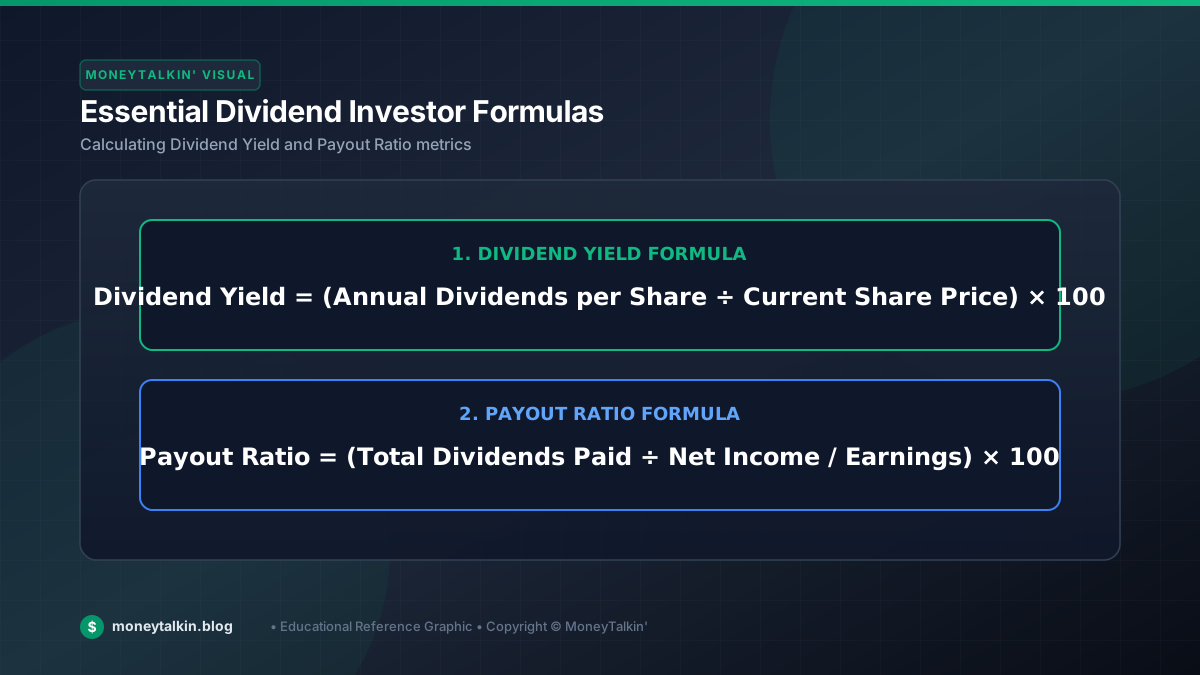
- Dividend Yield: Annual dividend payout divided by current stock price ($\text{Yield} = \text{Annual Dividend Per Share} / \text{Current Stock Price}$).
- Payout Ratio: Percentage of net earnings paid out as dividends ($\text{Payout Ratio} = \text{Dividends Per Share} / \text{Earnings Per Share}$).
- Sustainable Payout Ratio: Ideally between 30% and 60% for standard corporations; ratios exceeding 80%–90% signal high dividend cut risk.
- DRIP (Dividend Reinvestment Plan): Automatically reinvesting cash dividends into additional shares to compound long-term share count.
Key Metrics Evaluated by Dividend Investors
                    DIVIDEND INVESTING EVALUATION METRICS
┌───────────────────────────┐     ┌───────────────────────────┐     ┌───────────────────────────┐
│ 1. Dividend Yield         │     │ 2. Payout Ratio           │     │ 3. Dividend Growth Rate   │
│ Annual Payout / Share Price│    │ Net Dividends / Net Income│     │ Consecutive Annual Raises │
└───────────────────────────┘     └───────────────────────────┘     └───────────────────────────┘
1. Dividend Yield
Dividend yield measures the cash return paid relative to the stock's current market price:
$$\text{Dividend Yield} = \frac{\text{Annual Dividend Per Share}}{\text{Stock Price}}$$
Example: A stock trading at $100 per share that pays $1.00 quarterly ($4.00 annually) has a 4.0% dividend yield. Beware of extremely high yields (e.g., 10%+), which often indicate a falling stock price caused by financial distress.
2. Payout Ratio
The payout ratio evaluates dividend safety by measuring what portion of profits is paid to shareholders versus retained for business growth:
$$\text{Payout Ratio} = \frac{\text{Total Dividends Paid}}{\text{Net Income (Earnings)}}$$
A company earning $5.00 per share that pays $2.50 in annual dividends has a 50% payout ratio, leaving $2.50 per share to fund operations and buffer against economic downturns.
The Power of DRIP (Dividend Reinvestment Plans)
Reinvesting dividends automatically via DRIP turns quarterly cash payouts into additional fractional shares, compounding future dividend income.
Mathematical Comparison: Cash Payout vs. DRIP Reinvestment
Suppose an investor holds 1,000 shares of a company priced at $50 per share ($50,000 initial investment) paying a 4.0% dividend ($2.00/share annual dividend), assuming a 5% share price appreciation and 5% annual dividend growth over 20 years.
- Option A (Taking Cash Dividends): Receives annual cash payouts while share count stays fixed at 1,000 shares. Total value at Year 20: ~$132,000 + accumulated cash dividends.
- Option B (DRIP Reinvestment): Reinvesting all quarterly dividends increases share count from 1,000 shares to over 2,100 shares. Total value at Year 20: ~$280,000+.
Insight: Reinvesting dividends doubled the accumulated share count and dramatically increased final portfolio value.
Practical Takeaway Checklist
- Evaluate dividend safety using the Payout Ratio (target 30%–60%).
- Avoid yield traps; ultra-high yields (8%+) often indicate impending dividend cuts.
- Enable automatic DRIP reinvestment in your brokerage account for long-term growth.
Sources
- U.S. Securities and Exchange Commission (SEC Investor.gov): Dividends & Corporate Distributions
https://www.investor.gov/
Disclaimer
Educational content only. Past dividend payments do not guarantee future distributions.
Evaluating Dividend Quality: Payout Ratios & Aristocrats
Not all high dividend yields represent safe investments. Investors must evaluate corporate dividend sustainability using fundamental analysis:
- Dividend Payout Ratio: Calculated as annual dividends per share divided by earnings per share (EPS). A payout ratio below 60% indicates a company retains sufficient earnings to fund business operations and maintain dividend payments during economic downturns. Payout ratios exceeding 80-90% may signal risk of a dividend cut.
- Dividend Aristocrats: S&P 500 companies that have increased their annual dividend payouts for at least 25 consecutive years, demonstrating long-term capital discipline.
Tax Handling: Qualified vs. Non-Qualified Dividends
- Qualified Dividends: Dividends paid by U.S. corporations held for more than 60 days during a specific 121-day window qualify for preferential long-term capital gains tax rates (0%, 15%, or 20%), rather than higher ordinary income tax rates.
- Non-Qualified (Ordinary) Dividends: Dividends from Real Estate Investment Trusts (REITs) or short-term holding periods are taxed as ordinary income. Compare tax-advantaged account strategies in our guide to taxable brokerage account explained.
Dividend Reinvestment Plans (DRIPs) & Wealth Building
Many brokerage accounts offer automatic Dividend Reinvestment Plans (DRIPs):
- Compound Growth Acceleration: DRIPs automatically use cash dividend payouts to purchase additional fractional shares of the underlying stock or ETF without transaction commission fees.
- Dollar-Cost Averaging: Reinvesting dividends continuously acquires more shares during market pullbacks, accelerating long-term compound wealth growth inside tax-advantaged accounts.
Educational Summary & Key Definitions
Understanding financial fundamentals requires mastering core vocabulary and operational definitions:
- Principal: The original amount of money deposited or borrowed, excluding interest earnings or finance charges.
- Annual Percentage Yield (APY): The real rate of return earned on a deposit account, taking into account the effect of compounding interest over a 12-month period.
- Liquidity: The ease and speed with which an asset can be converted into liquid cash without incurring significant capital loss.
- Diversification: An investment risk management strategy that mixes a wide variety of investments within a portfolio to limit exposure to any single asset class.
Consulting official regulatory guidelines—such as disclosures from the CFPB, FDIC, NCUA, and Federal Reserve—ensures you make informed financial decisions backed by verified consumer protections.
Summary Principles for Dividend Investors
- Prioritize Dividend Safety Over High Yield: Evaluate payout ratios and balance sheet strength rather than chasing unsustainable double-digit yields.
- Hold Dividend Stocks in Tax-Advantaged Accounts: Hold high-yielding stocks or REITs in IRAs to defer or eliminate ordinary income tax drag.
MoneyTalkin' provides financial education, educational concepts, and general informational guides. Articles do not constitute personalized financial, investment, legal, or tax advice. Financial products, rates, terms, and regulatory rules change frequently; consult a qualified financial professional regarding your specific situation. Read our full Disclaimer Policy.
Written by MoneyTalkin'
MoneyTalkin' researches and publishes objective financial education content, money management fundamentals, and practical financial guides.
Related Technical Articles
Explore related topics in this cluster to deepen your understanding.