Cryptocurrency vs. Traditional Investments: Key Differences
Compare cryptocurrency with traditional assets—stocks, bonds, real estate, and cash—across 10 key dimensions including valuation, risk, custody, and income.
Cryptocurrency vs. Traditional Investments: Key Differences
When evaluating financial assets, investors weigh potential risk, return drivers, liquidity, legal rights, and structural characteristics. Traditional investments—such as stocks, bonds, mutual funds, real estate, and government-backed cash instruments—have operated within regulated global markets for decades. In contrast, digital assets powered by what is cryptocurrency represent an emerging technology class with distinct operational and economic dynamics.
This guide provides a neutral, side-by-side comparative analysis of digital assets and traditional financial instruments across ten essential investment dimensions.
1. Comparative Matrix Across 10 Financial Dimensions
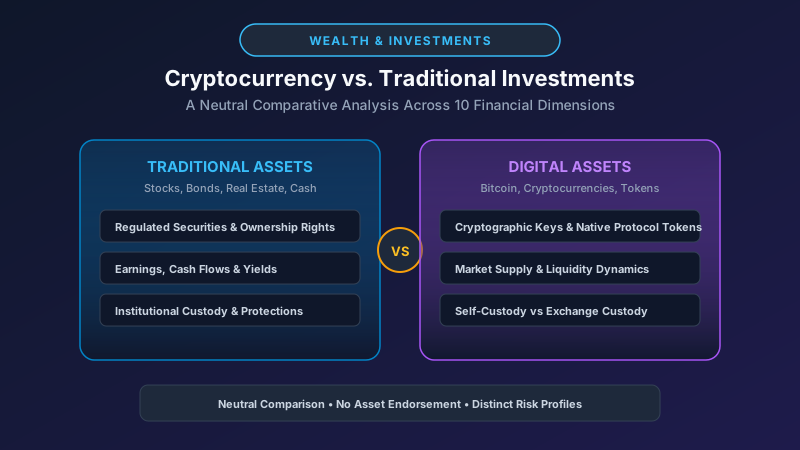
Traditional Investments (Stocks / Bonds / Cash) ◄──────────► Digital Assets (Cryptocurrencies / Tokens)
  • Earnings, Dividends & Interest Payments                    • Market Supply/Demand & Network Protocol Code
  • Government Deposit Insurance & Custody Protections          • Self-Custody & Cryptographic Key Responsibility
  • Regulated Market Hours & Sovereign Legal Rights            • 24/7 Global Trading & Irreversible Transfers
| Dimension | Traditional Investments (Stocks/Bonds/Cash) | Cryptocurrency & Digital Assets |
|---|---|---|
| 1. Ownership Rights | Legal title or shareholder equity enforced by corporate law and courts. | Cryptographic control over private keys on a distributed ledger. |
| 2. Valuation Basis | Corporate revenue, earnings, assets, book value, or benchmark interest rates. | Market supply and demand, liquidity cycles, protocol adoption, and sentiment. |
| 3. Volatility | Low to moderate (cash/bonds) or moderate (stocks). | High to extreme price fluctuations over short timeframes. |
| 4. Market Liquidity & Hours | Regulated exchanges operating during standard business hours. | 24/7 global peer-to-peer and exchange trading. |
| 5. Custody & Storage | Regulated brokerages, custodians, and banks with SIPC/FDIC protections. | Choice between self-custody wallets or private digital asset exchanges. |
| 6. Regulatory Oversight | Established oversight by agencies such as the SEC, FCA, or FINRA. | Evolving global regulatory frameworks with varying jurisdictional rules. |
| 7. Transaction Fees | Zero or low commission trading; management fees for index funds/ETFs. | Network transaction (gas) fees and exchange trading fees. |
| 8. Income Generation | Stock dividends, bond coupon payments, rental income, or interest rates. | Unbacked tokens do not generate earnings; PoS staking distributes token inflation. |
| 9. Diversification Role | Standard core asset classes for multi-decade portfolio building. | Non-correlated or regime-dependent speculative asset allocation. |
| 10. Loss Protections | Government deposit insurance (FDIC/FSCS) up to statutory limits. | No sovereign deposit insurance or loss guarantees for unbacked assets. |
2. In-Depth Comparison of Core Investment Characteristics
Valuation Models & Fundamental Drivers
- Traditional Assets: A corporate stock's fundamental value is anchored in company earnings, cash flow projections, balance sheet assets, and broader economic health. Bond values reflect fixed interest payments and sovereign creditworthiness. Learn fundamental asset modeling in asset-allocation-by-age.
- Cryptocurrency: Native digital tokens—such as bitcoin-explained—do not generate cash flows or earnings. Their valuation is determined by supply caps, adoption rates, macroeconomic liquidity, and market speculation.
Custody and Legal Protections
- Traditional Assets: Investors hold assets through regulated institutions (banks, brokerages) that provide investor protection programs (e.g., SIPC in the U.S., FSCS in the UK) in cases of broker insolvency.
- Digital Assets: Users can choose between custodial exchanges or self-custody wallets. Holding private keys provides direct control but transfers total responsibility for security to the individual. See crypto-wallets-explained.
Regulatory and Tax Structures
- Traditional Assets: Tax treatments for capital gains, dividends, and interest income are well-defined in most tax codes worldwide.
- Digital Assets: Tax authorities increasingly treat cryptocurrencies as taxable property, requiring tracking of cost basis for every trade, sale, or disposal. Review global tax principles in crypto-taxes-explained.
3. Risk Considerations for Investors
Financial planners emphasize that digital assets and traditional assets serve fundamentally different risk-return profiles within a financial plan:
Lower Risk / Capital Preservation ───────────────────────────────► Higher Speculative Risk
Cash / T-Bills ──► Government Bonds ──► Broad Index Funds ──► Individual Stocks ──► Crypto Assets
- Capital Preservation: Short-term government securities and FDIC-insured bank accounts focus on preserving principal and maintaining liquidity.
- Long-Term Growth: Index funds and equities historical track records demonstrate multi-decade wealth compounding supported by global economic expansion.
- Speculative Risk: Cryptocurrency markets carry high drawdowns, technical vulnerability, and market structure risks alongside potential upside.
4. Key Takeaways
- Traditional assets represent legal equity, debt obligations, or cash backed by established economic cash flows and legal protections.
- Cryptocurrencies operate on decentralized cryptographic ledgers without corporate earnings or sovereign deposit guarantees.
- Digital assets offer 24/7 global market access but exhibit significantly higher volatility and custody responsibility.
- Financial regulators view crypto as speculative assets rather than replacements for diversified core portfolios.
5. Frequently Asked Questions
Which asset class is better for long-term wealth accumulation?
Neither asset class is universally "better." Traditional diversified portfolios (such as low-cost index funds and bonds) have a century-long historical record of wealth creation tied to economic productivity. Digital assets represent an emerging technology class with high volatility and shorter market histories.
How do stablecoins fit into this comparison?
Stablecoins aim to bridge digital assets and traditional fiat currencies by maintaining a fixed 1:1 value ratio against fiat currencies like the U.S. Dollar. Explore how stablecoins compare with bank deposits in stablecoins-vs-bank-deposits.
Educational Disclaimer
This article is for general informational and educational purposes only and does not constitute financial, investment, tax, or legal advice. MoneyTalkin' does not recommend buying or selling any investment product or digital asset. Past market performance does not guarantee future results. Always consult a licensed financial advisor before allocating capital.
MoneyTalkin' provides financial education, educational concepts, and general informational guides. Articles do not constitute personalized financial, investment, legal, or tax advice. Financial products, rates, terms, and regulatory rules change frequently; consult a qualified financial professional regarding your specific situation. Read our full Disclaimer Policy.
Written by MoneyTalkin'
MoneyTalkin' researches and publishes objective financial education content, money management fundamentals, and practical financial guides.
Related Technical Articles
Explore related topics in this cluster to deepen your understanding.