What a Fed Rate Hike Means for Your Savings, Credit Cards and Mortgage
A practical breakdown of how Federal Reserve interest rate decisions ripple across credit cards, high-yield savings accounts, mortgages, and Treasury yields.
What a Fed Rate Hike Means for Your Savings, Credit Cards and Mortgage
Few economic announcements attract as much public attention as a Federal Reserve interest rate decision. When the Federal Open Market Committee (FOMC) adjusts monetary policy, financial media headlines rapidly announce changes to interest rates. However, many consumers remain uncertain about how central bank policy decisions directly impact their personal bank accounts, credit card balances, and home buying budgets.
Understanding the financial impact of a Fed rate decision requires examining what the central bank directly controls, how interest rate changes transmit across commercial banking products, and why different financial instruments respond at varying speeds.
1. What the Federal Reserve Directly Controls
To understand monetary policy transmission, consumers must first understand what the Federal Reserve does—and does not—directly control.
The Federal Reserve does not directly set commercial mortgage rates, credit card interest rates, or savings account yields. Instead, the FOMC sets the target range for the federal funds rate. The federal funds rate is the overnight interest rate at which commercial depository institutions lend reserve balances to one another on an uncollateralized basis.
When the Fed raises its target range for the federal funds rate, it increases the cost of short-term borrowing for commercial banks. To preserve net interest margins, commercial banks immediately adjust their benchmark Prime Rate—typically setting the Prime Rate 3.00 percentage points (300 basis points) above the upper bound of the federal funds rate target range.
2. Impact on Credit Card Debt: Direct and Immediate
Credit card interest rates represent the most immediate area where consumers feel the impact of a Fed rate hike.
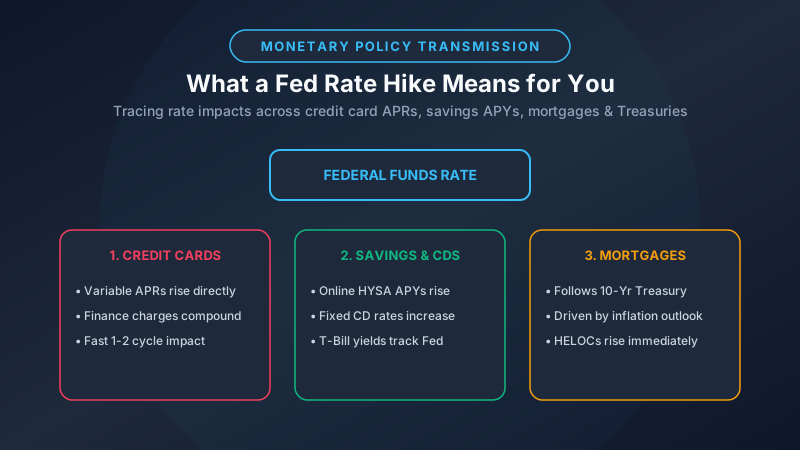
Most credit cards operate with variable Annual Percentage Rates (APRs). A variable APR is structured as the benchmark Prime Rate plus an issuer-defined margin (for example: Prime + 14.99%). When the Federal Reserve raises the federal funds rate by 0.25% (25 basis points), commercial banks raise the Prime Rate by 0.25%, which automatically increases the variable APR on existing credit card balances by 0.25%, usually within one to two billing cycles.
As analyzed in our guide to why-credit-card-debt-gets-more-expensive, higher APRs increase monthly finance charges, slowing down debt payoff timelines for consumers carrying revolving balances.
3. Impact on Deposit Accounts: High-Yield Savings and CDs
For savers, Federal Reserve rate hikes provide positive momentum, though transmission speeds vary across financial institutions:
-
High-Yield Savings Accounts (HYSAs): Online banks and digital neobanks operating with low physical overhead actively compete for consumer deposits. When the Fed raises rates, competitive online banks quickly increase their variable Annual Percentage Yields (APYs) to attract capital, boosting interest income for savers as detailed in high-yield-savings-rising-rate-environment.
-
Certificates of Deposit (CDs): Fixed-rate CD yields rise during rate-hike cycles, allowing savers to lock in guaranteed annual returns over terms ranging from 6 months to 5 years, a strategy explored in cd-rates-moving-again.
-
Traditional Brick-and-Mortar Savings: Traditional megabanks holding massive pools of sticky customer deposits often lag significantly behind, raising savings APYs by negligible fractions of a percent while keeping yields near 0.01%.
Savers must distinguish between the nominal interest rate and the compounded APY, a concept covered in apy-vs-interest-rate-explained.
4. Impact on Mortgages and Homebuying Budgets
A widespread financial myth assumes that the Federal Reserve directly sets mortgage rates on a 1-to-1 basis. In reality, 30-year fixed mortgage rates are not tied directly to the federal funds rate.
Instead, 30-year fixed mortgage rates move in close correlation with the 10-Year U.S. Treasury yield, which reflects long-term market expectations regarding inflation, economic growth, and government debt issuance—a relationship detailed in 10-year-treasury-yield-explained.
While a Fed rate hike increases short-term borrowing costs, long-term mortgage rates may rise, flatten, or even fall if bond market investors believe the Fed's rate hikes will successfully slow economic growth and reduce future inflation. However, Adjustable-Rate Mortgages (ARMs) and home equity lines of credit (HELOCs) are tied to short-term indices and rise directly when the Fed hikes rates.
5. Auto Loans, Personal Loans, and Treasury Yields
Other consumer financial products respond based on their maturity length and fixed versus variable structures:
-
Auto Loans: Fixed-rate auto loans move in response to medium-term Treasury yields and commercial bank funding costs. Rate hikes gradually elevate auto loan APRs for new borrowers over several months.
-
Personal Loans: Fixed personal loan rates rise gradually for new applicants, while existing fixed-rate personal loans remain unchanged.
-
U.S. Treasury Bills (T-Bills): Short-term Treasury bills (3-month, 6-month) track the federal funds rate very closely, offering risk-free yields backed by the U.S. government, as explained in treasury-bills-t-bills-explained.
6. Real Economic Impact on Household Budgets
The cumulative effect of Federal Reserve rate hikes alters consumer trade-offs across household finance. Higher borrowing costs discourage discretionary debt expansion while incentivizing cash accumulation in high-yield vehicles.
Furthermore, rate hikes influence macroeconomic conditions by tempering inflation risks, which directly protects long-term consumer purchasing power, as discussed in inflation-and-purchasing-power-explained.
7. Key Numbers Consumers Should Monitor
To navigate changing monetary policy effectively, household financial managers should track four core financial metrics:
-
The Commercial Prime Rate: Serves as the index benchmark for variable credit card APRs and HELOC interest rates.
-
The 10-Year Treasury Yield: Serves as the primary market benchmark for 30-year fixed mortgage rate trends.
-
Top Online HYSA APYs: Measures competitive deposit yields available across top insured digital banks.
-
Personal Credit Card Statement APRs: Inspect monthly statements to verify updated margin pricing following central bank policy moves.
Transmission Comparison Across Consumer Financial Products
The table below details how Fed policy rate hikes transmit across primary consumer financial categories:
| Financial Product | Rate Structure | Reaction Speed | Typical Impact Direction |
| :--- | :--- | :--- | :--- |
| Credit Cards | Variable (Prime + Margin) | Immediate (1-2 billing cycles) | Increases APRs & finance charges |
| Online Savings (HYSA)| Variable APY | Fast (Days to weeks) | Increases savings yield |
| Certificates of Deposit| Fixed term APY | Medium (New CDs only) | Increases locked-in rates |
| 30-Yr Fixed Mortgage| Fixed term | Correlated with 10-Yr Treasury | Driven by inflation expectations |
| HELOC / Variable ARM | Variable index | Direct & fast | Increases monthly payment |
| Short-Term T-Bills | Fixed discount yield | Fast (Tracks Fed funds) | Increases risk-free yield |
Practical Checklist for Consumers
During a changing Federal Reserve rate environment, consumers should take proactive financial steps:
-
Pay Down High-Interest Variable Credit Card Debt: Prioritize liquidating credit card balances before higher APRs compound interest liabilities.
-
Move Excess Cash to High-Yield Accounts: Transfer liquid emergency reserves out of 0.01% traditional accounts into competitive high-yield savings or Treasury bills.
-
Lock In CD Ladders if Rates Peak: Consider locking in fixed multi-year CD yields if monetary policy approaches the end of a tightening cycle.
-
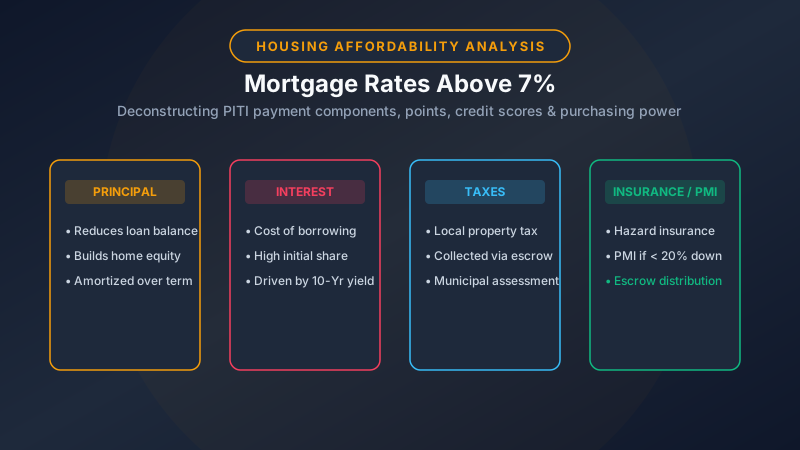
Evaluate Housing Budgets Based on Total PITI: When shopping for a mortgage, calculate total monthly housing obligations rather than relying solely on advertised interest rates.
By understanding how central bank policy moves through commercial banking channels, consumers can adjust their saving, borrowing, and debt payoff strategies to protect their household balance sheets.
MoneyTalkin' provides financial education, educational concepts, and general informational guides. Articles do not constitute personalized financial, investment, legal, or tax advice. Financial products, rates, terms, and regulatory rules change frequently; consult a qualified financial professional regarding your specific situation. Read our full Disclaimer Policy.
Written by MoneyTalkin'
MoneyTalkin' researches and publishes objective financial education content, money management fundamentals, and practical financial guides.
Related Technical Articles
Explore related topics in this cluster to deepen your understanding.