Why the 10-Year Treasury Yield Matters to Ordinary Americans
The 10-year Treasury yield is a core benchmark for global finance. Learn how it affects mortgage interest rates, consumer loans, and economic conditions.
Why the 10-Year Treasury Yield Matters to Ordinary Americans
Financial news broadcasts and market commentary frequently report daily movements in the 10-year U.S. Treasury yield. While government bond markets might seem distant from daily financial life, the 10-year Treasury yield serves as the foundational benchmark for pricing consumer credit, corporate borrowing, residential mortgages, and broader economic activity across the United States.
Data published by the U.S. Department of the Treasury and the Federal Reserve Bank of St. Louis (FRED) as of September 2026 demonstrate how shifts in benchmark bond yields ripple through commercial financial markets. Understanding what the 10-year Treasury yield represents—and what consumers should and should not infer from yield fluctuations—helps demystify interest rate movement in everyday personal finance.
1. What Is the 10-Year U.S. Treasury Note?
The 10-year Treasury note is a loan made by an investor to the United States federal government. When the U.S. Department of the Treasury issues debt to fund government operations and service existing liabilities, it auctions fixed-income notes with a 10-year maturity term.
Investors who purchase a 10-year Treasury note receive semi-annual interest payments (coupon payments) for 10 years, followed by the return of the face value (principal) at maturity.
The Inverse Relationship Between Bond Prices and Yields
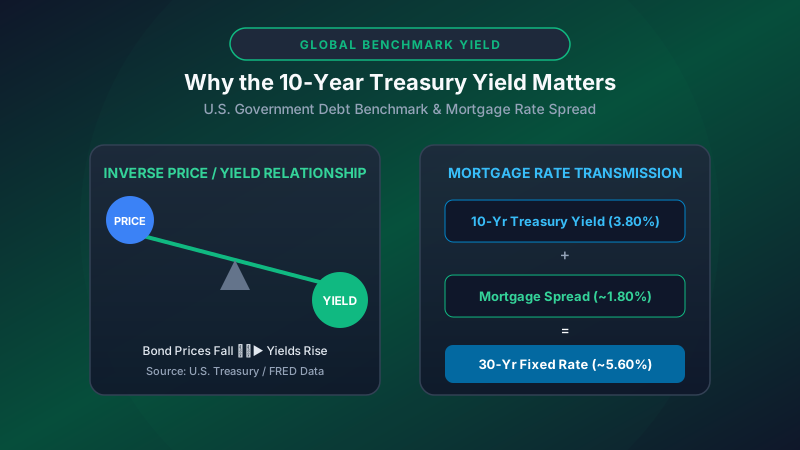
Understanding bond market mechanics requires recognizing that bond prices and yields move in opposite directions.
Investor Demand Increases ──► Bond Price Rises ──► Bond Yield Falls
Investor Demand Decreases ──► Bond Price Falls ──► Bond Yield Rises
- Nominal Coupon Rate: The fixed percentage interest rate set when the bond is issued.
- Secondary Market Price: After issuance, Treasury notes trade freely on secondary bond markets. As demand for Treasury bonds changes, their market price fluctuates.
- Yield to Maturity: The effective annual return an investor earns by purchasing a bond at its current market price and holding it to maturity.
When economic conditions cause investors to sell 10-year Treasury notes, bond prices drop, which causes the 10-year Treasury yield to rise. Conversely, when investors buy Treasuries as safe-haven assets, bond prices rise, pushing yields down.
2. How the 10-Year Treasury Yield Influences Mortgage Rates
The most direct connection between the 10-year Treasury yield and consumer personal finance is residential mortgage pricing.
Lenders pricing 30-year fixed-rate mortgages benchmark their rates against the 10-year Treasury yield rather than the federal funds rate. This occurs because the average residential mortgage is prepaid, refinanced, or paid off within 7 to 10 years as homeowners move or restructure debt.
10-Year Treasury Yield (Base Risk-Free Benchmark)
                      │
                      ▼
   + Lender Mortgage Spread (Default Risk, Servicing, Volatility)
                      │
                      ▼
   30-Year Fixed Residential Mortgage Rate Quoted to Borrowers
The Mortgage Spread
Mortgages carry higher interest rates than 10-year Treasuries because private borrowers present default risk, whereas U.S. government debt is considered virtually risk-free. The difference between the 30-year fixed mortgage rate and the 10-year Treasury yield is called the mortgage spread.
Historically, the spread between 30-year mortgage rates and the 10-year Treasury yield averages between 1.50 and 2.00 percentage points (150 to 200 basis points).
- If the 10-year Treasury yield is 3.80% and the mortgage spread is 1.80%, 30-year fixed mortgage rates average around 5.60%.
- If market uncertainty increases lender risk premiums and spreads widen to 2.80%, the same 3.80% Treasury yield results in mortgage rates near 6.60%.
Understanding how mortgage components work, as detailed in our guide on mortgage rates above 7 percent, highlights why Treasury yields are closely monitored by prospective homebuyers.
3. Broader Financial Effects Across the Economy
Beyond mortgage pricing, the 10-year Treasury yield serves as the "risk-free baseline" for the entire capital market structure:
| Economic Sector | How 10-Year Yield Influences Costs | Real-World Impact |
|---|---|---|
| Corporate Debt | Companies benchmark corporate bond interest rates against Treasuries | Higher yields increase corporate borrowing costs |
| Auto & Student Loans | Multi-year fixed installment loans track intermediate benchmark yields | Consumer loan interest rates rise |
| Equity Valuations | Analysts discount future corporate earnings using risk-free yields | Higher yields can compress stock price-to-earnings ratios |
| Government Debt Service | Federal interest obligations increase as new debt is issued at higher yields | Higher portion of federal budget goes to net interest |
Inflation and Growth Expectations
The 10-year Treasury yield reflects investors' long-term collective expectations for inflation and economic growth:
- Rising 10-Year Yields: Often signal that investors expect stronger economic growth or persistent inflation, demanding higher yields to compensate for purchasing power erosion over a 10-year horizon. Review our guide on inflation and purchasing power explained for details on how inflation affects long-term assets.
- Falling 10-Year Yields: Often signal economic cooling, lower expected inflation, or flight-to-safety buying during periods of market stress.
4. Yield Curve Slope: Inversion vs. Steepening Signals
Bond market analysts continuously monitor the shape of the Treasury Yield Curve—a chart plotting yields across maturities ranging from 1-month T-Bills to 30-year Treasury bonds.
Normal Yield Curve:       Short-Term Rates < Long-Term Rates (Upward Slope)
Inverted Yield Curve:     Short-Term Rates > Long-Term Rates (Downward Slope)
- Normal Yield Curve: Investors demand higher yields for committing capital over longer horizons (10 to 30 years) to compensate for inflation and duration risk.
- Inverted Yield Curve: When short-term Treasury yields (e.g., 2-year notes) rise higher than the 10-year Treasury yield, the yield curve inverts. Historically, a sustained yield curve inversion has served as a reliable leading indicator of economic recessions in the United States.
5. Fed Funds Rate vs. 10-Year Treasury Yield: Critical Differences
A common misconception is that the Federal Reserve directly sets the 10-year Treasury yield.
Federal Reserve Controlled:   Short-Term Federal Funds Rate (Overnight Lending)
Market Determined:            10-Year Treasury Yield (10-Year Supply/Demand & Growth Expectations)
- Short-Term Rates (Fed Funds): Directly established by the Federal Open Market Committee (FOMC) for overnight interbank lending.
- Long-Term Rates (10-Year Yield): Determined entirely by supply and demand in global fixed-income markets based on 10-year inflation and economic projections.
While Fed rate hikes influence short-term borrowing costs—such as credit card APRs—the 10-year Treasury yield can move independently. For example, if the Fed raises short-term rates to curb inflation, the 10-year yield may fall if investors believe central bank tightening will slow future economic growth.
6. Treasury Securities Comparison: T-Bills vs. 10-Year Notes
Retail investors evaluating fixed-income options should distinguish short-term Treasuries from intermediate notes:
- Treasury Bills (T-Bills): Short-term debt issued with maturities of 4, 8, 13, 26, or 52 weeks. T-Bills pay no periodic coupon; they are sold at a discount to face value. Learn more about short-term government paper in treasury bills t-bills explained.
- 10-Year Treasury Notes: Intermediate-term debt paying semi-annual coupons. Holders face secondary market price volatility if sold prior to the 10-year maturity date.
- Tax Status: Interest earned on all U.S. Treasury debt is exempt from state and local income taxes, though subject to federal income tax.
Holding fixed-income assets inside a tax-advantaged framework can be compared against standard taxable account rules, as outlined in taxable brokerage account explained.
Key Takeaways for Consumers
- Benchmark for Borrowing: Use 10-year Treasury yield trends to anticipate upcoming shifts in fixed mortgage rates and consumer loan pricing.
- No 1-to-1 Fixed Lock: Recognize that mortgage spreads fluctuate; a drop in Treasury yields does not automatically yield an identical dollar-for-dollar cut in consumer mortgage quotes.
- Market Indicator: View the 10-year yield as a barometer of market sentiment regarding long-term inflation, economic momentum, and government borrowing.
For consumer interest rate impacts, read What a Fed Rate Hike Means for Your Money.
MoneyTalkin' provides financial education, educational concepts, and general informational guides. Articles do not constitute personalized financial, investment, legal, or tax advice. Financial products, rates, terms, and regulatory rules change frequently; consult a qualified financial professional regarding your specific situation. Read our full Disclaimer Policy.
Written by MoneyTalkin'
MoneyTalkin' researches and publishes objective financial education content, money management fundamentals, and practical financial guides.
Related Technical Articles
Explore related topics in this cluster to deepen your understanding.