Mortgage Rates Above 7%: What Determines Your Monthly Payment?
When mortgage interest rates exceed 7%, homebuyer purchasing power shifts dramatically. Here is a breakdown of what influences your monthly housing costs.
Mortgage Rates Above 7%: What Determines Your Monthly Payment?
When 30-year fixed mortgage rates fluctuate above the 7% threshold—as reflected in Freddie Mac Primary Mortgage Market Survey benchmarking as of September 2026—prospective homebuyers and homeowners evaluating refinancing face a significantly different financial landscape than during previous low-rate eras. A difference of two or three percentage points on a long-term mortgage does not simply add a small increment to monthly expenses; it fundamentally reshapes debt service calculations, housing affordability, and long-term equity accumulation.
However, a mortgage rate is only one component of a homeowner's recurring housing obligations. Understanding how mortgage interest interacts with principal repayment, property taxes, homeowners insurance, mortgage insurance, and loan structures enables consumers to evaluate real-world affordability accurately.
1. The Core Calculation: Principal & Interest (P&I)
The foundation of any mortgage payment consists of principal (the repayment of the original balance borrowed) and interest (the fee paid to the lender for borrowing that capital).
Most residential mortgages in the United States rely on an amortization schedule. In the early years of a 30-year fixed-rate mortgage, the overwhelming majority of each monthly payment goes toward interest, while only a small fraction reduces the principal balance. As time progresses, this ratio gradually reverses.
Interest Rate vs. Annual Percentage Rate (APR)
Borrowers often see two different interest metrics quoted by mortgage lenders:
- Nominal Interest Rate: The base percentage used to calculate monthly interest charges on the remaining loan principal.
- Annual Percentage Rate (APR): A broader metric that reflects the total annualized cost of borrowing. The APR incorporates the nominal interest rate along with upfront lender fees, discount points, processing costs, and broker fees.
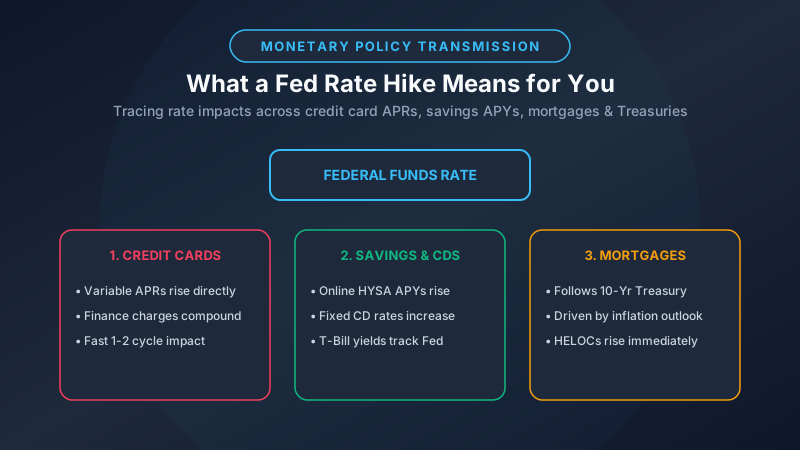
Because APR reflects total transaction costs, comparing mortgage offers based on APR provides a more accurate picture of relative expense than comparing nominal interest rates alone. Understanding how credit card APRs function offers a helpful parallel for how financial institutions charge interest across consumer products.
2. The PITI Formula and Total Monthly Housing Costs
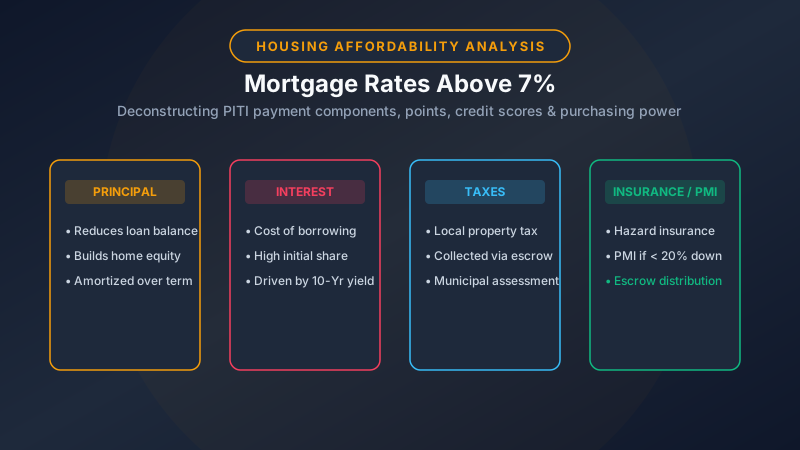
While lenders quote loans based on Principal and Interest, homeowners actually pay what is known as PITI: Principal, Interest, Taxes, and Insurance. In many cases, additional recurring fees also apply.
Total Monthly Housing Cost = Principal + Interest + Property Taxes + Homeowners Insurance + PMI/MIP + HOA Fees
| Payment Component | Purpose | Variable or Fixed? |
|---|---|---|
| Principal | Pays down original borrowed balance | Fixed (on fixed-rate loan) |
| Interest | Cost paid to lender for capital | Fixed (on fixed-rate loan) |
| Property Taxes | Local government municipal service funding | Variable (re-assessed periodically) |
| Homeowners Insurance | Property loss and liability coverage | Variable (annual policy renewal) |
| PMI / MIP | Default protection for lender (if down payment < 20%) | Fixed until cancellation criteria met |
| HOA Fees | Community property maintenance and amenities | Variable (subject to board adjustment) |
Property Taxes
Local municipalities assess real estate taxes to fund public education, emergency services, infrastructure, and local administration. Property taxes vary widely by geographic location and are generally collected through a lender-managed mortgage escrow account.
Homeowners Insurance
Hazard insurance protects both the borrower and the lender against physical damage from fire, storms, or covered disasters. Premium rates fluctuate based on property location, building materials, rebuilding cost inflation, and chosen deductibles. Evaluating your homeowners insurance deductible is a crucial step when structuring housing expenses.
Private Mortgage Insurance (PMI)
If a buyer purchases a home with a conventional loan and puts down less than 20% of the purchase price, lenders typically require private mortgage insurance (PMI). PMI protects the lender in case of borrower default and adds a monthly premium to the mortgage obligation until the borrower reaches 20% equity.
Homeowners Association (HOA) Fees
For properties located within condominiums, townhome complexes, or planned unit developments, HOA dues cover shared amenities, common area maintenance, and building reserves. These fees are paid directly to the HOA or escrowed and do not reduce mortgage principal.
3. Hypothetical Monthly Payment Comparison: 4% vs. 7% Mortgage Rate
To illustrate how interest rate increases alter monthly debt service and purchasing power, consider the following hypothetical scenario.
- Assumed Home Purchase Price: $420,000
- Down Payment: 20% ($84,000)
- Loan Amount: $336,000
- Loan Term: 30-Year Fixed
- Estimated Annual Property Taxes: $4,800 ($400/month)
- Estimated Annual Homeowners Insurance: $1,800 ($150/month)
(Note: This scenario assumes 20% down payment, so PMI is $0. Figures are rounded to the nearest dollar for illustrative clarity and do not constitute loan quotes.)
| Financial Metric | Scenario A: 4.00% Interest Rate | Scenario B: 7.25% Interest Rate | Difference ($) |
|---|---|---|---|
| Monthly Principal & Interest | $1,604 | $2,292 | +$688 / month |
| Monthly Escrow (Taxes + Insurance) | $550 | $550 | $0 |
| Total Monthly PITI Payment | $2,154 | $2,842 | +$688 / month |
| Total Interest Paid Over 30 Years | $241,440 | $489,120 | +$247,680 |
In this hypothetical example, a 3.25 percentage point increase in interest rates increases the monthly Principal and Interest payment by approximately 42.9%, adding $688 per month to the household budget and doubling total interest paid over the life of the 30-year loan.
4. Why Advertised Mortgage Rates Differ From Individual Quotes
Market benchmark rates reported in national news—such as the Freddie Mac survey rate—represent averages for highly qualified applicants under specific underwriting conditions. Individual mortgage rate quotes depend on several underwriting factors:
- Credit Score: Borrowers with higher credit scores (typically 740 and above) qualify for lower interest rate tiers under Fannie Mae and Freddie Mac Loan-Level Price Adjustments (LLPAs). Lower scores increase borrowing costs.
- Loan-to-Value (LTV) Ratio: Larger down payments lower lender risk, which can result in better pricing terms compared to minimum-down-payment loans.
- Debt-to-Income (DTI) Ratio: Lenders evaluate recurring total debt obligations relative to gross monthly income. Maintaining a manageable debt-to-income ratio is essential for mortgage approval.
- Loan Type: FHA, VA, USDA, and conventional loans carry distinct interest rate structures, mortgage insurance requirement rules, and guarantee fees.
- Mortgage Discount Points: Borrowers can pay upfront fees at closing—known as mortgage points—to permanently lower their nominal interest rate.
5. Fixed-Rate vs. Adjustable-Rate Mortgages (ARMs)
When fixed interest rates remain elevated, borrowers frequently evaluate Adjustable-Rate Mortgages (ARMs), such as a 5/6 or 7/6 ARM.
- Fixed-Rate Mortgages: Lock in a single interest rate and Principal & Interest payment for the entire loan duration (e.g., 15 or 30 years), offering complete payment predictability.
- Adjustable-Rate Mortgages: Feature a fixed interest rate for an initial introductory period (e.g., 5, 7, or 10 years), after which the rate adjusts periodically based on a benchmark index (such as the Secured Overnight Financing Rate, or SOFR) plus a lender margin.
While ARMs often start with lower initial interest rates than 30-year fixed loans, they introduce interest rate risk if market rates remain high or rise further when the adjustment period begins.
6. How High Rates Reshape Buyer Purchasing Power
When mortgage rates rise significantly while home prices remain firm, buyer purchasing power contracts. Mortgage underwriters enforce strict debt-to-income caps (typically requiring total housing debt to remain under 28% to 36% of gross monthly income).
If a household qualifies for a maximum monthly PITI payment of $2,800:
- At a 4% interest rate, that $2,800 monthly allocation could support a home purchase price near $520,000 (assuming 20% down).
- At a 7.25% interest rate, the same $2,800 allocation supports a maximum purchase price near $415,000.
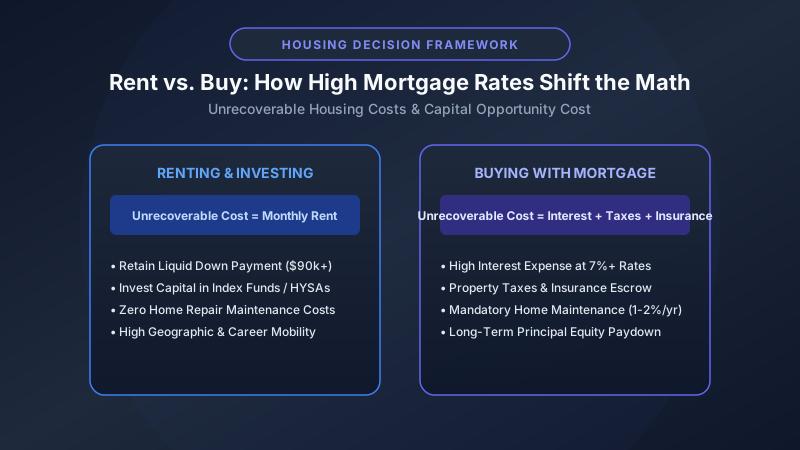
To adapt to higher rates, prospective buyers often adjust target locations, increase down payment allocations, consider temporary or permanent rate buydowns, or evaluate mortgage refinancing opportunities if benchmark rates decline in future years.
Summary Checklist for Prospective Borrowers
- Review the Full PITI Cost: Never budget based on advertised Principal & Interest alone; factor in property taxes, insurance, PMI, and HOA dues.
- Compare APR, Not Just Rates: Examine loan estimate forms to compare total borrowing costs inclusive of lender fees and points.
- Audit Credit & DTI: Optimize credit scores and pay down existing revolving debts prior to application to qualify for favorable rate pricing tiers.
MoneyTalkin' provides financial education, educational concepts, and general informational guides. Articles do not constitute personalized financial, investment, legal, or tax advice. Financial products, rates, terms, and regulatory rules change frequently; consult a qualified financial professional regarding your specific situation. Read our full Disclaimer Policy.
Written by MoneyTalkin'
MoneyTalkin' researches and publishes objective financial education content, money management fundamentals, and practical financial guides.
Related Technical Articles
Explore related topics in this cluster to deepen your understanding.