Private Mortgage Insurance (PMI) Explained: Costs, Cancellation, and How It Works
A comprehensive guide to Private Mortgage Insurance (PMI), explaining premium calculations, federal cancellation thresholds under the HPA, and FHA MIP differences.
Private Mortgage Insurance (PMI) Explained: Costs, Cancellation, and How It Works
For many home buyers, accumulating a 20% down payment is a significant barrier to homeownership. Fortunately, conventional mortgage guidelines permit purchases with down payments as low as 3% to 5%.
However, when putting down less than 20% on a conventional loan, lenders require Private Mortgage Insurance (PMI).
Understanding how PMI functions—including premium calculations, lender protection rules, statutory cancellation guidelines under the Homeowners Protection Act (HPA), and critical distinctions between PMI and FHA mortgage insurance—is essential for managing monthly housing budgets alongside guides on the hidden costs of homeownership, managing a mortgage escrow account, and analyzing renting vs. buying math.
1. What Is Private Mortgage Insurance (PMI)?
Private Mortgage Insurance (PMI) is an insurance policy issued by private insurers protecting the lender (not the borrower) against financial loss if the borrower defaults.
Key characteristics include:
- Protects the Lender: Reimburses the lender for unpaid principal if foreclosure occurs.
- Paid by the Borrower: Included in the borrower's monthly payment despite benefiting the lender.
- Applies to Conventional Loans: Required whenever a conventional loan's Loan-to-Value (LTV) ratio exceeds 80% (less than 20% down).
2. PMI vs. Other Housing Insurances
Homeowners often confuse PMI with other insurance policies:
| Insurance Type | Insured Party | Coverage Scope | Mandatory Requirement |
|---|---|---|---|
| Private Mortgage Insurance (PMI) | Mortgage Lender | Default losses on conventional loans | Mandatory for conventional loans with <20% down |
| FHA Mortgage Insurance Premium (MIP) | Mortgage Lender / FHA | Default losses on FHA government loans | Mandatory on all FHA loans (Upfront & Annual MIP) |
| Homeowners Insurance (Hazard) | Homeowner | Structural damage, personal property, liability | Mandatory for all mortgaged properties |
3. How Much Does PMI Cost?
PMI premiums generally range from 0.5% to 1.5% of the initial loan balance per year, determined by key risk factors:
- Credit Score: Higher scores yield lower PMI rates. A 760 score pays significantly less than a 640 score.
- Loan-to-Value (LTV) Ratio: Putting down 15% (85% LTV) incurs lower PMI than putting down 3% (97% LTV).
- Loan Term & Structure: 30-year fixed-rate mortgages carry different PMI pricing than ARMs.
Hypothetical PMI Cost Example
A buyer purchases a $400,000 home with a 5% down payment ($20,000), taking out a $380,000 conventional mortgage (95% LTV).
If the borrower's credit score qualifies for an annual PMI rate of 0.75%:
$$\text{Annual PMI Cost} = $380,000 \times 0.0075 = \mathbf{$2,850 \text{ per year}}$$
$$\text{Monthly PMI Payment} = \frac{$2,850}{12} = \mathbf{$237.50 \text{ per month}}$$
This $237.50 monthly fee is collected through the borrower's mortgage escrow account until PMI is removed.
4. PMI Payment Structures
While Monthly PMI is standard, lenders offer alternative structures:
- Borrower-Paid Monthly PMI (BPMI): Standard monthly fee added to mortgage statements until equity targets are met.
- Single-Premium PMI: Paid as a single lump-sum upfront at closing (or financed into the loan). Non-refundable if sold or refinanced early.
- Split-Premium PMI: Combines a smaller upfront payment at closing with a lower monthly fee.
- Lender-Paid PMI (LPMI): Lender pays upfront PMI in exchange for a permanently higher interest rate (e.g., 0.25%–0.50% higher). LPMI cannot be cancelled when equity reaches 20%; the higher rate remains unless refinanced.
5. Federal Cancellation Rules (Homeowners Protection Act of 1998)
Unlike FHA mortgage insurance (which often persists for the loan term), conventional PMI can be cancelled as equity grows. Under the Homeowners Protection Act (HPA) of 1998, borrowers have statutory cancellation rights on primary residences:
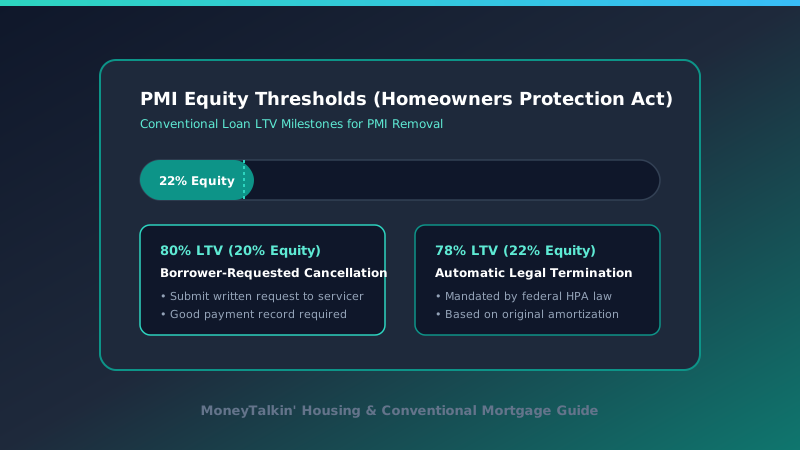
[Borrower Equity Reaches 20% (80% LTV)] ➔ [Borrower Submits Written Cancellation Request]
[Borrower Equity Reaches 22% (78% LTV)] ➔ [Lender Must Automatically Terminate PMI]
A. Borrower-Requested Cancellation (80% LTV / 20% Equity)
When loan balance reaches 80% of original value (20% equity based on original amortization), you may submit a written request to cancel PMI.
Requirements:
- Submit written request to your servicer.
- Maintain a clean payment history (no payments 30+ days late in past 12 months, or 60+ days late in past 24 months).
- Verify property value has not declined below original value.
- Confirm no subordinate liens (such as a HELOC) exist.
B. Automatic Termination (78% LTV / 22% Equity)
Servicers must automatically terminate PMI when the loan balance is scheduled to reach 78% of original value (22% equity), provided payments are current.
C. Final Termination Midpoint
If not cancelled sooner, PMI must terminate the month following the midpoint of the loan's amortization schedule (e.g., year 15 of a 30-year mortgage).
6. Early PMI Cancellation via Home Price Appreciation
HPA benchmarks rely on original purchase value. However, strong market appreciation or structural home improvements can push current LTV below 80% much faster.
Fannie Mae & Freddie Mac Guidelines
Servicers allow cancellation based on updated market values under specific rules:
- Loans Open 2–5 Years: Current appraised LTV must be 75% or lower (25% equity).
- Loans Open 5+ Years: Current appraised LTV must be 80% or lower (20% equity).
- Substantial Improvements: Documented structural renovations allow immediate cancellation requests regardless of loan age.
Note: Appraisals for PMI removal must be ordered directly by the servicer through an approved appraisal management company.
7. Conventional PMI vs. FHA Mortgage Insurance Premiums (MIP)
Borrowers comparing conventional low-down-payment loans to FHA loans must evaluate critical insurance differences:
| Feature | Conventional PMI | FHA Mortgage Insurance (MIP) |
|---|---|---|
| Upfront Fee | None (unless Single-Premium) | Mandatory 1.75% Upfront MIP at closing |
| Annual Fee | 0.5%–1.5% (credit-score dependent) | 0.15%–0.75% (flat pricing tiers) |
| Credit Sensitivity | High (higher scores pay less) | Low (less variation by score) |
| Cancellation Rule | Cancellable at 80% LTV / 20% equity | Non-cancellable for loan life if <10% down |
For borrowers with strong credit (720+), conventional PMI is generally far less expensive than FHA MIP and offers a direct path to cancellation without requiring mortgage refinancing. Conversely, borrowers with lower credit scores or smaller down payments may find FHA financing more accessible despite the non-cancellable annual MIP requirement.
8. Summary Checklist for Managing PMI
To minimize and eliminate PMI costs:
- Review Amortization Schedule: Note exact dates for 80% LTV (borrower request) and 78% LTV (automatic termination).
- Track Home Values: Monitor local sales; contact your servicer for an appraisal if values rise.
- Keep Payments Current: Maintain clean payment history to protect HPA rights.
- Analyze LPMI Carefully: Avoid LPMI if staying long-term, as higher rates cannot be removed.
- Consider Refinancing: Evaluate refinancing into a no-PMI mortgage if equity and rates permit.
Sources
- Consumer Financial Protection Bureau (CFPB): Homeowners Protection Act (HPA) PMI Cancellation Rules https://www.consumerfinance.gov/compliance/supervision-examinations/homeowners-protection-act/
- Fannie Mae: Single Family Servicing Guide: Canceling Conventional Mortgage Insurance https://singlefamily.fanniemae.com/
- Federal Reserve Board: Consumer Guide to Mortgage Insurance https://www.federalreserve.gov/
Educational Disclaimer
This guide is for educational purposes only and does not constitute financial, real estate, or legal advice. PMI rates, HPA rules, and appraisal guidelines vary by servicer, investor policies, and state law. Consult a licensed mortgage professional regarding your loan.
MoneyTalkin' provides financial education, educational concepts, and general informational guides. Articles do not constitute personalized financial, investment, legal, or tax advice. Financial products, rates, terms, and regulatory rules change frequently; consult a qualified financial professional regarding your specific situation. Read our full Disclaimer Policy.
Written by MoneyTalkin'
MoneyTalkin' researches and publishes objective financial education content, money management fundamentals, and practical financial guides.
Related Technical Articles
Explore related topics in this cluster to deepen your understanding.