Mortgage Escrow Accounts Explained: Taxes, Insurance, and Payments
A practical guide for U.S. homeowners explaining mortgage escrow accounts, property tax and insurance disbursements, annual escrow analysis, and shortages.
Mortgage Escrow Accounts Explained: Taxes, Insurance, and Payments
When purchasing a home or refinancing a residential mortgage, buyers quickly discover that their monthly payment includes more than just principal and loan interest. For most U.S. homeowners, a significant portion of each monthly payment goes directly into a mortgage escrow account.
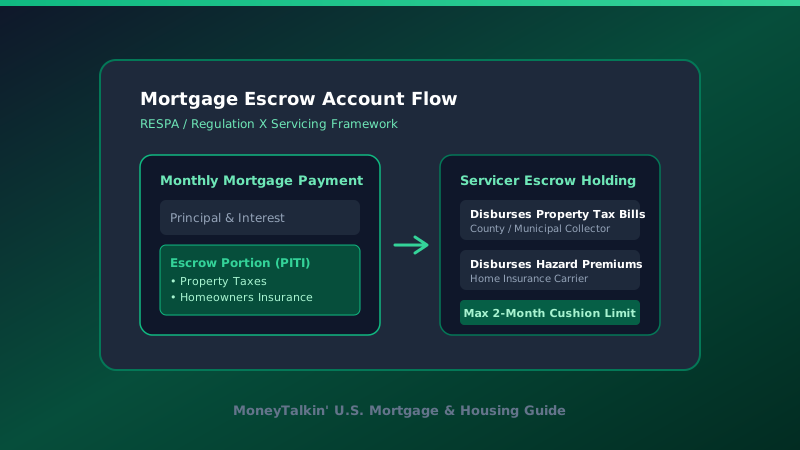
An escrow account is a specialized holding account managed by your loan servicer to collect and disburse funds for recurring property expenses—specifically local property taxes and homeowners insurance premiums.
Understanding how mortgage escrow accounts work—along with annual escrow analysis statements, shortages, surpluses, RESPA cushion regulations, and escrow waivers—is essential for managing ongoing housing budgets alongside guides on the hidden costs of homeownership, mortgage evaluation metrics like debt-to-income (DTI) ratio, and upfront loan tools like mortgage discount points.
1. What Is a Mortgage Escrow Account?
A mortgage escrow account (also called an impound account in some states) is a neutral holding account established by your lender or servicer at closing.
Instead of requiring homeowners to pay large lump sums when annual municipal tax bills and insurance premiums come due, the servicer divides these estimated annual expenses into 12 equal monthly installments.
Each month, the homeowner submits a single combined payment known as PITI:
$$\text{Monthly Mortgage Payment (PITI)} = \text{Principal} + \text{Interest} + \text{Taxes} + \text{Insurance}$$
- Principal & Interest (P&I): Pays down your outstanding mortgage principal and covers monthly loan interest.
- Taxes & Insurance (T&I): Deposited into your escrow account. When property tax bills or insurance premiums are due, the servicer disburses funds directly to tax authorities and insurance carriers on your behalf.
2. Why Lenders Require Escrow Accounts
Lenders require escrow accounts primarily to protect their financial interest in the property:
- Preventing Property Tax Liens: If property taxes go unpaid, local tax authorities can place a super-priority tax lien on the property, creating severe financial risk for the lender.
- Preventing Uninsured Property Losses: If a hazard insurance policy lapses and the home suffers fire or structural damage, the underlying collateral value is destroyed. Escrow ensures continuous policy coverage.
- Flood Insurance Compliance: Under federal law (the Flood Disaster Protection Act), lenders must escrow flood insurance premiums for properties located in designated Special Flood Hazard Areas.
3. How Escrow Payments Are Calculated
Servicers calculate monthly escrow payments by estimating annual tax and insurance obligations. Consider this hypothetical example:
Hypothetical Property Expenses
- Annual Property Taxes: $4,800
- Annual Homeowners Insurance Premium: $1,200
- Annual Flood Insurance Premium: $600
- Total Annual Escrow Obligations: $$4,800 + $1,200 + $600 = \mathbf{$6,600 \text{ per year}}$
Monthly Escrow Portion
Dividing total annual obligations by 12 months yields:
$$\text{Monthly Escrow Portion} = \frac{$6,600}{12} = \mathbf{$550.00 \text{ per month}}$$
If the homeowner's monthly Principal & Interest payment is $1,500.00, the total combined monthly PITI payment billed is:
$$\text{Total Monthly PITI Payment} = $1,500.00 + $550.00 = \mathbf{$2,050.00 \text{ per month}}$$
4. Initial Escrow Deposits and Closing Costs
At closing, home buyers must fund an initial escrow deposit to establish a baseline cash balance.
Because property tax and insurance billing cycles vary throughout the year, this initial deposit ensures sufficient funds are available when the first bill arrives.
The RESPA Cushion Rule
Federal regulations under the Real Estate Settlement Procedures Act (RESPA / Regulation X), enforced by the Consumer Financial Protection Bureau (CFPB), govern escrow account reserves:
- Maximum Escrow Cushion: Servicers may maintain a maximum cushion equal to one-sixth (1/6th) of total estimated annual disbursements (equivalent to 2 months of escrow payments).
- Purpose of the Cushion: The cushion absorbs unexpected tax assessment hikes or insurance premium increases before the next annual analysis.
- Excess Buffer Prohibition: Servicers are legally prohibited from collecting cash buffers exceeding this 2-month RESPA limit.
5. Annual Escrow Analysis: Shortages and Surpluses
Even with a fixed-rate mortgage, your total monthly payment can fluctuate from year to year. Under federal law, servicers must perform an Annual Escrow Analysis at least once every 12 months.
[Actual Bills Paid vs. Estimated Escrow] ➔ [Escrow Analysis] ➔ [Result: Shortage or Surplus] ➔ [Payment Adjusted]
A. Escrow Shortage
An escrow shortage occurs when property taxes or insurance premiums rise, driving the account balance below the required RESPA cushion minimum (or creating a negative balance).
Servicers typically give homeowners two options:
- Pay the Shortage in Full: Make a single lump-sum payment to cover the shortfall.
- Spread Over 12 Months: Divide the shortage amount across the next 12 monthly payments.
Note: Even if you pay the shortage lump sum, your monthly payment will still adjust upward to reflect higher ongoing tax or insurance rates.
B. Escrow Surplus
An escrow surplus occurs when tax assessments or insurance premiums come in lower than projected, leaving an excess balance above the RESPA limit.
Under RESPA rules:
- Surplus of $50 or More: The servicer must refund the full amount via check within 30 days of the analysis (if the account is current).
- Surplus Under $50: The servicer may credit the amount toward upcoming escrow payments.
6. Escrow Waivers: Managing Expenses Yourself
Some borrowers prefer to pay property taxes and insurance premiums directly rather than utilizing an escrow account.
Qualifying for an Escrow Waiver
Lenders may grant an escrow waiver if you satisfy key underwriting criteria:
- Loan Type: Conventional loans allow waivers; government-backed FHA loans generally require escrow accounts for the life of the loan.
- Loan-to-Value (LTV) Ratio: Lenders usually require at least 20% equity (80% LTV or lower).
- Payment History: A clean track record with zero recent mortgage delinquencies.
- Waiver Fee: Lenders may charge a small one-time fee (e.g., 0.125% to 0.25% of the loan amount) or slightly adjust interest rates.
Trade-Offs of Escrow Waivers
Managing payments independently provides cash flow flexibility and allows you to hold tax funds in a high-yield savings account. However, it requires disciplined budgeting to pay large annual bills out-of-pocket.
7. Homeowner Checklist for Managing Mortgage Escrow
Follow this practical checklist to maintain control over your escrow account:
- Review Annual Escrow Statements: Compare projected disbursements against actual property tax and insurance payments.
- Monitor Tax Assessments: Check local tax assessment notices and file an appeal if property values are assessed unfairly.
- Shop Insurance Annually: Compare homeowners insurance quotes to keep premium costs reasonable.
- Maintain an Emergency Buffer: Keep extra savings in your emergency fund to handle potential escrow shortages.
- Confirm Tax Disbursements: Verify with your county tax collector that your servicer paid annual property taxes on time.
Sources
- Consumer Financial Protection Bureau (CFPB): Real Estate Settlement Procedures Act (RESPA / Regulation X) Escrow Rules https://www.consumerfinance.gov/rules-policy/regulations/1024/
- U.S. Department of Housing and Urban Development (HUD): Escrow Account Guidelines and FAQ https://www.hud.gov/
- Fannie Mae: Servicing Guide: Administration of Escrow Accounts https://singlefamily.fanniemae.com/
Educational Disclaimer
This guide is for educational purposes only and does not constitute financial, legal, tax, or lending advice. Escrow regulations, cushion limits, and waiver rules vary by lender, loan type, state, and contract terms. Consult a qualified mortgage professional or tax advisor regarding your specific loan.
MoneyTalkin' provides financial education, educational concepts, and general informational guides. Articles do not constitute personalized financial, investment, legal, or tax advice. Financial products, rates, terms, and regulatory rules change frequently; consult a qualified financial professional regarding your specific situation. Read our full Disclaimer Policy.
Written by MoneyTalkin'
MoneyTalkin' researches and publishes objective financial education content, money management fundamentals, and practical financial guides.
Related Technical Articles
Explore related topics in this cluster to deepen your understanding.