Mortgage Points Explained: How Discount Points Work
A practical guide to mortgage discount points, explaining upfront costs, interest rate reductions, breakeven formulas, refinancing trade-offs, and IRS tax rules.
Mortgage Points Explained: How Discount Points Work
When evaluating mortgage quotes from lenders, home buyers and homeowners looking to refinance often encounter an option to pay for mortgage points (also known as discount points).
Paying discount points allows a borrower to pay fee capital upfront at closing in exchange for a permanently lower interest rate over the life of the loan. Understanding how mortgage points work—along with calculating your breakeven period, evaluating refinancing risks, and reviewing IRS tax deductibility guidelines—helps borrowers evaluate the total economics of a loan alongside guides on the hidden costs of homeownership and mortgage underwriting metrics like debt-to-income (DTI) ratio.
1. What Are Mortgage Points?
In mortgage lending, one point equal to 1% of the total loan amount. For example:
- On a $200,000 mortgage, 1 point equals $2,000.
- On a $300,000 mortgage, 1 point equals $3,000.
- On a $400,000 mortgage, 1 point equals $4,000.
Mortgage points generally fall into two distinct categories:
A. Discount Points (Rate Buydown)
Discount points represent prepaid interest paid upfront to the lender at closing. Purchasing discount points permanently lowers the interest rate on your mortgage (for example, reducing a 30-year fixed rate by approximately 0.25 percentage points per point, depending on market conditions and lender pricing).
B. Origination Points (Lender Fees)
Origination points are upfront fees charged by the lender to cover the administrative costs of processing, underwriting, and closing the mortgage. Unlike discount points, origination points do not reduce your interest rate.
2. How Mortgage Discount Points Work
When you purchase discount points, you make a trade-off between upfront liquidity and ongoing monthly savings:
- You pay more cash out-of-pocket at the closing table.
- You receive a lower monthly mortgage payment and pay less total interest over the life of the loan, provided you hold the mortgage long enough.
The exact rate reduction offered per point varies by lender, prevailing market rates, loan type, and market volatility. While a common baseline example assumes 1 point reduces a 30-year fixed rate by approximately 0.25 percentage points (e.g., from 6.75% to 6.50%), actual lender pricing fluctuates dynamically.
3. The Breakeven Formula: Calculating Your Recovery Timeline
To determine whether buying discount points makes financial sense, borrowers must calculate their breakeven period—the exact number of months it takes for monthly payment savings to equal the out-of-pocket cost of the points.
The Breakeven Formula
$$\text{Breakeven Period (Months)} = \frac{\text{Total Upfront Cost of Discount Points}}{\text{Monthly Payment Savings}}$$
$$\text{Breakeven Period (Years)} = \frac{\text{Breakeven Period (Months)}}{12}$$
4. Hypothetical Calculation Example
To see how the breakeven calculation works in practice, consider a home buyer taking out a $300,000 30-year fixed-rate mortgage:
Scenario A: Zero Discount Points
- Loan Amount: $300,000
- Interest Rate: 6.75%
- Monthly Principal & Interest Payment: $1,945.79
- Upfront Point Cost: $0
Scenario B: Purchasing 1.5 Discount Points
- Loan Amount: $300,000
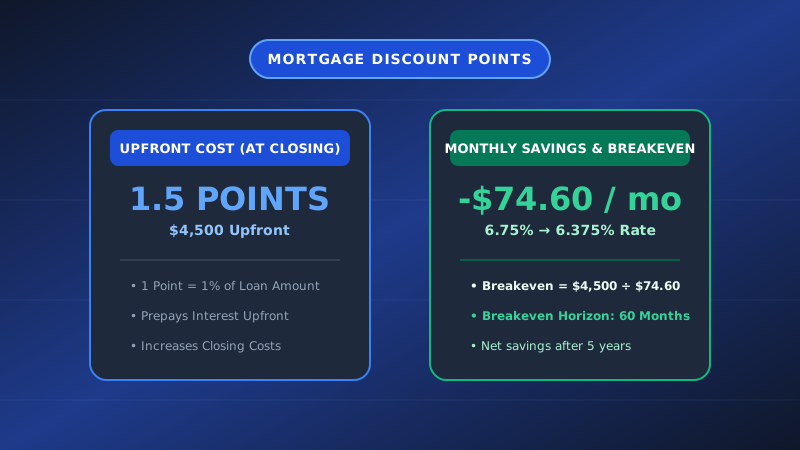
- Upfront Point Cost (1.5% of $300,000): $4,500
- Reduced Interest Rate: 6.375% (0.375% reduction)
- New Monthly Principal & Interest Payment: $1,871.61
Step-by-Step Breakeven Analysis
-
Calculate Monthly Savings: $$\text{Monthly Savings} = $1,945.79 - $1,871.61 = \mathbf{$74.18 \text{ per month}}$$
-
Calculate Breakeven Months: $$\text{Breakeven Months} = \frac{$4,500}{$74.18} \approx \mathbf{60.7 \text{ months}} \quad (\text{approx. } 5.1 \text{ years})$$
Interpretation of Results
In this hypothetical example, the borrower breaks even at approx. 61 months (5.1 years).
- If the borrower keeps the mortgage for longer than 5.1 years, buying points yields net long-term savings.
- If the borrower sells the home or refinances in less than 5.1 years, buying points results in a net financial loss.
5. When Paying Mortgage Points Makes Sense (and When It Doesn't)
Buying discount points is not a universally beneficial decision. It depends heavily on how long you plan to keep the mortgage.
Points May Make Sense If:
- You Plan to Stay Long-Term: You intend to keep the property and mortgage well past the calculated breakeven horizon (e.g., 7 to 10+ years).
- You Have Ample Cash Reserves: You can comfortably pay point costs at closing without depleting your post-closing liquid reserves or primary emergency fund.
- Interest Rates Are Stable or Declining Slowly: You do not anticipate a major drop in market rates that would trigger an early refinancing.
Points May NOT Make Sense If:
- You Plan to Move or Refinance Soon: If you expect to sell or refinance within 3 to 5 years, you will not recover the upfront points cost.
- Cash Is Needed for Closing or Repairs: Depleting cash reserves to buy points can leave home buyers underfunded for home repairs, moving costs, or property tax bills.
- 15-Year vs. 30-Year Mortgage: On shorter 15-year terms, baseline interest rates are already lower, potentially lengthening breakeven timelines.
6. Refinancing Risks and Discount Points
A major risk when purchasing discount points is early refinancing risk. If market interest rates drop significantly 2 years after closing, a borrower may decide to refinance into a lower rate.
However, if the original discount points had a 5-year breakeven period, refinancing at year 2 forfeits the remaining 3 years of savings required to recover the initial $4,500 upfront expenditure.
7. IRS Tax Deductibility Guidelines for Mortgage Points
Under current U.S. Internal Revenue Service (IRS) regulations (Topic 504), mortgage points paid on a primary residence may be tax-deductible as itemized deductions on Schedule A (Form 1040) under specific conditions:
Primary Home Purchase vs. Refinance
- Primary Home Purchases: If points meet IRS criteria (e.g., standard business practice in your area, funds provided directly at closing), the full cost of discount points may be fully deductible in the tax year paid.
- Refinanced Mortgages: For refinanced loans, points generally cannot be deducted in full in the year paid. Instead, the IRS requires points to be deducted pro-rata over the total term of the loan (e.g., 1/30th per year on a 30-year mortgage).
Tax treatment depends on individual filing status, itemized deduction thresholds, and current federal tax law. Borrowers should consult a qualified Certified Public Accountant (CPA) or tax professional regarding mortgage interest and point deductions.
Sources
- Consumer Financial Protection Bureau (CFPB): What Are Mortgage Points and How Do They Work? https://www.consumerfinance.gov/
- Internal Revenue Service (IRS): Topic No. 504 Home Mortgage Points https://www.irs.gov/taxtopics/tc504
- Fannie Mae: Single Family Mortgage Pricing Guidelines https://singlefamily.fanniemae.com/
Educational Disclaimer
This article is for educational and informational purposes only and does not constitute formal tax, legal, or mortgage advice. Discount point pricing, interest rate buydowns, and breakeven timelines vary by lender, loan product, and market conditions. Consult a licensed mortgage advisor and tax professional for guidance regarding your situation.
MoneyTalkin' provides financial education, educational concepts, and general informational guides. Articles do not constitute personalized financial, investment, legal, or tax advice. Financial products, rates, terms, and regulatory rules change frequently; consult a qualified financial professional regarding your specific situation. Read our full Disclaimer Policy.
Written by MoneyTalkin'
MoneyTalkin' researches and publishes objective financial education content, money management fundamentals, and practical financial guides.
Related Technical Articles
Explore related topics in this cluster to deepen your understanding.