Debt-to-Income Ratio Explained: How to Calculate Your DTI
A practical guide to Debt-to-Income ratio (DTI), detailing the calculation formula, front-end vs back-end DTI, lender benchmarks, and strategies to improve your ratio.
Debt-to-Income Ratio Explained: How to Calculate Your DTI
When applying for a mortgage, auto loan, or personal loan, lenders evaluate several key financial metrics to determine creditworthiness and borrowing capacity. While your credit score reflects payment history and reliability, your Debt-to-Income (DTI) ratio measures your cash flow capacity to comfortably manage monthly loan payments.
Understanding how to calculate your DTI ratio—along with the difference between front-end and back-end DTI, lender evaluation guidelines, and DTI limitations—helps prospective borrowers prepare for major loan applications alongside guides like credit scores explained and the financial trade-offs of renting vs. buying a home.
1. What Is Debt-to-Income Ratio (DTI)?
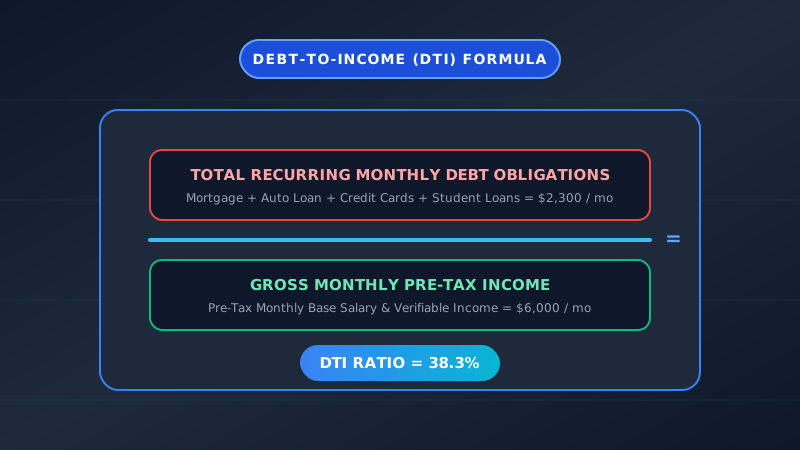
Your Debt-to-Income (DTI) ratio is the percentage of your gross monthly income (before taxes and deductions) that goes toward paying recurring monthly debt obligations.
Mathematically, the basic DTI formula is expressed as:
$$\text{DTI Ratio} = \left( \frac{\text{Total Recurring Monthly Debt Payments}}{\text{Gross Monthly Income}} \right) \times 100%$$
Lenders use DTI as a primary risk indicator. A lower DTI ratio indicates a healthy balance between debt and income, demonstrating that you have sufficient income margin to absorb new monthly mortgage or loan payments.
2. Front-End DTI vs. Back-End DTI
In mortgage underwriting, lenders evaluate two distinct DTI figures:
A. Front-End DTI (Housing Ratio)
The front-end DTI measures the percentage of gross monthly income allocated specifically to housing expenses. Housing costs include:
- Mortgage principal and interest payments
- Property taxes
- Homeowners insurance premiums
- Homeowners association (HOA) or condo fees
$$\text{Front-End DTI} = \left( \frac{\text{Total Proposed Monthly Housing Costs}}{\text{Gross Monthly Income}} \right) \times 100%$$
B. Back-End DTI (Total Debt Ratio)
The back-end DTI includes all housing expenses plus all other recurring monthly debt obligations. This is the primary ratio most lenders evaluate during loan underwriting.
$$\text{Back-End DTI} = \left( \frac{\text{Housing Costs} + \text{All Other Monthly Debts}}{\text{Gross Monthly Income}} \right) \times 100%$$
3. Which Expenses Count in Your DTI Ratio?
A common point of confusion is distinguishing between contractual debt payments and general living expenses.
Included in DTI Calculations
Only recurring contractual debt payments are included in your monthly debt total:
- Proposed monthly mortgage or current rent payment
- Minimum monthly credit card payments
- Auto loan monthly payments
- Student loan monthly payments (including income-driven payment amounts)
- Personal loan payments
- Court-ordered child support or alimony payments
Excluded from DTI Calculations
General household living expenses and variable bills are not included in DTI calculations:
- Groceries and food expenses
- Utilities (electric, gas, water, internet)
- Cell phone bills
- Health, auto, and life insurance premiums
- Streaming subscriptions and discretionary spending
4. How to Calculate Your DTI Ratio (Hypothetical Example)
To see how DTI is calculated in practice, consider a hypothetical loan applicant with the following monthly income and debt figures:
Step 1: Calculate Gross Monthly Income
- Annual Salary: $72,000
- Gross Monthly Income: $$72,000 \div 12 = \mathbf{$6,000}$
Step 2: Sum Recurring Monthly Debt Obligations
- Proposed Housing Payment (Mortgage Principal, Interest, Taxes, Insurance): $1,600
- Minimum Monthly Credit Card Payments: $150
- Auto Loan Monthly Payment: $350
- Student Loan Monthly Payment: $200
- Total Monthly Debt Obligations: $$1,600 + $150 + $350 + $200 = \mathbf{$2,300}$
Step 3: Apply the DTI Formula
- Front-End DTI: $\left( \frac{$1,600}{$6,000} \right) \times 100% = \mathbf{26.67%}$
- Back-End DTI: $\left( \frac{$2,300}{$6,000} \right) \times 100% = \mathbf{38.33%}$
In this example, the borrower has a front-end DTI of ~26.7% and a back-end DTI of ~38.3%.
5. How Lenders Evaluate DTI Ratios
There is no single universally mandatory DTI limit across all credit products. However, federal guidelines and mortgage loan programs establish general benchmark ranges:
General Mortgage Underwriting Guidelines
- Historical Benchmark (28/36 Rule): Historically, traditional guidelines often cited a maximum front-end DTI of 28% and a back-end DTI of 36%.
- Qualified Mortgage (QM) Framework: Under Consumer Financial Protection Bureau (CFPB) regulations, conventional Qualified Mortgages previously enforced a strict 43% back-end cap. Modern General QM rules evaluate loan pricing spreads alongside automated underwriting systems (such as Fannie Mae or Freddie Mac), which may approve back-end ratios up to 45%–50% for borrowers with strong compensating factors (such as high credit scores or substantial cash reserves).
- Government-Backed Loans (FHA / VA): Government-backed loan programs (such as FHA or VA loans) accommodate different back-end DTI thresholds under specific automated underwriting guidelines.
Lenders establish individual underwriting overlays based on loan type, loan-to-value (LTV) ratio, and applicant credit profiles.
6. DTI vs. Credit Score: What Is the Difference?
While both metrics are required during loan underwriting, DTI and credit scores measure fundamentally different financial dimensions:
| Dimension | Debt-to-Income (DTI) Ratio | Credit Score (FICO / VantageScore) |
|---|---|---|
| Primary Focus | Monthly cash flow capacity | Historical repayment reliability |
| Calculation | Monthly Debt ÷ Gross Monthly Income | Payment history, utilization, credit age, mix |
| Credit Report Impact | Not listed on credit reports | Generated directly from credit bureau reports |
| Primary Risk Assessed | Can the borrower afford the monthly payment? | Will the borrower pay bills on time? |
A borrower can have an excellent 780 credit score but still face mortgage denial if their back-end DTI exceeds lender thresholds. Conversely, a low DTI does not compensate for recent late payment defaults on a credit report.
7. How to Lower Your DTI Ratio
If your DTI ratio exceeds target underwriting guidelines, several practical strategies can improve the calculation prior to applying for a loan:
- Pay Off Small Revolving Balances: Paying off credit cards with small balances eliminates their minimum monthly payments from the DTI equation entirely.
- Consolidate High-Interest Debt: Restructuring credit card balances into a lower-rate personal loan via debt consolidation can reduce total monthly debt service.
- Avoid Taking on New Debt: Refrain from opening new credit card accounts or financing purchases prior to mortgage application.
- Increase Documented Gross Income: Adding verifiable income from a secondary job, salary raise, or side business increases the calculation denominator.
8. Limitations of the DTI Ratio
While DTI is a standard underwriting metric, it has inherent financial limitations:
- Uses Gross Income Instead of Net Income: DTI uses pre-tax gross income, which ignores income taxes, payroll withholdings, and healthcare deductions.
- Ignores Essential Living Expenses: DTI does not account for local cost of living, childcare, food, or transportation costs.
- Does Not Measure Savings Reserves: A borrower with a 42% DTI and $100,000 in liquid reserves may be in a safer financial position than a borrower with a 30% DTI and zero emergency savings.
Sources
- Consumer Financial Protection Bureau (CFPB): Debt-to-Income Ratio Guidelines and QM Rules https://www.consumerfinance.gov/
- U.S. Department of Housing and Urban Development (HUD): FHA Single Family Housing Policy Handbook https://www.hud.gov/
- Fannie Mae: Selling Guide: Debt-to-Income Ratios https://singlefamily.fanniemae.com/
Educational Disclaimer
This guide is for informational and educational purposes only and does not constitute personalized lending, legal, or financial advice. DTI thresholds, loan qualification rules, and underwriting guidelines vary by lender, loan program, and borrower profile. Consult a licensed mortgage professional or financial counselor regarding your specific situation.
MoneyTalkin' provides financial education, educational concepts, and general informational guides. Articles do not constitute personalized financial, investment, legal, or tax advice. Financial products, rates, terms, and regulatory rules change frequently; consult a qualified financial professional regarding your specific situation. Read our full Disclaimer Policy.
Written by MoneyTalkin'
MoneyTalkin' researches and publishes objective financial education content, money management fundamentals, and practical financial guides.
Related Technical Articles
Explore related topics in this cluster to deepen your understanding.