Debt Consolidation Explained: Loans, Balance Transfers & Risks
Detailed financial analysis and educational guide on Debt Consolidation Explained: Loans, Balance Transfers & Risks.
Debt Consolidation Explained: Loans, Balance Transfers, and Structural Risks
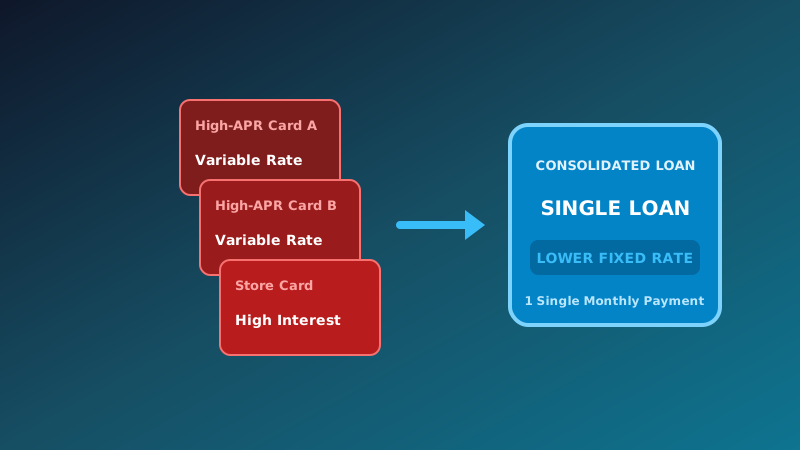
Debt consolidation is a financial restructuring strategy that combines multiple existing high-interest debts—such as credit card balances, medical bills, store cards, or personal loans—into a single new loan with a single monthly payment.
When executed properly, debt consolidation reduces monthly interest rates, simplifies bill tracking, and establishes a fixed timeline to become debt-free. However, consolidation is not debt forgiveness. If a borrower consolidates their balances without addressing the underlying spending habits that caused the debt, they risk taking on new credit debt alongside the consolidation loan.
Executive Summary: Consolidation Parameters
- Primary Options: Unsecured Personal Consolidation Loans, 0% APR Balance Transfer Credit Cards, and Home Equity Options (HELOCs/Home Equity Loans).
- Core Requirement: New consolidation vehicle must have a lower effective Annual Percentage Rate (APR) than the weighted average APR of existing debts.
- Critical Risk: Clearing credit card balances creates open credit lines that invite additional spending if behavioral habits are not modified.
- Fee Friction: Watch for origination fees on personal loans (1%–8%) and balance transfer fees (3%–5%).
How Debt Consolidation Works
Debt consolidation replaces fragmented, high-interest balances with a single structured obligation.
                    DEBT CONSOLIDATION STRUCTURE
┌───────────────────────────┐
│ Credit Card A ($5,000 @ 24%)│
├───────────────────────────┤     ┌───────────────────────────────┐
│ Credit Card B ($3,000 @ 22%)├────►│  Single Consolidation Loan    │
├───────────────────────────┤     │  $12,000 Total @ 11.5% APR    │
│ Store Card   ($4,000 @ 27%)│     │  Single Monthly Payment       │
└───────────────────────────┘     └───────────────────────────────┘
The Three Main Consolidation Vehicles
- Unsecured Personal Consolidation Loans:
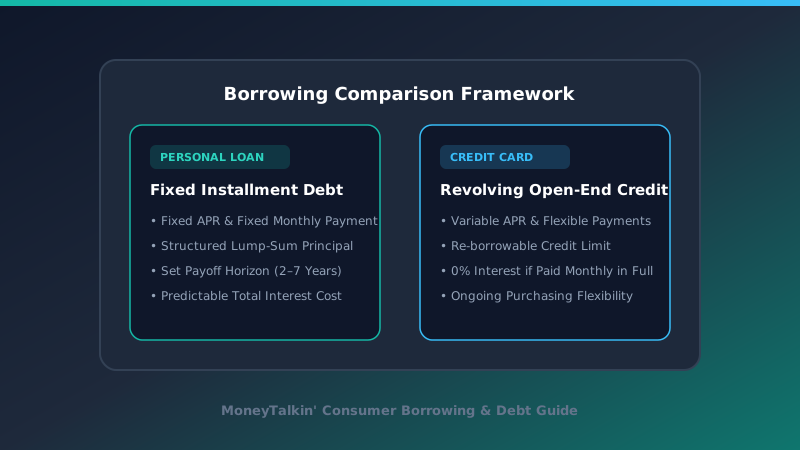
Fixed-rate installment loans offered by banks, credit unions, and online lenders. Terms typically range from 2 to 7 years with fixed monthly payments. - 0% APR Balance Transfer Credit Cards:
Promotional credit cards offering 0% APR on transferred balances for a introductory period (typically 12 to 21 months). Requires a balance transfer fee (usually 3% to 5% of the transferred amount). - Home Equity Loans / HELOCs:
Secured loans using your primary residence as collateral. While interest rates are typically lower than credit cards, failure to repay puts your home at risk of foreclosure.
Step-by-Step Mathematical Example
Consider a borrower managing three high-interest credit card accounts:
- Card 1: $6,000 balance at 24.99% APR (Min payment: $180)
- Card 2: $4,000 balance at 22.99% APR (Min payment: $120)
- Card 3: $5,000 balance at 26.99% APR (Min payment: $150)
- Total Debt: $15,000 | Weighted Average APR: 24.8% | Total Minimum Payments: $450/month
Scenario A: Minimum Payments on Credit Cards
Paying minimum balances only takes over 17 years to eliminate the debt and costs over $14,200 in interest alone.
Scenario B: Consolidated Personal Loan (3-Year Term at 11.5% APR)
- Monthly Payment: $495 per month
- Total Time to Debt-Free: 36 Months (3 Years)
- Total Interest Paid: $2,820
- Total Interest Saved: $11,380
Common Debt Consolidation Pitfalls
- Re-accumulating Credit Card Debt: Paying off credit cards with a loan frees up card limits. If you continue spending on those cards, you end up with both the loan and new card debt.
- Ignoring Origination Fees: A 5% loan origination fee on a $20,000 loan adds $1,000 upfront. Calculate total net costs before agreeing to terms.
- Extending the Payment Term: Extending a loan from 3 years to 7 years may lower your monthly payment, but total interest costs over time could end up higher despite a lower APR.
Practical Takeaway Checklist
- List all current debts, balances, minimum payments, and exact APRs.
- Calculate your weighted average APR across all accounts.
- Compare consolidation loan APRs including all origination and transfer fees.
- Close or freeze consolidated credit cards to prevent new debt accumulation.
Sources
- Consumer Financial Protection Bureau (CFPB): Debt Consolidation Options Guide
https://www.consumerfinance.gov/ask-cfpb/what-is-debt-consolidation-en-1561/
Disclaimer
Educational content only. Consult a accredited non-profit credit counselor or financial advisor for personal assistance.
Comparing Debt Consolidation Options
Choosing the appropriate debt consolidation strategy depends on your credit score, existing interest rates, and total debt load:
| Consolidation Strategy | Key Advantages | Potential Risks & Drawbacks |
|---|---|---|
| 0% Balance Transfer Card | Temporary 0% APR interest freeze (12-21 mos) | Upfront transfer fee (3-5%), rate spikes after promo ends |
| Fixed Unsecured Personal Loan | Single fixed monthly payment & fixed payoff date | Requires good credit (700+) for lowest rates |
| Debt Management Plan (DMP) | Reduced interest rates negotiated by non-profit credit counseling | Accounts must be closed; modest impact on credit score |
Credit Score Impact During Debt Consolidation
When applying for a consolidation personal loan or balance transfer credit card, lenders perform a hard credit inquiry, causing a temporary 3 to 5 point drop in credit scores. However, rapidly paying off high-utilization revolving credit card balances lowers your overall credit utilization ratio, often resulting in a net credit score increase over subsequent months. Compare personal loan structures in our guide to personal loans vs credit cards.
Common Pitfalls to Avoid in Debt Consolidation
While consolidating high-interest debt simplifies monthly payments, borrowers must avoid common operational mistakes:
- Accumulating New Balances on Paid-off Cards: Clearing credit card balances with a consolidation loan creates available credit line capacity. Running up new card balances while paying off the loan doubles household debt obligations.
- Ignoring Balance Transfer Fee Math: Always calculate the upfront 3% to 5% balance transfer fee against expected interest savings before opening a promotional card.
Debt Consolidation Decision Framework
- Calculate True APR: Include balance transfer fees or origination fees when evaluating consolidation offers.
- Commit to Budgeting: Consolidating debt without addressing underlying cash flow deficits leads to re-accumulating revolving debt.
Educational Summary & Key Definitions
Understanding financial fundamentals requires mastering core vocabulary and operational definitions:
- Principal: The original amount of money deposited or borrowed, excluding interest earnings or finance charges.
- Annual Percentage Yield (APY): The real rate of return earned on a deposit account, taking into account the effect of compounding interest over a 12-month period.
- Liquidity: The ease and speed with which an asset can be converted into liquid cash without incurring significant capital loss.
- Diversification: An investment risk management strategy that mixes a wide variety of investments within a portfolio to limit exposure to any single asset class.
Consulting official regulatory guidelines—such as disclosures from the CFPB, FDIC, NCUA, and Federal Reserve—ensures you make informed financial decisions backed by verified consumer protections.
Compare payoff strategies in our detailed breakdown of Debt Snowball vs. Debt Avalanche.
MoneyTalkin' provides financial education, educational concepts, and general informational guides. Articles do not constitute personalized financial, investment, legal, or tax advice. Financial products, rates, terms, and regulatory rules change frequently; consult a qualified financial professional regarding your specific situation. Read our full Disclaimer Policy.
Written by MoneyTalkin'
MoneyTalkin' researches and publishes objective financial education content, money management fundamentals, and practical financial guides.
Related Technical Articles
Explore related topics in this cluster to deepen your understanding.