Personal Loans vs. Credit Cards: How to Compare Borrowing Options
A neutral financial comparison of personal loans and credit cards, detailing interest rate structures, repayment mechanics, credit score impacts, and borrowing scenarios.
Personal Loans vs. Credit Cards: How to Compare Borrowing Options
When consumers need financing for a major purchase, home improvement project, unexpected expense, or debt consolidation effort, two primary borrowing options frequently come to mind: personal loans and credit cards.
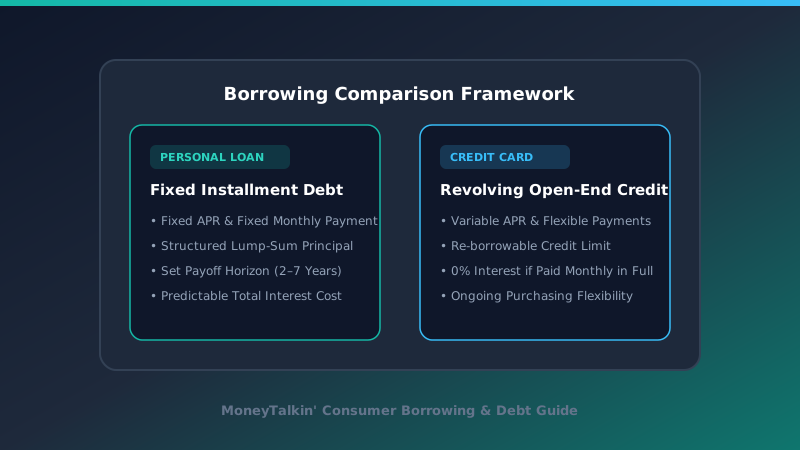
While both financial tools allow you to access capital and pay it back over time, they operate under fundamentally different structural rules. Personal loans provide a single lump-sum payout repaid via fixed monthly installment payments over a set duration. Credit cards provide an open-ended revolving line of credit with variable interest rates and flexible minimum monthly payments.
Neither option is universally superior under all financial circumstances. Evaluating interest rate structures, fee schedules, repayment timelines, and borrowing math helps consumers choose the right financing method alongside resources on credit card APRs, structured debt consolidation strategies, and credit evaluation metrics like credit scores.
1. How Personal Loans Work
A personal loan is a form of installment credit offered by commercial banks, credit unions, and online lenders.
When approved for a personal loan:
- Lump-Sum Disbursal: The lender disburses the entire approved loan amount (e.g., $10,000) directly into your bank account at closing.
- Fixed Interest Rates: Most personal loans feature fixed Annual Percentage Rates (APRs), meaning your interest rate remains constant throughout the loan term.
- Structured Repayment Period: You repay the principal and interest through equal monthly payments over a predetermined timeframe (typically ranging from 2 to 7 years).
- Unsecured vs. Secured Options: Most personal loans are unsecured (requiring no collateral), though secured personal loans backed by savings accounts or vehicles are available for borrowers with lower credit scores.
2. How Credit Cards Work
A credit card is a form of revolving credit issued by financial institutions.
When approved for a credit card:
- Revolving Credit Line: The issuer assigns a maximum credit limit (e.g., $10,000). You can repeatedly borrow against this limit, pay down the balance, and re-borrow as needed.
- Variable Interest Rates: Most consumer credit cards feature variable APRs pegged to an underlying benchmark index, such as the U.S. Prime Rate.
- Flexible Monthly Payments: Each month, you receive a statement listing your ending balance and a minimum payment due (typically 1% to 3% of the statement balance).
- Interest-Free Grace Period: If you pay your statement balance in 100% full by the due date every month, you incur zero interest charges on regular purchases. However, if you carry a balance past the due date, interest compounds daily across billing cycles.
3. Direct Comparison: Personal Loans vs. Credit Cards
To compare how these two borrowing vehicles operate side by side, review this detailed comparison matrix:
| Feature | Personal Loan | Credit Card |
|---|---|---|
| Credit Category | Installment Debt | Revolving Debt |
| Capital Access | Single upfront lump sum | Ongoing revolving credit line |
| Interest Rate Structure | Typically Fixed APR | Typically Variable APR |
| Repayment Term | Set duration (e.g., 36 to 84 months) | Open-ended (no set maturity date) |
| Monthly Payment | Fixed dollar amount every month | Variable amount (depends on current balance) |
| Upfront Fees | Origination fee (0% to 10% of loan amount) | Annual fees, balance transfer fees, cash advance fees |
| Prepayment Penalties | Rarely charged by modern lenders | None (can pay off 100% at any time) |
| Best Used For | Large, one-time expenses with fixed payoff plans | Ongoing daily spending, minor short-term financing |
| Primary Financial Risk | Fixed monthly obligation if budget tightens | Daily compounding interest if balance carried long-term |
4. Hypothetical Borrowing Math Example
To evaluate how borrowing costs differ in practice, consider a consumer who needs $8,000 to fund a necessary home repair and evaluates two borrowing scenarios:
Scenario A: Unsecured Personal Loan
- Approved Loan Amount: $8,000
- Fixed Interest Rate (APR): 11.50%
- Repayment Term: 36 months (3 years)
- Origination Fee (2%): $160 (subtracted from loan proceeds)
- Fixed Monthly Payment: $263.85
- Total Interest Paid Over 3 Years: $1,498.60
- Total Repayment Cost: $$8,000 + $1,498.60 = \mathbf{$9,498.60}$
Scenario B: Credit Card (Carrying Balance)
- Borrowed Amount: $8,000
- Variable Interest Rate (APR): 21.99%
- Repayment Plan: Paying a fixed monthly payment of $263.85 (matching Scenario A)
- Time to Pay Off Balance: 43 months (3.6 years)
- Total Interest Paid: $3,293.40
- Total Repayment Cost: $$8,000 + $3,293.40 = \mathbf{$11,293.40}$
Math Takeaway
In this hypothetical example, using the fixed-rate personal loan (Scenario A) saves $1,794.80 in total interest compared to carrying the balance on a 21.99% credit card (Scenario B), while locking in a definitive 3-year payoff timeline.
5. When Is a Personal Loan the Better Choice?
A personal loan is generally advantageous in borrowing situations such as:
- Large One-Time Expenditures: Funding major home improvements, medical procedures, or weddings where the total expense is known upfront.
- High-Interest Debt Consolidation: Combining multiple high-rate credit card balances into a single lower-rate fixed payment, establishing a clear debt-free target date.
- Desire for Behavioral Budget Discipline: Fixed monthly payments enforce structured debt reduction, preventing the temptation to re-borrow that exists with revolving credit cards.
6. When Is a Credit Card the Better Choice?
A credit card is generally advantageous in situations such as:
- Ongoing Small Expenses & Daily Purchasing: Facilitating regular monthly expenses, online shopping, and travel reservations while earning rewards points or cash back.
- Short-Term Cash Flow Buffer (Paid in Full): Financing short-term purchases that you can pay off 100% in full before the monthly due date, taking full advantage of the 0% interest-free grace period.
- 0% Introductory APR Offers: Leveraging a qualified 0% intro APR card for planned purchases or balance transfers, provided you pay off the balance before the promotional rate expires.
7. How Each Option Affects Your Credit Score
Both borrowing options report data to Equifax, Experian, and TransUnion, but they affect credit scoring models differently:
- Credit Utilization Impact: Credit card balances directly increase your revolving credit utilization ratio (which accounts for ~30% of your FICO Score). High credit card utilization depresses scores. Personal loans, as installment debt, are excluded from credit utilization calculations.
- Credit Mix (Score Boost): Credit scoring models reward consumers who manage a healthy mix of both revolving credit (credit cards) and installment credit (personal loans/auto loans). Adding an installment loan can diversify your credit mix.
- Payment History: Both options require on-time monthly payments. A single payment missed by 30 days or more on either a loan or credit card can severely damage your credit score.
8. Summary Checklist: Choosing Between Personal Loans and Credit Cards
Before taking on new debt, use this decision checklist:
- Determine the Total Amount and Timeline: Do you need a single lump sum for a multi-year payoff, or flexible ongoing credit for short-term use?
- Compare Fixed vs. Variable Rates: Evaluate whether a fixed APR personal loan provides safer budget predictability than a variable credit card APR.
- Check Total Fees: Review personal loan origination fees (0% to 10%) against credit card annual fees or balance transfer fees.
- Calculate Total Interest Cost: Run loan amortization math to compare total out-of-pocket interest costs across both options.
- Commit to a Strict Repayment Plan: Ensure your monthly budget comfortably absorbs the fixed installment payment or credit card payoff amount.
Sources
- Consumer Financial Protection Bureau (CFPB): Comparing Personal Loans and Credit Cards https://www.consumerfinance.gov/consumer-tools/personal-loans/
- Federal Reserve Board: Consumer Credit Report and Interest Rate Trends https://www.federalreserve.gov/releases/g19/
- Federal Trade Commission (FTC): Understanding Personal Loans and Borrowing Options https://consumer.ftc.gov/
Educational Disclaimer
This guide is for educational and informational purposes only and does not constitute formal financial, lending, or legal advice. Interest rates, origination fees, loan terms, and credit approval guidelines vary by lender and individual creditworthiness. Consult a qualified financial advisor regarding major borrowing decisions.
MoneyTalkin' provides financial education, educational concepts, and general informational guides. Articles do not constitute personalized financial, investment, legal, or tax advice. Financial products, rates, terms, and regulatory rules change frequently; consult a qualified financial professional regarding your specific situation. Read our full Disclaimer Policy.
Written by MoneyTalkin'
MoneyTalkin' researches and publishes objective financial education content, money management fundamentals, and practical financial guides.
Related Technical Articles
Explore related topics in this cluster to deepen your understanding.